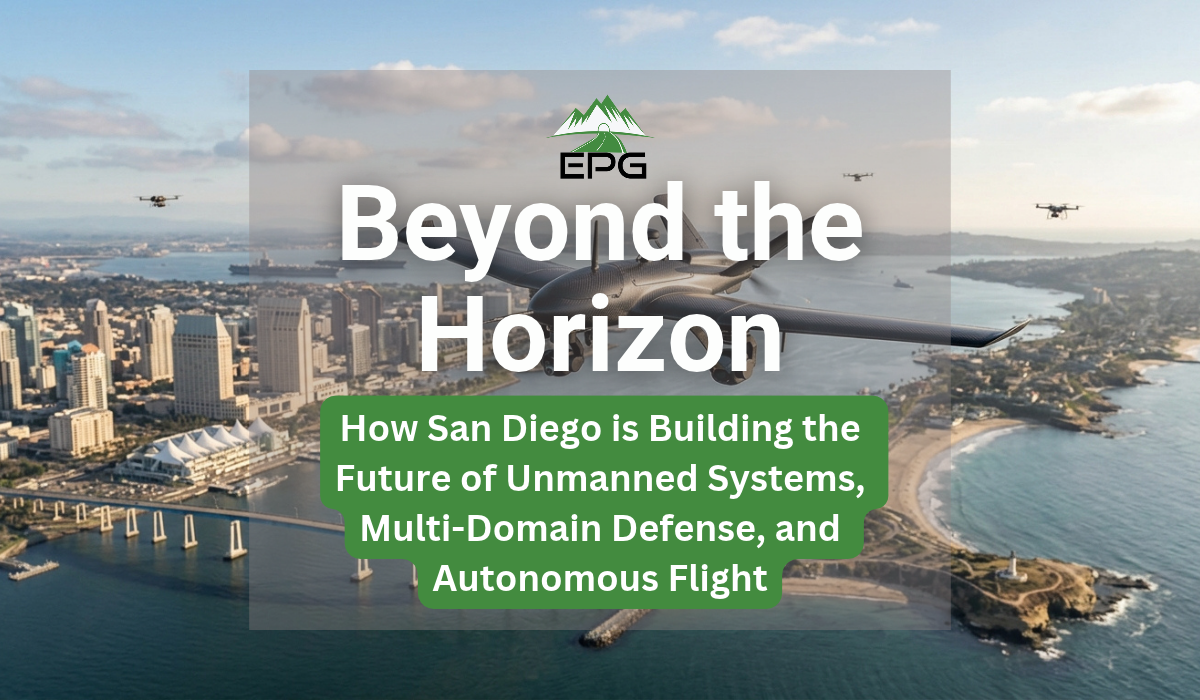
Beyond the Horizon: How San Diego is Building the Future of Unmanned Systems, Multi-Domain Defense, and Autonomous Flight
Summary: San Diego, California, is a premier global hub for Unmanned Aerial Vehicle (UAV) innovation, maritime robotics, and defense flight autonomy. Furthermore, strong military infrastructure and ocean test ranges allow local companies to pioneer software-defined airframes, swarm AI, and 3D subsurface mapping. As a result, key regional leaders, including General Atomics, Northrop Grumman, Kratos Defense, Shield AI, Firestorm, HavocAI, AeroVironment (AEVEX), ModalAI, Seasats, Exodigo, ManTech, Jacobs, Galt, LandCare, IntrepidGS, Voyager Technologies, and TSMG Holding, are rapidly scaling their technical engineering teams.
From the early days of naval aviation to modern aerospace breakthroughs, Southern California has consistently anchored flight innovation. Today, San Diego is establishing itself as a dominant epicenter for Unmanned Aerial Vehicles (UAVs), Unmanned Surface Vessels (USVs), edge-AI autonomy, and intelligent spatial technologies.
Because local firms enjoy direct access to maritime testing corridors and deep military infrastructure, they can create systems that sense, decide, and execute across land, sea, air, and subsurface environments.
1. Defense Modernization: Software-Defined Airframes & Swarm Autonomy
Modern tactical environments demand intelligent, adaptable aerial platforms. Therefore, rather than relying on static hardware or continuous human piloting, San Diego’s defense ecosystem leads the development of software-defined hardware, attritable airframes, and swarm intelligence.
Foundational defense leaders like Northrop Grumman and General Atomics Aeronautical Systems continue to redefine long-endurance UAS platforms. Similarly, Kratos Defense leads the charge in high-performance jet-powered unmanned aerial target systems and attritable fighter drones.
In addition, local innovators are advancing AI flight capabilities across multiple tactical levels:
-
Shield AI advances pilotless combat capability with its flagship Hivemind AI driver and V-BAT platform.
-
Firestorm pioneers expeditionary 3D-printed modular UAVs designed for rapid deployment.
-
HavocAI drives forward low-cost, attritable aerial platforms.
-
AeroVironment (AEVEX) provides critical long-range intelligence, surveillance, and reconnaissance (ISR) capabilities.
-
Galt (Global Air Logistics and Telemetry) bridges complex operational gaps with resilient airborne command and control communications.
2. Multi-Domain & Maritime Dominance: Air-to-Sea Integration
San Diego’s geography provides an unmatched operational edge. For example, teams enjoy seamless access to offshore flight corridors and naval testing grounds. Multi-domain platforms pairing aerial drones with autonomous maritime vessels are critical for coastal defense and oceanographic research.
Consequently, key players like Seasats are scaling autonomous solar-powered USVs designed for months-long ocean deployments alongside airborne sensors. Meanwhile, defense integrators like ManTech and Jacobs deliver the mission engineering, digital twin modeling, and cybersecurity required to route massive datasets from autonomous fleets.
3. Commercial Autonomy, Micro-Electronics & Subsurface Intelligence
While defense innovation commands headlines, San Diego’s commercial unmanned ecosystem is expanding rapidly across infrastructure and core compute platforms. In fact, local technology providers are solving critical physical-world challenges:
-
Hardware & Compute Boards: ModalAI, Inc. accelerates drone autonomy nationwide by producing VOXL® compute engines and U.S.-made NDAA-compliant perception hardware.
-
Subsurface Intelligence: Exodigo leverages non-invasive 3D subterranean mapping and sensor fusion—frequently paired with aerial site survey units—to eliminate underground construction risks.
-
Commercial Field Ops & Infrastructure: Enterprises like LandCare are introducing aerial drone imaging across commercial land management. Additionally, teams at IntrepidGS, Voyager Technologies, and TSMG Holding drive specialized satellite communications, ground stations, and tactical logistics that keep autonomous networks connected.
4. Fueling the Engineering & Flight Operations Talent Pipeline
As these companies scale from rapid prototyping to full-rate production, local demand for high-skilled technical talent has reached record highs. As a result, talent acquisition teams across the region are actively recruiting across key technical disciplines:
-
Autonomy & Embedded Systems: AI/ML researchers, ROS/Linux firmware developers, and autonomous flight control engineers.
-
Flight Operations & Field Testing: Part 107 operators, USV test pilots, and flight test technicians conducting real-world marine flight trials.
-
Rapid Prototyping & Assembly: Composite technicians, harness technicians, and systems integration engineers building specialized sensor payloads.
Overall, as capital continues to prioritize multi-domain robotics, San Diego is actively engineering the future of autonomous flight.
Frequently Asked Questions (FAQs)
What makes San Diego a primary hub for UAV and autonomous system development?
San Diego combines top-tier defense infrastructure with direct proximity to offshore flight test ranges. In addition, a dense concentration of specialized engineering talent allows local companies to rapidly prototype and deploy multi-domain autonomous systems.
What are the most in-demand technical engineering roles in San Diego?
The most competitive roles in San Diego include Flight Controls Engineers, Embedded Firmware (ROS/Linux) Developers, RF Integration Engineers, and Flight Test Technicians. Furthermore, composite and 3D additive manufacturing specialists remain in high demand.
Why are defense contractors moving toward modular and attritable airframes?
Modular and attritable airframes allow operators to rapidly reconfigure sensors while lowering manufacturing costs. Moreover, San Diego innovators lead this space by utilizing U.S.-made NDAA-compliant compute boards to deliver affordable mass without sacrificing operational capability.
How do recruitment partners accelerate hiring for technical UAV teams?
Specialized UAV recruiting partners leverage deep technical networks to identify pre-vetted engineers and operators. Consequently, this eliminates wasted interview cycles and significantly reduces time-to-fill for critical defense and commercial programs.
Looking to Scale Your UAV, Autonomous, or Defense Tech Team?
Navigating the candidate landscape in San Diego’s UAV ecosystem requires deep domain knowledge and targeted industry connections. Whether you are filling critical engineering vacancies in AI flight controls, embedded firmware, or field test operations, working with a specialized talent acquisition partner ensures you secure top-tier candidates.
If you are ready to expand your technical operations or want insights into current San Diego salary benchmarks, EPG is here to assist.
Get in Touch
Fill out our quick Contact Form to share your current open positions, and our specialized recruiting team will follow up promptly.
Prefer to talk through your hiring strategy directly? Schedule a Call with one of our autonomous systems recruitment specialists today.
About the Author: EPG