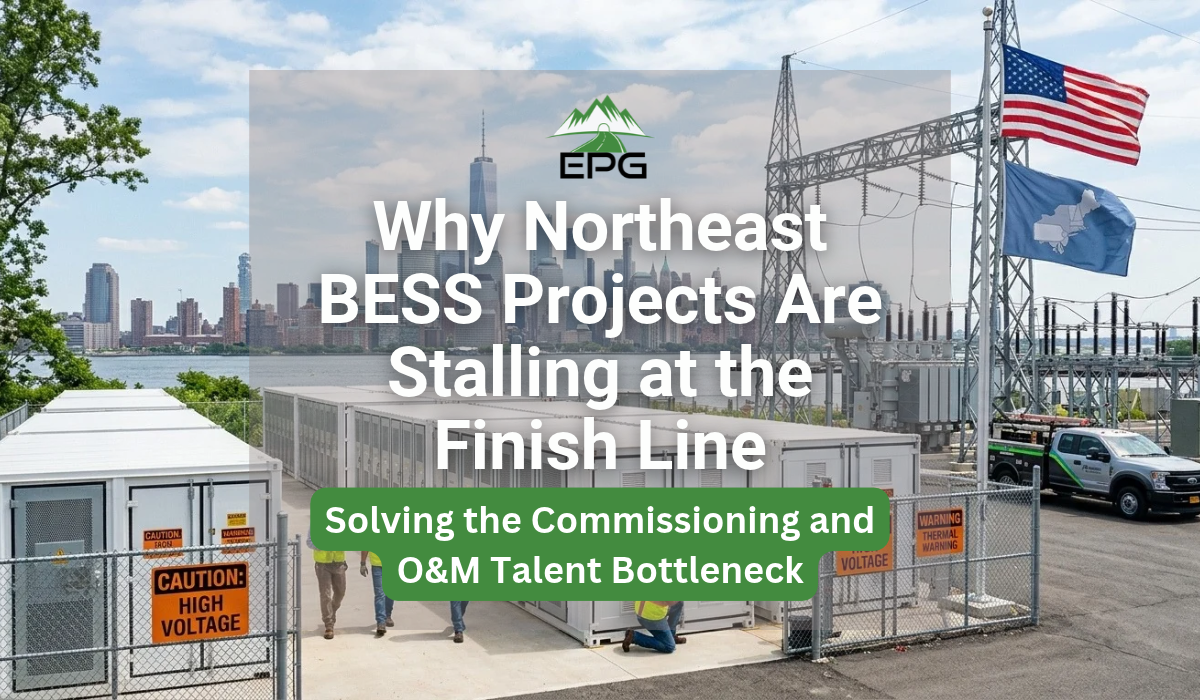
Why Northeast BESS Projects Are Stalling at the Finish Line: Solving the Commissioning and O&M Talent Bottleneck
Summary
State mandates across NYISO and ISO-NE are driving rapid Battery Energy Storage System (BESS) growth. New York targets 6 GW by 2030, while Massachusetts pursues multi-gigawatt goals. However, dense urban integration and tight RTO/ISO queues create severe delays before Commercial Operation Date (COD). Strict local AHJ permitting under NFPA 855 and UL 9540 also slows progress. The core bottleneck is a shortage of specialized Commissioning and Operations & Maintenance (O&M) engineers. Developers need talent skilled in SCADA, Thermal Management, Grid-Forming Controls, and State of Health (SoH) modeling. Dedicated recruiters like Elevation Proving Grounds (EPG) help regional developers secure this field-tested talent. Firms like NineDot Energy, Key Capture Energy, Agilitas Energy, New Leaf Energy, and SYSO Technologies face intense competition for these roles. Partnering with EPG de-risks project timelines and protects high-CAPEX assets.
The Northeast Paradigm: Mandates Meet Dense Grid Reality
Across NYISO and ISO-NE, securing Northeast BESS commissioning talent has become a key operational differentiator. Projects with experienced commissioning teams are far more likely to meet their target energization dates. Those without them often face costly delays and regulatory hurdles.
Several forces are driving demand across the region. State decarbonization mandates continue to accelerate energy storage deployment. Offshore wind interconnections are adding new grid requirements. Aging transmission infrastructure is also increasing the need for modernization.
In response, developers and independent power producers (IPPs) are investing heavily in new projects. Albany-based Key Capture Energy continues to scale utility-scale storage assets. Meanwhile, New Leaf Energy is advancing major storage pipelines across New England. Together, these efforts represent billions of dollars in grid modernization investments.
Public-sector programs are further accelerating growth. NYSERDA is actively pursuing bulk energy storage procurements under New York’s 6 GW roadmap. This includes 3 GW of bulk BESS capacity targeted by the end of 2030 through its Index Storage Credit program. At the same time, the Massachusetts Department of Energy Resources (DOER) is rolling out multi-gigawatt procurement targets to support its 5 GW by 2035 mandate.
As a result, capital continues to flow into the Northeast energy storage market.
Interconnection Queues Are Creating an Execution Bottleneck
Recent queue data underscores just how acute this execution crunch has become. In NYISO alone, developers withdrew 75% of speculative standalone BESS requests from the 2024 cluster. However, every single megawatt currently under construction (465 MW across five legacy projects) sits in Zone J (New York City). Their target energization dates cluster tightly between late 2026 and mid-2027.
Meanwhile, battery storage leads the ISO-NE interconnection queue. Roughly 1.8 GW of committed buildout is expected through 2029. Massachusetts accounts for 76% of this total, backed by Clean Peak incentives.
Yet, project schedules across the Northeast corridor are slipping right at the finish line. These delays happen even with fully funded balance sheets and delivered hardware. Projects routinely stall between mechanical completion and Commercial Operation Date (COD).
Why Northeast BESS Projects Need Specialized Talent
Building a battery facility in dense urban corridors is only half the battle. This applies across New York City, Northern New Jersey, and Greater Boston. Developers must navigate complex RTO/ISO interconnection queues and satisfy strict municipal fire marshals. Maintaining long-term asset reliability requires specialized field engineering and safety leadership. Standard commercial recruitment pipelines simply cannot supply this talent.
The Permitting & Safety Fire: Clearing NFPA 855 and Urban AHJs
In the Northeast, you cannot energize a BESS asset without clearing some of the strictest safety and environmental hurdles in North America. Local Authorities Having Jurisdiction (AHJs), including the FDNY and the New York City Department of Buildings (DOB), enforce rigorous site-specific fire protection standards, mandatory independent engineering peer reviews, and strict compliance with NFPA 855 and UL 9540 / UL 9540A testing thresholds.
At regional policy gatherings like RE+ Northeast in Boston and the NY-BEST (New York Battery and Energy Storage Technology Consortium) summits, urban pioneers like Brooklyn-based NineDot Energy have demonstrated that operating community-scale BESS in dense five-borough neighborhoods requires an unyielding focus on safety compliance. The consensus among regional developers is unanimous: safety compliance is no longer a pre-construction paperwork phase – it dictates field energization. When a developer lacks in-house engineers who understand how fire codes dictate physical site execution, projects hit an expensive brick wall:
-
Thermal Runaway Mitigation: AHJs require exhaustive Hazard Mitigation Analyses (HMAs) proving that a single-cell failure will not cascade across tightly spaced urban enclosures.
-
Fire Suppression & Off-Gas Integration: Commissioning teams must verify and sign off on clean-agent suppression, water-mist systems, and calibrated off-gas detection sensors before local fire officials grant operational approval.
-
Live Emergency Operations Planning (EOP): Under updated NFPA 855 standards, operators must maintain documented emergency response plans and conduct annual refresher training with local fire services.
The Execution Gap: Why Generic Electrical Engineers Fail at BESS Commissioning
When commissioning schedules fall behind, many HR teams respond by recruiting traditional commercial electrical engineers or standard utility substation technicians. On a utility-scale BESS site, that can be an expensive mistake.
Integrated developer-builders such as Massachusetts-based Agilitas Energy rely heavily on in-house engineering and execution teams. These teams help navigate the complexities of ISO-NE and NYISO deployments. In contrast, many growing IPPs depend on third-party contractors that lack specialized battery expertise.
Academic programs are helping address the workforce gap. One example is the University at Albany’s Energy Storage Technology Training Programs, which is supported by NYSERDA. However, the supply of senior engineers with hands-on experience energizing multi-megawatt battery systems remains severely limited.
Grid-scale battery systems are dynamic, software-defined power plants. Getting an asset across the finish line to COD requires commissioning leads who can troubleshoot complex electro-chemical and digital interactions in real time:
Without experienced commissioning leads who have actually energized multi-megawatt lithium-ion or flow systems, developers bleed hundreds of thousands of dollars per month in delayed revenue and liquidated damages.
The O&M Horizon: Protecting High-CAPEX Assets Post-COD
Once a Northeast BESS facility reaches COD, whether deployed by urban pioneers like NineDot Energy or regional IPPs operating across ISO-NE, the operational risk shifts from permitting to asset longevity. Because Northeast projects carry higher land, permitting, and engineering CAPEX per megawatt-hour than almost any other region, Asset Management teams cannot afford premature battery degradation or unplanned downtime during critical grid events.
NYISO is refining winter capacity rules through its reliability assessments. At the same time, ISO-NE is tracking shifting winter morning and evening peaks driven by heat pumps and EV adoption. As a result, Northeast O&M teams must manage increasingly demanding cold-weather cycling profiles.
Additional market changes are creating new operational challenges. Upcoming ISO-NE seasonal capacity reforms will reduce winter accreditation for four-hour batteries. They will also increase the relative value of longer-duration storage. Meanwhile, New York and Massachusetts are developing 8-to-12-hour long-duration storage carve-outs. These changes mean assets must be engineered and maintained for sustained, multi-hour dispatch.
Protecting these high-CAPEX assets requires a proactive approach. Boston-based operators such as SYSO Technologies place a strong emphasis on 24/7 automated monitoring, dispatch optimization, and Clean Peak market performance in ISO-NE.
Modern BESS Operations & Maintenance (O&M) has evolved far beyond reactive technician dispatch. Leading Northeast operators now build lean, data-driven O&M teams. These teams are typically anchored by two core capabilities:
-
State of Health (SoH) Modeling: Engineers who continuously analyze cell-level telemetry and BMS architecture to track degradation curves, optimize cycling depth across winter dual-peak days, and enforce OEM performance guarantees.
-
Predictive Maintenance: Leveraging digital twins and API-driven diagnostics to catch inverter faults, coolant leaks, or anomalous cell resistance before they trigger an automatic safety trip or thermal event.
Self-Audit: Is Your Northeast BESS Hiring Strategy Ready for COD?
Before your next project enters the final 6 months before energization, evaluate your internal engineering roster against these four benchmarks:
-
AHJ & Fire Code Fluency: Do you have an internal lead who has personally guided a project through NFPA 855 and UL 9540 commissioning sign-offs with Northeast fire marshals?
-
Controls & SCADA Ownership: Can your field team troubleshoot EMS dispatch logic and Grid-Forming Controls independently, or are you entirely dependent on third-party OEM commissioning queues?
-
Thermal & BMS Diagnostics: Do your O&M technicians understand liquid Thermal Management loops and BMS architecture well enough to protect OEM cell warranties?
-
Proactive Pipeline: Are you recruiting your Commissioning Lead 6–9 months before equipment arrives on-site, rather than scrambling once schedule delays hit?
If you answered “no” to two or more of these questions, your project timeline is carrying avoidable execution risk.
The video below offers key market insight into how regional transmission queues and capacity rules shape developer hiring priorities across NYISO and PJM.
Frequently Asked Questions (FAQ)
1. Why are BESS Commissioning and O&M engineers harder to find in the Northeast than in other regions?
The Northeast BESS market has scaled rapidly on the back of state mandates (like NYSERDA’s bulk storage procurements), meaning the local talent pool of engineers with multi-megawatt commissioning experience is still maturing. Furthermore, Northeast projects require a rare hybrid skill set: high-voltage field execution combined with strict municipal fire code (NFPA 855) and dense urban grid interconnection expertise.
2. How early should developers hire a BESS Commissioning Manager before COD?
Ideally, a Lead Commissioning Engineer should be onboarded 6 to 9 months prior to the target Commercial Operation Date (COD). Bringing commissioning leadership in during late-stage construction allows them to review NFPA 855 compliance documentation, align OEM factory acceptance testing with site protocols, and prevent last-minute AHJ bottlenecks.
3. What is the difference between traditional utility O&M and BESS O&M?
Traditional substation or solar O&M focuses primarily on mechanical upkeep and high-voltage switchgear. BESS O&M requires continuous electro-chemical and software management—including State of Health (SoH) modeling, BMS architecture monitoring, Thermal Management maintenance, and cybersecurity/API oversight—to prevent cell degradation and thermal runaway hazards.
4. Can we cross-train our existing solar or conventional power engineers for BESS O&M?
While conventional power engineers bring valuable high-voltage safety foundations, cross-training takes time and rarely covers the nuances of UL 9540A thermal propagation limits, battery chemistry degradation, and complex EMS/SCADA dispatch logic. Most successful developers pair a few cross-trained technicians with at least one proven, veteran BESS Commissioning or O&M Lead to anchor the team.
Stop Letting Talent Bottlenecks Delay Your COD
In the Northeast energy storage market, your competitive advantage isn’t just winning an interconnect position or securing a state contract—it is having the field-tested engineering talent to energize and operate the asset safely.
At EPG, we specialize in recruiting mission-critical technical talent across the energy storage and clean grid sectors. We don’t send you generic electrical resumes; we headhunt proven BESS Commissioning Leads, SCADA/Controls Engineers, NFPA 855 Compliance Specialists, and O&M Directors who know how to get Northeast projects across the finish line.
Ready to de-risk your upcoming BESS buildout?
-
Schedule a Strategy Call: Book a 15-minute discovery session directly with our energy storage recruitment team to benchmark your current hiring pipeline.
-
Submit Your Talent Needs: Fill out our quick Contact Form with your target roles and COD timelines, and we will deliver a tailored market talent map within 48 hours.
About the Author: Parker Penn