Raleigh-Durham EV & Clean Tech Hiring Guide: Navigating the Semiconductor & Battery Materials Talent Pool
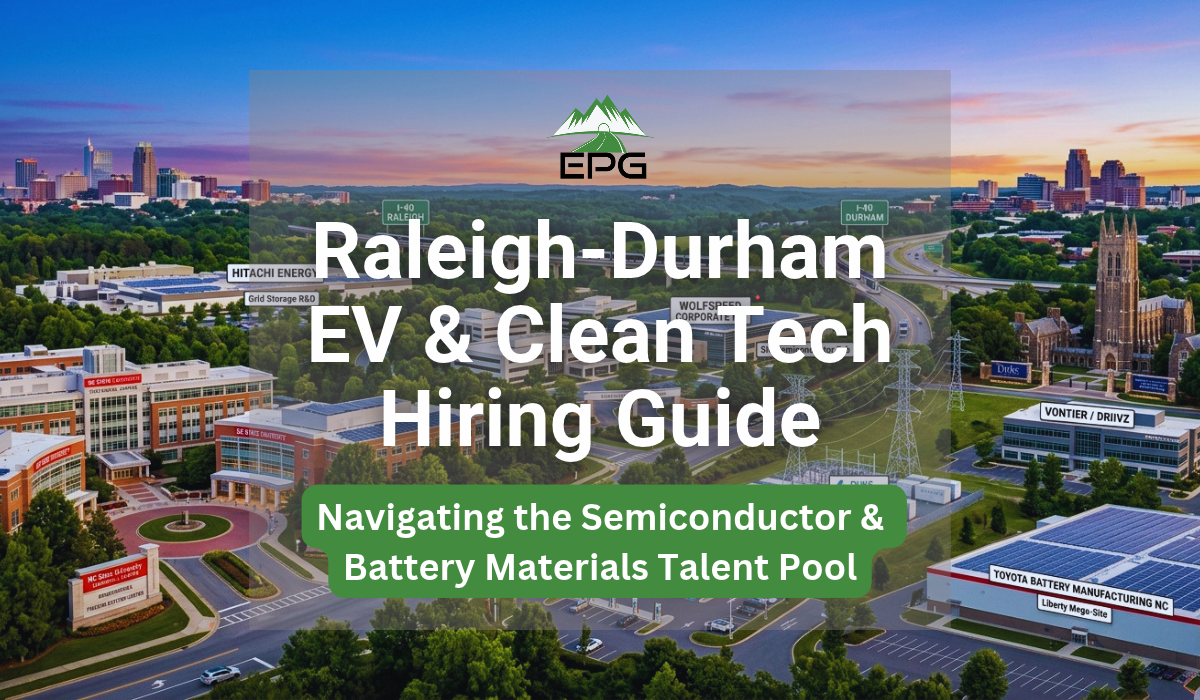
Key Takeaways: The Raleigh-Durham EV & Clean Tech Ecosystem
Before diving into regional recruitment playbooks, talent acquisition leaders should keep four core characteristics of the Research Triangle market top of mind:
The Primary Regional Ecosystem: North Carolina’s Research Triangle Park (Raleigh-Durham) has established itself as a national hub for wide-bandgap semiconductors (Silicon Carbide), battery materials, and smart grid infrastructure.
Key Local Employer Clusters: Talent sourcing is heavily concentrated around industry anchors, including Wolfspeed (SiC power devices), Toyota Battery Manufacturing (materials and cells), Vontier/Driivz (mobility tech HQ), Kempower and IONNA (DC fast charging), and Eaton and Duke Energy (grid and power management).
High-Demand Technical Roles: Local candidate competition is fiercest for power electronics designers, EV software and cloud platform architects, grid integration specialists, and battery electrochemists.
Academic Talent Sourcing Pipelines: The area offers direct access to specialized MS and PhD engineering talent via North Carolina State University (PowerAmerica and FREEDM Systems Center), Duke University, and UNC Chapel Hill.
As the global electric vehicle (EV) sector transitions from early-stage design to high-volume manufacturing and advanced infrastructure deployment, talent acquisition has become the primary bottleneck for industry expansion. While traditional automotive hubs in Michigan and the Midwest remain critical for assembly and chassis engineering, North Carolina’s Research Triangle Park (Raleigh, Durham, Chapel Hill, and surrounding areas) has emerged as the premier epicenter for the hardware intelligence powering the next generation of mobility: wide-bandgap semiconductors, power electronics, and battery materials.
For hiring managers, talent acquisition specialists, and engineering directors, recruiting in the Raleigh-Durham region requires a specialized strategy. The local talent landscape is highly technical, interdisciplinary, and fiercely competitive.
This guide breaks down the Research Triangle EV and clean tech ecosystem, mapping the primary employer clusters, specialized technical skill sets, university talent pipelines, and actionable recruitment playbooks needed to successfully attract top engineering talent in the region.
1. The Research Triangle Ecosystem: Why Raleigh-Durham?
The Research Triangle Park (RTP) region offers a unique convergence of technical disciplines vital to modern EV innovation:
-
Silicon Carbide (SiC) & Wide-Bandgap Semiconductors: Durham is the birthplace of commercial Silicon Carbide power electronics, providing the foundational hardware for EV inverters, fast chargers, and high-voltage power conversion.
-
Advanced Battery Materials & Supply Chain: From upstream chemical processing to large-scale battery cell manufacturing, the region connects raw materials research directly with gigafactory-scale production.
-
Grid & Charging Infrastructure: As EV adoption grows, local power management leaders and regional energy providers are designing the microgrids, DC fast chargers, and smart grid systems required to handle high-power distribution.
2. Key Local Employer Clusters & Technical Skill Sets
To build an effective sourcing strategy in the Research Triangle, recruitment teams must understand where specialized talent currently resides and how skills translate across sub-sectors.
Research Triangle EV Talent Map
Raleigh-Durham Regional Skill Sets & Primary Employers
Power Electronics & SemisAnchor Employers
Core Technical Focus
|
Battery Materials & MfgAnchor Employers
Core Technical Focus
|
EV Infrastructure & GridAnchor Employers
Core Technical Focus
|
Power Electronics & Wide-Bandgap Semiconductors
Raleigh-Durham boasts one of the highest concentrations of power device and semiconductor design talent in North America.
-
Anchor Employers: Wolfspeed (Durham/Siler City), Monolithic Power Systems (MPS), MACOM.
-
Key Roles & Technical Skill Sets:
-
SiC Power Device Engineers: Epitaxy, wafer fabrication, device characterization, MOSFET/diode design.
-
Power Electronics Design Engineers: High-voltage DC-DC converters, main traction inverters, onboard chargers (OBC), thermal modeling (ANSYS/COMSOL), and PCB layout for high EMI/EMC environments.
-
Firmware & Embedded Systems Engineers: Embedded C/C++, DSP controllers, CAN bus, ISO 26262 functional safety, and AUTOSAR compliance.
-
Advanced Battery Materials & Gigafactory Manufacturing
Driven by multi-billion-dollar investments, the regional battery landscape connects high-volume cell manufacturing directly to utility-scale Battery Energy Storage Systems (BESS) and smart grid integration.
-
Anchor Employers: Toyota Battery Manufacturing North Carolina (TBMNC) (Liberty mega-site), Hitachi Energy.
-
Key Roles & Technical Skill Sets:
-
Process & High-Volume Manufacturing Engineers: Roll-to-roll electrode coating, high-precision slurry mixing, cleanroom environment control, and automated pack assembly (Toyota).
-
BESS & Systems Safety Engineers: Multi-megawatt container thermal management, liquid-cooling architecture, fire suppression logic (NFPA 855), and power conversion system (PCS) design (Hitachi Energy).
- Quality & Yield Engineers: Six Sigma, inline computer vision inspection, laser-weld verification, electrochemical impedance spectroscopy (EIS), and non-destructive cell testing.
-
EV Charging Infrastructure & Grid Integration
With Raleigh-Durham serving as a primary hub for global mobility headquarters, charging hardware manufacturers, and energy suppliers, technical infrastructure talent is in exceptionally high demand.
-
Anchor Employers: Vontier / Driivz (Raleigh HQ — global mobility tech & EV software platform), Kempower (Durham — North American HQ & manufacturing facility), IONNA (Durham HQ — national fast-charging network), Eaton (Raleigh — power distribution & microgrids), Duke Energy (regional grid integration & utility fleet power), ABB E-mobility, Delta Electronics, Schneider Electric.
-
Key Roles & Technical Skill Sets:
-
EV Cloud & Platform Architects: SaaS telemetry, Open Charge Point Protocol (OCPP), smart charging algorithms, DERMS, and energy management platforms (Vontier / Driivz).
-
Systems & Charging Hardware Engineers: High-power DC fast charging (150kW to 1MW+), Megawatt Charging Systems (MCS), dynamic power sharing, and UL/IEEE compliance (Kempower, IONNA).
-
Grid Interconnection & Power Engineers: High-voltage switchgear, substation automation, microgrid design, and utility-scale grid interconnection (Eaton, Duke Energy).
-
3. Tapping into the University & Research Pipelines
A major competitive advantage of the Research Triangle is its continuous output of advanced engineering graduates and federally funded research institutes.
Research Triangle University Pipelines
Key Academic Research Centers & Core Technical Focus Areas
NC State UniversityPowerAmerica & FREEDM Center Specialized Engineering Disciplines
|
Duke UniversityPratt School of Engineering Specialized Engineering Disciplines
|
UNC Chapel HillKenan Laboratories Specialized Engineering Disciplines
|
-
North Carolina State University (NC State):
-
Home to PowerAmerica, the Department of Energy’s wide-bandgap semiconductor manufacturing institute, and the FREEDM Systems Center (Future Renewable Electric Energy Delivery and Management). NC State is the premier national pipeline for MS and PhD graduates specializing in Silicon Carbide, Gallium Nitride (GaN), and power grid modernization.
-
-
Duke University (Pratt School of Engineering):
-
A top-tier source for advanced materials science, battery modeling, bio-inspired materials, and embedded hardware/AI systems engineering.
-
-
-
Strong research contributions in fundamental chemistry, catalysis, and advanced polymer synthesis, ideal for R&D-focused battery materials roles.
-
4. The Hiring Manager’s Playbook: How to Win Top Talent in RTP
Given the density of competing clean tech and semiconductor firms in the Triangle, talent acquisition teams must tailor their offer structures and recruitment tactics to stand out.
1. Benchmark for Technical Specialization
Engineers with specialized Silicon Carbide design or high-voltage power electronics skills command premium compensation packages. Standard “hardware engineer” salary bands often fall short of local market rates driven by aggressive semiconductor hiring. Ensure compensation models reflect wide-bandgap and high-voltage expertise.
2. Emphasize Career Growth in the “Silicon Corridor”
Candidates in Raleigh-Durham value long-term career ecosystems. Position your company not just as a single job opportunity, but as a long-term hub within North Carolina’s growing clean tech corridor. Highlighting continuous internal R&D investment and modern laboratory/manufacturing facilities is a strong differentiator.
3. Leverage Cross-Industry Skill Mobility
The talent pool in Raleigh-Durham is uniquely versatile. Many top power electronics and embedded systems engineers have prior experience in telecom, industrial automation, defense, or medical devices. Look for candidates with transferable fundamentals in high-power design, thermal management, and safety-critical embedded controls who can quickly transition into automotive EV applications.
4. Provide Relocation Packages Targeted at Cost-of-Living Offsets
While Raleigh-Durham’s cost of living has adjusted in recent years, it remains highly attractive compared to the San Francisco Bay Area, Boston, and Southern California. Explicitly framing relocation packages around quality of life, local schools, and proximity to major tech hubs enables successful recruiting of out-of-state talent from West Coast and East Coast tech centers.
Frequently Asked Questions (FAQs)
What makes Raleigh-Durham a key hub for EV engineering talent?
Raleigh-Durham (Research Triangle Park) is a top hub for EV talent due to its unique concentration of wide-bandgap semiconductor pioneers (Wolfspeed), battery material suppliers (Albemarle), mobility and software HQs (Vontier/Driivz), charging hardware manufacturers (Kempower), power management and utility leaders (Eaton, Duke Energy), and top academic research centers at NC State, Duke, and UNC Chapel Hill.
Which technical roles are hardest to fill in the Research Triangle clean tech sector?
The highest demand and tightest candidate supply are found in Silicon Carbide (SiC) power device design, high-voltage inverter engineering, battery chemistry process engineering, cloud-based EV platform architecture, and ISO 26262-compliant embedded firmware engineering.
How do university partnerships in NC help EV hiring managers?
Institutions like NC State host federally funded institutes like PowerAmerica and the FREEDM Systems Center, providing hiring managers with direct access to specialized MS and PhD engineering talent trained specifically in SiC/GaN semiconductors, power electronics, and smart grid systems.
How should employers benchmark salaries for power electronics engineers in Raleigh-Durham?
Due to direct competition between automotive EV OEMs, semiconductor foundries, and clean tech infrastructure providers in RTP, local salary benchmarks for high-voltage power electronics design often exceed national hardware averages. Employers must align compensation with specialized power semiconductor skill sets rather than general electrical engineering tiers.
Master the Research Triangle Clean Tech Market
Navigating North Carolina’s “Silicon Corridor” requires more than standard recruitment tactics. It requires a strategic partner who understands local power electronics clusters, battery gigafactory supply chains, and passive talent channels across Raleigh-Durham.
Whether you are looking to scale your technical engineering team or need market intelligence to build your hiring roadmap, EPG is here to help.
-
Schedule a Strategy Call — Book a 1-on-1 consultation with our specialized EV tech recruiters.
-
Fill Out Our Growth Form — Tell us about your critical hiring needs, and we’ll match you with top regional talent.
Let’s discuss the data, the local talent trends, and your next key hire.
About the Author: Parker Penn