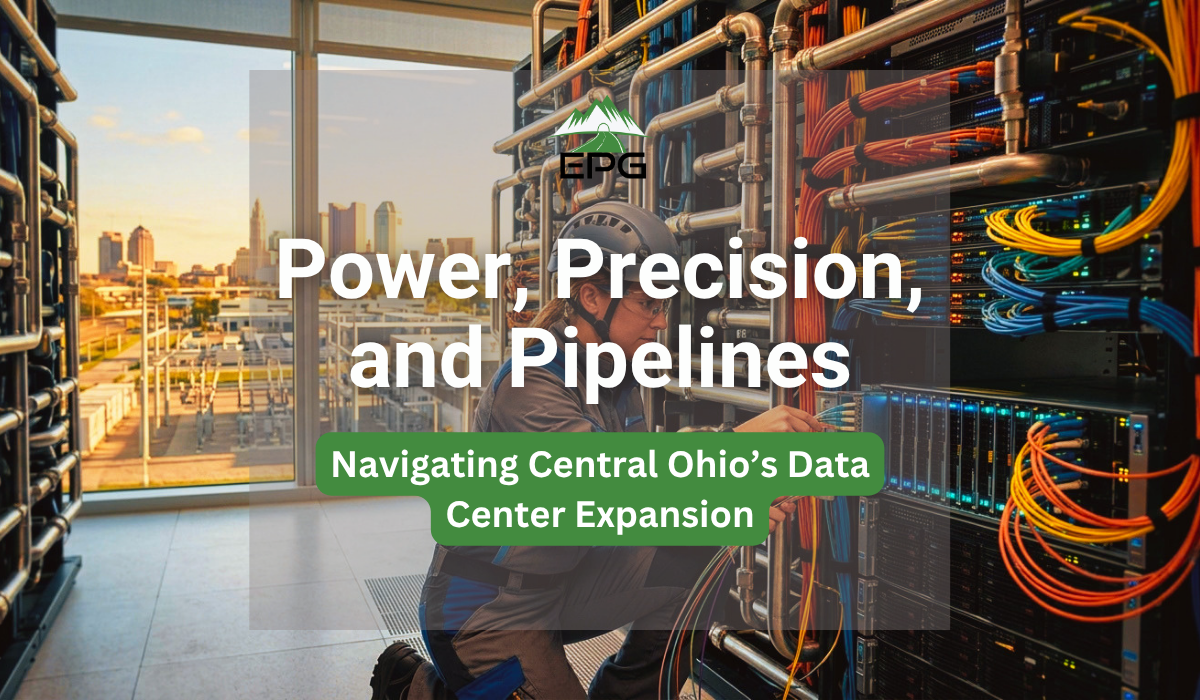
Power, Precision, and Pipelines: Navigating Central Ohio’s Data Center Expansion
Summary: Rapid hyperscale and colocation expansion across Central Ohio (New Albany, Dublin, Hilliard) by industry leaders—including AWS, Google, Microsoft, Meta, Cologix, QTS, STACK, CyrusOne, EdgeConneX, Aligned, Vantage, Edged Energy, Expedient, Csquare, Lumen, Uniti, Cogent, WOW! Business, Bresco, and LexisNexis—is straining regional infrastructure, creating acute demand for specialized MEP engineers, critical facilities managers, and high-density thermal leads to navigate AEP Ohio/PJM grid queues, 40kW–100kW+ direct-to-chip cooling, and mission-critical operations.
Central Ohio has cemented its position as the premier digital infrastructure corridor of the Midwest. Stretching across Franklin, Delaware, and Licking Counties – from New Albany to Dublin and Hilliard – the Columbus region plays a pivotal role in housing hyperscale cloud platforms, enterprise colocation, and the next generation of artificial intelligence workloads.
As tech giants and multi-tenant providers scale their local footprints, the regional ecosystem faces three defining operational realities: navigating evolving power tariffs, integrating high-density cooling architectures, and securing the specialized workforce needed to execute at scale.
1. Navigating Power Provisioning & Grid Interconnection
Power availability remains the single most critical factor shaping data center deployment timelines across Central Ohio. Recent local reporting by WSYX ABC 6 highlights that tech giants—including Microsoft, Meta, Google, Amazon AWS, and Intel — now control over 5,000 acres in the region, driving AEP Ohio to manage more than 13,000 MW in active data center power requests. Under local grid frameworks managed by AEP Ohio and the PJM Interconnection, power reservation rules and capacity tariffs require operators to take a sophisticated, multi-layered approach to energy strategy.
Hyperscale Grid Strategy
Industry leaders continue to make multi-billion-dollar infrastructure investments across Franklin, Delaware, and Licking Counties. Securing gigawatt-scale capacity while maintaining corporate sustainability commitments has accelerated demand for localized power purchase agreements (PPAs), battery energy storage systems (BESS), and on-site substation co-location. Highlighting this shift toward on-site generation to bypass utility queue delays, developers like EdgeConneX (via PowerConneX) are proposing dedicated on-site natural gas power plants – such as a 430MW generation facility in New Albany – to serve as the primary electricity source for new data center campuses.
Wholesale & Hybrid Power Distribution
At the wholesale and colocation layer, developers including Cologix, QTS, STACK Infrastructure, CyrusOne, EdgeConneX, Aligned Data Centers, and Vantage Data Centers are designing facilities that offer robust power redundancies. Underscoring this colocation surge, Cologix is driving major investments across Delaware and Licking Counties—including its multi-megawatt COL5 campus in Orange Township and a planned $7 billion, 800MW AI-ready campus in Johnstown. These facilities balance immediate megawatt delivery with long-term grid stabilization, ensuring enterprise tenants maintain continuous uptime despite shifting utility reservation frameworks.
2. Advanced Cooling Architectures for AI Densities
As artificial intelligence models push rack power densities past 40kW–100kW, traditional air cooling is rapidly reaching its thermodynamic limits. Central Ohio facilities are aggressively upgrading thermal management infrastructure to maintain thermal efficiency and control Power Usage Effectiveness (PUE) metrics.
Ultra-Efficient & Liquid Cooling Systems
Next-generation operators like Edged Energy are leading the charge in sustainable deployment by using waterless direct-to-chip liquid cooling systems engineered specifically to handle high-density AI chips without placing unnecessary demand on local municipal water supplies.
Enterprise Hybrid Thermal Systems
Hybrid facilities managed by Expedient and Csquare are adapting existing raised-floor layouts with localized liquid-to-air heat exchangers and contained cold/hot aisles, allowing corporate clients to scale intensive data analytics workloads without requiring complete building overhauls.
3. Connectivity, Talent, and Technical Execution
A data center is only as strong as the network fiber that connects it and the skilled talent that keeps it operational. Central Ohio’s digital ecosystem relies heavily on specialized fiber networks, enterprise IT providers, and local technical talent to execute seamlessly.
High-Speed Fiber Corridors
Extremely low-latency connectivity across Columbus is powered by a dense network of regional and national fiber providers. Carrier-neutral connectivity and dark fiber pipelines provided by Lumen, Uniti, Cogent Communications, WOW! Business E-solutions, and local network specialists like Bresco Broadband ensure that data flows unimpeded between local campuses and global edge nodes. To keep pace with these terabit-scale AI demands, wholesale transport providers are aggressively expanding footprint and speed-to-market; for example, Uniti is adding roughly 20 new data center on-ramps while utilizing its pre-deployed FastWaves™ program to shrink 100G and 400G wavelength turn-up times down to three weeks or less.
As artificial intelligence workloads drive ultra-high density requirements, hyperscalers are actively securing their physical supply chains for optical hardware. Illustrating this shift, Meta entered a multi-year agreement valued at up to $6 billion with Corning through 2030 to supply high-density optical fiber, cable, and connectivity solutions required to power its next-generation AI data center clusters—including major campus expansions across New Albany.
Local Technical Talent & Operational Execution
Building, securing, and operating these critical facilities requires a constant pipeline of skilled personnel—ranging from MEP field engineers and HVAC technicians to network administrators and cloud engineers. Companies across the region—including data platform providers like LexisNexis that rely on high-availability cloud infrastructure—are actively hiring to build out their local technical operations. This demand for specialized talent is reaching a critical point as major projects transition into active development and construction. As reported by NBC4, major developments like Microsoft’s multi-campus expansion in Licking County across Heath and Hebron – adding to its established footprint in New Albany – highlight the continuous need for experienced MEP engineers, commissioning agents, and critical facilities managers to keep buildouts on schedule.
Frequently Asked Questions (FAQs)
Why has Columbus, Ohio become a major hub for hyperscale and enterprise data centers?
Central Ohio offers an ideal combination of affordable land, extensive dark fiber connectivity, competitive state tax incentives, and low natural disaster risk. Its strategic location allows data centers to deliver ultra-low latency connectivity to major population centers across the East Coast and Midwest.
How are Central Ohio data centers adapting to AEP Ohio grid constraints and PJM tariffs?
Operators are shifting toward aggressive energy mitigation strategies. This includes co-locating near high-voltage substations, integrating local Battery Energy Storage Systems (BESS) for load shedding, signing long-term Power Purchase Agreements (PPAs) for renewables, and deploying waterless direct-to-chip cooling to lower total megawatt consumption.
What are the most in-demand technical roles for Central Ohio data center facilities?
The most critical talent shortages in the Columbus market include MEP Engineers, Mission-Critical Commissioning Agents, Critical Facilities Managers, High-Voltage Electrical Technicians, Network/Fiber Architects, and Liquid Cooling Specialists.
How do direct-to-chip liquid cooling systems benefit local data center operations?
Direct-to-chip (D2C) liquid cooling captures heat directly at the CPU/GPU level using thermal fluid loops. This enables facilities to run high-density AI workloads (over 40kW per rack) while dramatically lowering overall PUE and eliminating the massive water consumption associated with traditional evaporative cooling towers.
Solve Your Central Ohio Technical Staffing Bottlenecks
Scaling mission-critical facilities in the Silicon Heartland requires more than just capital – it takes specialized talent that understands high-density engineering, power infrastructure, and operational reliability. Whether you are accelerating a hyperscale buildout, upgrading cooling systems for AI workloads, or expanding facility operations, finding experienced engineering and technical leaders is often the hardest part of the equation.
EPG specializes in recruiting hard-to-find MEP engineers, commissioning leads, critical facilities managers, and network specialists specifically tailored to the Central Ohio market.
Ready to build out your local technical team?
📅 Schedule a Call with Our Data Center Recruiting Specialists to discuss custom talent sourcing strategies for your Columbus operations.
👉 Fill out our Talent Solutions Contact Form to share your current hiring requirements.
About the Author: EPG