Scaling the Central Texas Mega-Corridor: Talent, Infrastructure, and the AI Hiring Surge Across Austin and San Antonio
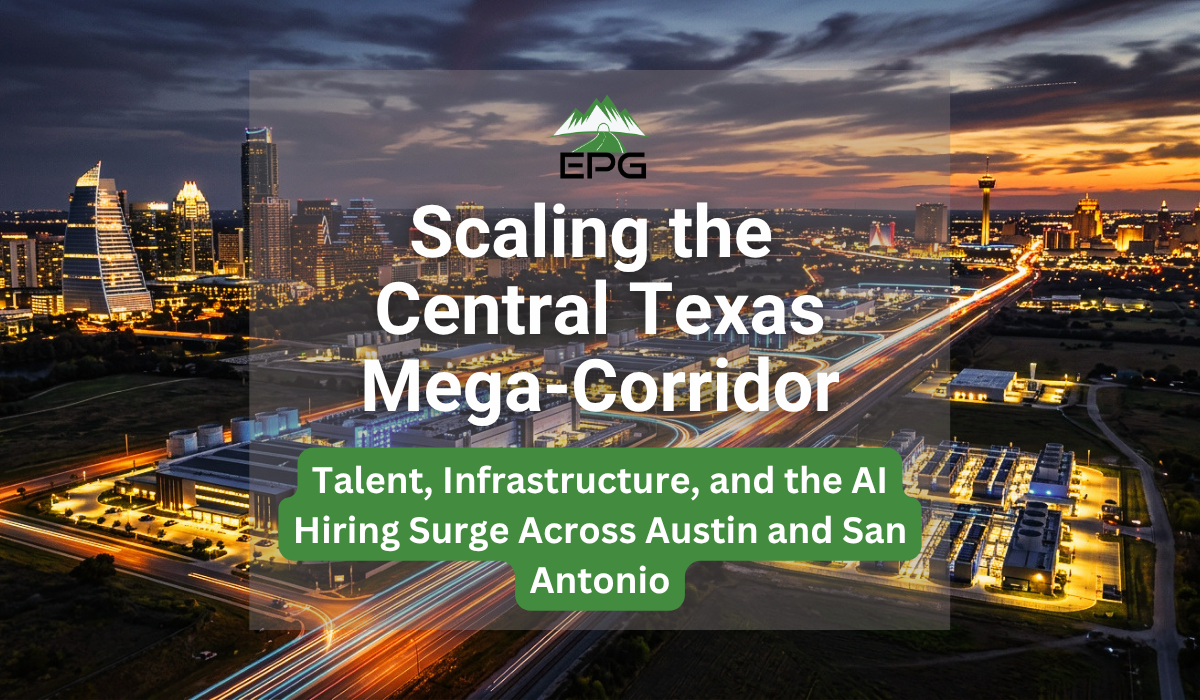
Overview: Rapid growth in the Austin–San Antonio digital infrastructure corridor has created an acute talent shortage for specialized Critical Facilities Technicians, MEP engineers, and high-density thermal experts as operators, cloud leaders, and colocation providers compete aggressively for mission-critical personnel.
The tech corridor stretching from Austin through Central Texas down to San Antonio has solidified its role as one of North America’s premier digital hubs. With over 7,800 megawatts of planned capacity currently moving through the Austin–San Antonio pipeline, the physical backbone of the region’s digital economy is expanding at an unprecedented rate.
Yet, as physical capacity surges across megawatt-scale campuses and edge facilities alike, regional operators face a shared challenge: securing and retaining the specialized talent required to build, power, cool, and maintain these mission-critical environments with zero downtime.
Addressing the unique infrastructure and hiring dynamics shaping the Austin–San Antonio data center landscape reveals three defining shifts transforming the market today.
1. The Austin–San Antonio Mega-Corridor Talent Squeeze
The geographic alignment between Austin and San Antonio offers an ideal combination of fiber connectivity, land availability, and regional power grid access. Consequently, global hyperscalers, colocation providers, and digital infrastructure developers are scaling aggressively across the corridor.
This momentum isn’t limited to one city – it spans the entire region. Digital Realty relocated its global headquarters from San Francisco to Austin, establishing Central Texas as a corporate command center. This presence is further reinforced by massive regional developments, such as Iron Mountain’s planned 500-acre, seven-building hyperscale campus in nearby Hutto, Skybox Datacenters & Prologis’ 600 MW PowerCampus Austin, and CloudHQ‘s 3-million-square-foot, 600 MW SAT Campus on the San Antonio end of the corridor.
Together with massive expansions from CyrusOne, Switch, QTS, Vantage, Sabey Data Centers, and Stream Data Centers, these mega-projects demonstrate how Central Texas has evolved from a regional colocation market into a primary decision-making and operational hub for global digital infrastructure.
This hyper-growth has triggered an intense regional talent squeeze. Operating a modern critical facility requires a highly specialized blend of mechanical, electrical, plumbing (MEP), and network infrastructure skills. As new campuses come online, local demand has outpaced the existing talent pool for key roles, including:
-
Critical Facilities Technicians (CFTs) & Engineers: Overseeing continuous power distribution, UPS systems, emergency generators, and high-voltage switchgear.
-
Network & Fiber Infrastructure Engineers: Managing high-capacity fiber routes, cross-connects, and core network architecture.
-
Site Operations & EHS Managers: Navigating safety compliance, environmental standards, and 24/7/365 operational continuity.
While facility operators scale site construction, Texas-focused connectivity leaders like LOGIX Fiber Networks – which recently deployed multi-terabit fiber routes across the Austin-to-Bastrop corridor to connect regional campuses—alongside national giants like Lumen, Cogent Communications, and GTT Communications, are simultaneously competing for fiber and network engineers to link these massive campuses to regional backbones.
2. Scaling AI-Ready Infrastructure: Niche Technical Requirements
As artificial intelligence and high-performance computing (HPC) workloads scale, traditional air-cooling methods are reaching their physical limits. Facilities across Central Texas are rapidly converting and building out capacity for high-density power configurations capable of supporting 40kW to 100kW+ per rack.
This shift to AI-ready infrastructure requires a fundamental evolution in facility design and a distinct set of technical competencies:
-
Liquid & Direct-to-Chip Cooling: Specialized thermal engineers and mechanics trained in liquid immersion, rear-door heat exchangers, and closed-loop cooling systems.
-
High-Density Power & Microgrids: Power engineers proficient in managing massive electrical loads, redundant transformer setups, and localized renewable power integrations.
-
Specialized Compute & Mining Infrastructure: Operators handling high-density blockchain and HPC environments, where thermal density and power efficiency are paramount.
Innovators expanding high-density and specialized compute capacity across Central Texas are setting unprecedented power and thermal benchmarks. In Caldwell County alone, master-plan developers like Tract (with its 1,515-acre, 2 GW site) are paving the way for specialized operators like Edged Energy ($2.8B, 462 MW waterless closed-loop campus) and Prime Data Centers ($4.2B, 384 MW liquid-cooled campus) to build out extreme-density AI environments.
Concurrently, Colovore is bringing a $500 Million, 40 MW liquid-cooled campus to Hutto engineered specifically for extreme-density AI workloads supporting up to 600+ kW per rack. Meanwhile, EdgeConneX is building out a $5 Billion, multi-campus footprint in Bastrop County anchored by AI cloud providers like CoreWeave. Alongside players like Element Critical, LightEdge, Data Foundry, H5 Data Centers, and Rowan Digital Infrastructure, these operators are actively seeking engineers with expertise in next-generation power and thermal management.
Specialized digital asset and infrastructure operators are executing rapid conversions to support frontier AI workloads. A prime example is Riot Platforms, which recently secured a landmark $9.1 Billion, 20-year lease with frontier AI lab Anthropic for 191 MW of high-density capacity at its Rockdale campus just east of Austin. Just adjacent, Bitdeer Technologies Group completed a $100 Million cash acquisition of 200 greenfield acres to expand its Rockdale footprint to 742 MW of planned AI/HPC capacity. Along with operators like Core Scientific, these massive campus expansions are driving acute demand for technical personnel who can manage multi-hundred-megawatt power distribution and hybrid cooling architectures.
Hyperscale cloud leaders are laying long-term groundwork to support this next generation of high-density compute. A prime example is Amazon Data Services (AWS), which recently secured over 1,300 acres in Bastrop County’s Cedar Creek area for strategic hyperscale capacity banking. At the southern end of the corridor, Microsoft’s expanding Medina County cluster – including developments like SAT 82, SAT 93, and SAT 94 – is reshaping regional talent strategy by creating a demand pipeline for hundreds of permanent engineers and specialized facility contractors.
As a result, facility operators across the region must recruit and retain continuous rosters of high-voltage electricians, controls engineers, and critical systems technicians spanning both the Austin and San Antonio sub-markets.
3. Retaining Skilled Critical Facilities Personnel in Central Texas
In a 24/7/365 mission-critical environment, technical talent retention is directly tied to operational reliability. High turnover among Critical Facilities Technicians and site engineers creates risk, increases training overhead, and strains existing teams.
The top-performing data center operations in Central Texas are winning the retention battle by implementing strategic workforce initiatives:
-
Clear Career Pathways: Structuring transparent advancement tracks from entry-level CFT roles to Facility Managers and Regional Operations Directors.
-
Targeted Cross-Training: Upskilling professionals with adjacent technical backgrounds—such as Navy nuclear personnel, industrial electricians, and HVAC specialists—into mission-critical roles.
-
Competitive Compensation Benchmarking: Aligning pay scales, shift differentials, and benefits with the rapid rise in Central Texas market rates.
Frequently Asked Questions (FAQs)
What critical facilities roles are most in demand across Austin and San Antonio?
The highest local hiring demand centers on Critical Facilities Technicians (CFTs), MEP Engineers, High-Voltage Electrical Specialists, Liquid Cooling/HVAC Technicians, Fiber Network Engineers, and Critical Infrastructure EHS Managers.
How is AI expansion impacting data center hiring in Central Texas?
AI and HPC workloads require high-density power distribution and liquid/immersion cooling architectures. As a result, data centers in Austin and San Antonio are seeking specialized thermal engineers, liquid cooling mechanics, and power systems engineers proficient in 40kW–100kW+ rack environments.
What strategies help Central Texas data centers retain critical facilities talent?
Successful retention strategies include offering structured career progression from technician to leadership levels, providing continuous technical training on next-generation cooling systems, maintaining competitive shift differentials, and aligning pay scales with regional Texas compensation benchmarks.
Why is the Austin–San Antonio corridor experiencing a data center boom?
The corridor provides robust fiber density, strategic regional power grid access, available land, and proximity to major technology hubs. This makes Central Texas an ideal location for hyperscalers, colocation providers, and high-density compute facilities.
How can data center hiring managers in Texas solve candidate shortages for niche roles?
Leveraging niche technical recruitment partners with deep networks in critical infrastructure, active duty/transitioning military talent (such as Navy Nuclear and power plant technicians), and passive candidate pools accelerates time-to-hire for hard-to-fill CFT and engineering roles.
Solve Your Central Texas Data Center Staffing Challenges
Building and scaling a mission-critical team in the competitive Austin–San Antonio market requires more than traditional recruiting—it requires a partner who understands the unique engineering, power, and thermal demands of modern data center environments. Whether you are expanding a hyperscale campus, deploying AI-ready liquid cooling infrastructure, or securing top-tier Critical Facilities Technicians to protect your 99.999% uptime, EPG brings direct access to the region’s best mission-critical talent.
Ready to fill your open mission-critical roles or benchmark your regional compensation strategy?
👉 Schedule a Hiring Strategy Call with Our Critical Infrastructure Team
Or, tell us about your immediate hiring needs by submitting our Contact Form, and one of our specialized data center recruiters will follow up within 24 hours.
About the Author: EPG