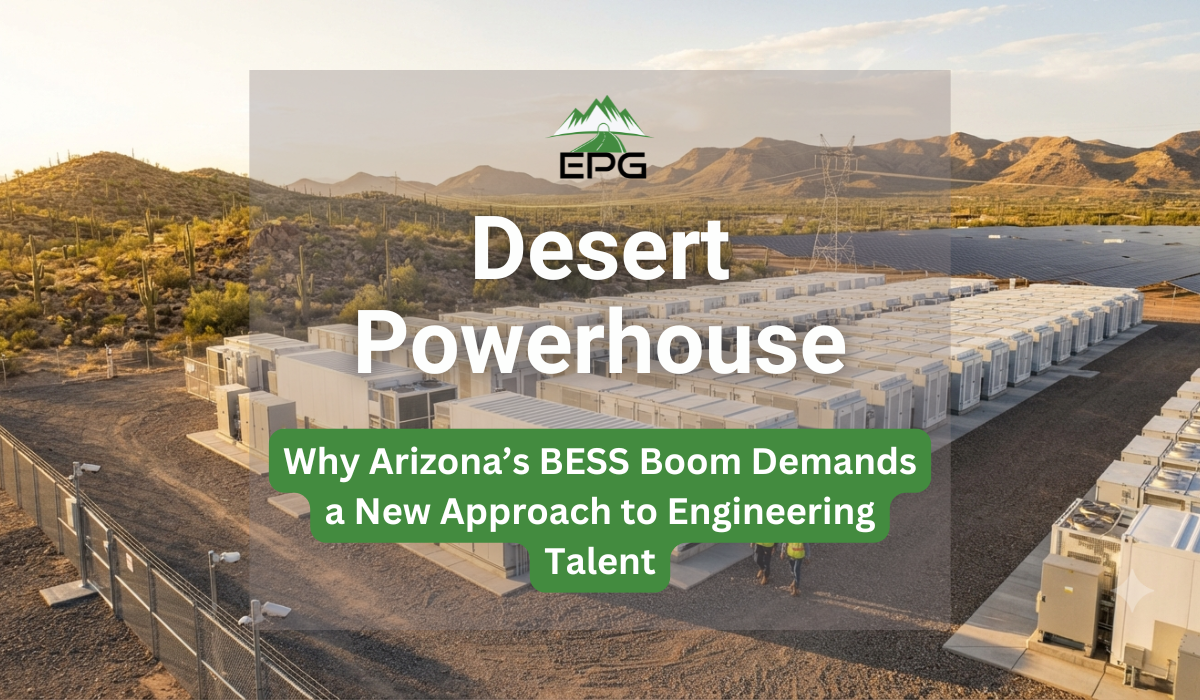
Desert Powerhouse: Why Arizona’s BESS Boom Demands a New Approach to Engineering Talent
Summary
This article analyzes the explosive growth of the Battery Energy Storage System (BESS) market in Arizona, examining the convergence of extreme climate-driven thermal loads, rapid data center expansion, and massive utility-scale infrastructure development. Built for hiring managers, technical recruiters, and energy executives, the piece breaks down the core engineering hurdles of desert-scale storage, maps critical secondary recruitment keywords like thermal management and State of Health (SoH) modeling, and highlights local talent pipelines, regulatory updates, and actionable pathways for securing specialized engineering talent in a hyper-competitive market.
When energy sector analysts look at the map of American energy storage, three states routinely dominate the conversation: California, Texas, and Arizona. While Texas chases market-driven price volatility and California navigates aggressive clean-energy mandates, Arizona has carved out a distinct identity as the Southwest’s ultimate thermal proving ground. Driven by a combination of intense solar adoption, a massive influx of high-tech manufacturing, and booming data center demand, Arizona’s battery capacity has scaled dramatically. Major utilities like Arizona Public Service (APS) and Tucson Electric Power (TEP) are aggressively expanding their pipelines, backed by state-level pushes like the Arizona Energy Promise Taskforce, which is actively optimizing grid regulations to accommodate gigawatts of new storage – raising a critical question for project leaders across the state: do your engineering teams have the specialized desert-weather expertise to protect your long-term asset ROI?
However, this hyper-acceleration has exposed a major operational bottleneck: generic engineering doesn’t work in the desert.
For engineering VPs, project developers, and talent acquisition leaders, building utility-scale storage that survives 115°F summers requires specialized competencies. Below, we break down the primary drivers shaping Arizona’s energy storage market, the hidden operational risks, and the specific talent profiles required to turn desert assets into profitable long-term portfolios.
The Hook: Arizona as a Desert Powerhouse
Unlike coastal or temperate storage markets, Arizona operates under extreme climate-driven load requirements. The primary driver of growth isn’t just a general push for renewables; it is the collision of relentless solar generation, sprawling suburban growth, and power-hungry data centers clustering around the Phoenix metro area.
When ambient temperatures routinely break records, cooling parasitic loads skyrocket, placing unprecedented stress on battery enclosures. Designing for this environment requires deep expertise in Thermal Management and robust BMS Architecture. Generic systems engineered for moderate climates face rapid capacity fade and thermal throttling here, making specialized local design a non-negotiable asset for developers aiming for true Peak Shaving and grid reliability.
The Talent Need: Why Standard Electrical Engineering Falls Short
When hiring managers open requisitions for BESS projects in the Southwest, they often make the mistake of pulling general electrical or civil engineering profiles. In a desert environment, that strategy results in costly project delays and compliance failures.
Operating high-capacity lithium-ion or alternative chemistry blocks under extreme thermal stress demands rigorous safety-critical design. Hiring teams are actively hunting for specialists who excel at:
-
Thermal Runaway Mitigation: Designing active and passive cooling architectures that prevent cascading failures under extreme ambient heat.
-
Fire Suppression Systems & Compliance: Navigating strict local interpretations of NFPA 855 and UL 9540 standards to secure rapid Authority Having Jurisdiction (AHJ) approval.
-
Safety-Critical Design: Implementing fail-safes that protect both project capital and surrounding municipal infrastructure.
Recruiter Note: If your candidate pipelines aren’t explicitly loaded with safety and thermal compliance credentials, your projects risk getting bogged down in regulatory review before ground is even broken.
Interconnection & Scale: Managing Desert Infrastructure Expansion
Grid congestion and interconnection bottlenecks are the silent killers of project ROI. As utility-scale solar-plus-storage farms flood the queue, navigating regional transmission organization frameworks becomes intensely complex.
Engineers who understand Interconnection (IEEE 1547) protocols, RTO/ISO queue navigation, and Grid-Forming Controls are among the most heavily recruited assets in the western Interconnection network. Developers need talent that can interface seamlessly with local utilities, ensuring that gigawatt-scale assets transition smoothly from EPC (Engineering, Procurement, and Construction) phases straight into commercial operation without triggering grid instability or costly redesigns.
Operational Risk: Moving Beyond “Nameplate Capacity”
Anyone can build a battery on paper. Keeping it profitable across a 15-to-20-year lifecycle in the Sonoran Desert, or any high-demand market, is an entirely different challenge. Industry-wide data underscores just how fragile these assets can be when system-level integration fails: manufacturing analyses from firms like Intertek CEA reveal that the vast majority of critical safety and operational defects stem not from the battery cells themselves, but from balance-of-system components, faulty enclosures, and mismanaged thermal controls. High-profile containment events, from the 2019 incident in Surprise, Arizona to large-scale thermal events in California, remind asset owners that minor design oversights can result in multi-million-dollar write-offs and severe community friction.
Forward-thinking asset owners are shifting their focus away from raw “nameplate capacity” and prioritizing long-term yield optimization. This requires advanced software integration and predictive modeling disciplines, featuring active regional builds like TEP’s Roadrunner Reserve executed by firms like DEPCOM Power:
-
State of Health (SoH) Modeling: Continuously tracking degradation curves accelerated by high ambient operating temperatures.
-
Energy Management Systems (EMS) & Dispatch Logic: Writing algorithms that optimize charge-discharge cycles to capture maximum revenue during peak evening demand while preserving cell integrity.
-
Predictive Maintenance: Leveraging continuous data streams via API access to catch cell anomalies before they manifest into field failures.
The Arizona Talent Pipeline: Where Do BESS Engineers and Technicians Come From?
For hiring managers trying to scale fast, relying solely on national job boards often leads to a dead end. Winning organizations tap into regional talent ecosystems – sourcing technical leads and hands-on trade operators who already understand the nuances of the Southwest grid.
-
The Academic Core: Institutions like Arizona State University (ASU) and the University of Arizona produce a steady stream of electrical and chemical engineers well-versed in power systems and renewable integration.
-
Trade and Retraining Programs: Local community colleges across the Phoenix and Tucson metros are increasingly adapting their technical curricula to offer specialized certificates in high-voltage maintenance, industrial safety, and battery system deployment.
-
The EPC Footprint: With major engineering, procurement, and construction (EPC) firms, such as Scottsdale-based DEPCOM Power, headquartering or executing massive regional builds like TEP’s Roadrunner Reserve locally, Arizona boasts a rich cross-pollination pool of specialized commissioning managers, safety inspectors, and SCADA technicians.
Frequently Asked Questions (FAQ)
1. What makes Arizona’s BESS market different from Texas or California?
While Texas is driven by merchant market volatility and ancillary service arbitrage, and California relies heavily on state-mandated decarbonization timelines, Arizona’s growth is anchored by extreme climate-driven cooling loads, rapid population growth, and heavy industrial/data center expansion. The physical environment—specifically extreme ambient heat—places unique demands on hardware durability and thermal engineering.
2. Which technical skills are most critical when hiring for Arizona BESS projects?
Hiring managers should prioritize candidates with proven expertise in Thermal Management, BMS Architecture, Grid-Forming Controls, and rigorous safety compliance (NFPA 855 / UL 9540). For operational assets, background in SoH Modeling and Predictive Maintenance is vital to protect project ROI.
3. How are supply chain shifts and local regulations impacting BESS talent acquisition in the region?
Backed by modern administrative frameworks like the Governor’s Energy Promise Taskforce, the ecosystem has matured rapidly. However, executive search data shows a persistent talent shortage for engineers who possess both hands-on commissioning experience and advanced familiarity with local utility interconnection constraints.
4. How can engineering firms secure top-tier BESS talent in a competitive market?
Because specialized storage engineers are in high demand across the Sunbelt, firms must move quickly with precise compensation packages and clear pathways for project ownership. Partnering with a dedicated technical recruitment specialist allows hiring teams to bypass surface-level applicant pools and target passive candidates with exact regional deployment experience.
Secure the Engineering Talent Your Projects Need
Building utility-scale energy storage in Arizona’s demanding climate requires more than standard staffing—it requires precision talent acquisition backed by deep industry insight. Whether you are scaling up your internal engineering team or staffing an upcoming EPC milestone, EPG (Elevation Proving Grounds) connects you with the specialized technical leaders who keep projects on schedule and on budget.
👉 Schedule a Consultation with Our Team Today or Fill Out Our Contact Form to discuss your hiring goals and discover how our targeted recruitment strategies can strengthen your next energy storage deployment.
About the Author: EPG