Robotaxi Safety Benchmarks & Incident Reporting: How Waymo, Tesla, and Zoox Compare
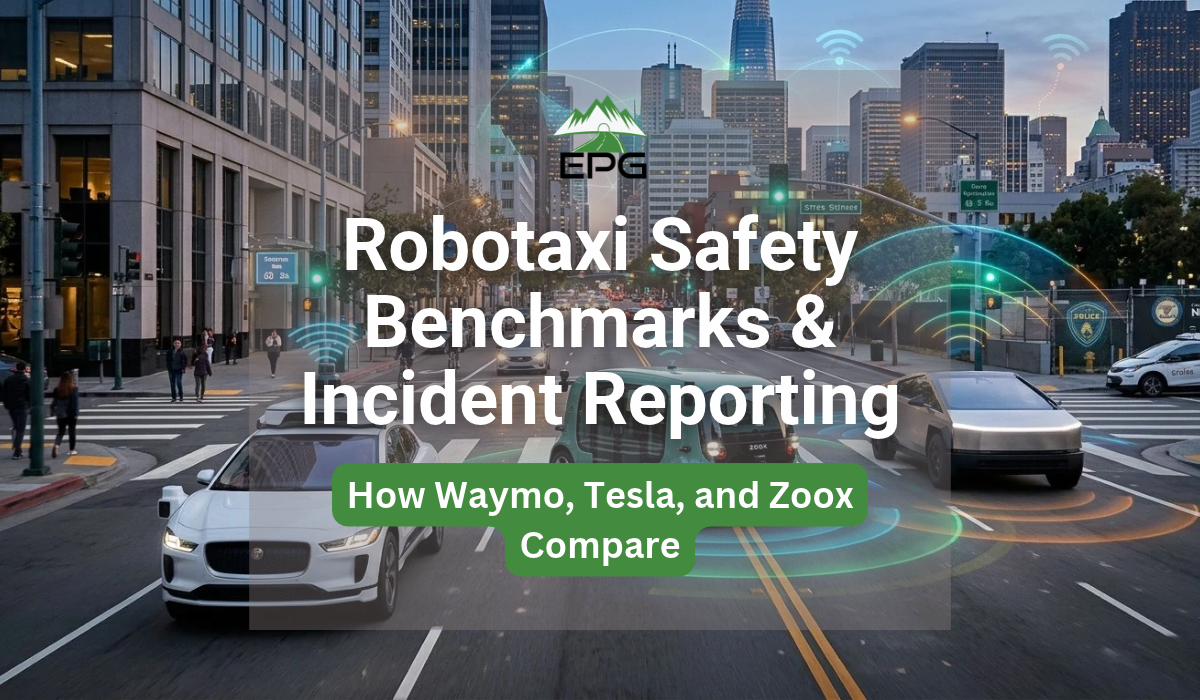
Quick Answer: Across 271.3 million rider-only miles in 15 U.S. metros, Waymo leads commercial robotaxi safety with an 82% reduction in injury-causing crashes and a 95% reduction in serious-injury crashes compared to human drivers. Tesla has crossed 5 million unsupervised Robotaxi miles across 8 cities in Texas and Florida with zero reported airbag deployments or pedestrian/cyclist strikes in its 2026 NHTSA Standing General Order (SGO) filings, while Zoox achieved 60,682 miles per disengagement (MPI) in California DMV testing alongside commercial rollouts in Las Vegas and San Francisco. Meanwhile, Cruise’s 2024 shutdown following $2 million in federal fines remains the industry’s defining lesson in AV incident reporting compliance and engineering team stability.
In the commercial autonomous vehicle (AV) sector, safety metrics are no longer just engineering KPIs, they are the primary currency for regulatory survival, multi-city expansion, and talent acquisition.
For engineering leaders and technical job seekers alike, comparing Waymo, Tesla, and Zoox, alongside the regulatory cautionary tale of Cruise, reveals how sensor architectures, AV incident reporting compliance, and transparent safety validation dictate whether a robotaxi program scales across dozens of cities or faces regulatory grounding.
Below is a data-driven breakdown of the latest robotaxi safety statistics, federal crash filings, autonomous vehicle disengagement rates, and active U.S. deployment markets, alongside what these numbers reveal about where top Functional Safety and Validation & Verification (V&V) teams are scaling.
Executive Summary: The 2026 AV Safety Landscape
| Metric / Benchmark | Waymo | Tesla Robotaxi | Zoox |
|---|---|---|---|
| Operational Status (Late 2026) | 15 U.S. Metros Commercial scaling across 15 U.S. metros (271.3M+ rider-only miles) |
8 Unsupervised Cities 24/7 unsupervised service in 8 cities (TX & FL; 5.0M+ autonomous miles) + supervised Bay Area service |
2 Commercial + 12 Test Purpose-built robotaxi commercial service (Las Vegas, SF) + 12-city test footprint |
| Sensor & Compute Architecture | Multi-modal (LiDAR, Radar, Vision) | Vision-only end-to-end neural network (Model Y & steering-wheel-free Cybercab) | Multi-modal (LiDAR, Radar, Vision, Long-Wave IR) on bidirectional pods |
| CA DMV Test Miles & MPI (Dec 2024 – Nov 2025) |
3,346,709 miles / 19,234 MPI (Testing fleet; rider-only excluded) |
N/A (Operates under CA TCP limousine/supervised permit; does not report DMV AV disengagements) |
1,213,646 miles / 60,682 MPI (Up significantly from 2024) |
| Injury & Crash Performance | 82% reduction in any-injury crashes; 95% reduction in serious injury/worse | 0 injury crashes, 0 airbag deployments, and 0 pedestrian/cyclist hits across 3.1M audited 2026 miles | Low pre-crash speeds (~6.07 mph avg in NHTSA SGO filings); high stationary rear-end share |
| Primary Safety & Regulatory Approach | Peer-reviewed counterfactual human benchmarks + NHTSA SGO transparency | Real-world fleet mileage benchmarking against Texas CRIS police crash data | Quantitative Safety Case Framework (Composite Incident Frequency / CIF) + NHTSA FMVSS exemption |
1. Waymo: Setting the Gold Standard in Actuarial Safety Data
With 271.3 million rider-only miles logged across 15 U.S. metro areas, spanning mature Sunbelt hubs like Phoenix, San Francisco, Los Angeles, Austin, and Atlanta, alongside 2026 expansions into Dallas, Houston, San Antonio, Miami, Orlando, Tampa, Nashville, Las Vegas, San Diego, and Denver, Waymo holds the largest and most geographically diverse safety dataset in the industry. Notably, its September 2026 public launches in Denver and San Diego serve as clean-slate validation benchmarks for its 6th-generation hardware across high-altitude winter weather and dense coastal tourism corridors.
Rather than relying solely on raw crash counts (which naturally rise as fleet mileage scales), Waymo benchmarks its performance against human drivers operating in the exact same zip codes and road types, adjusting for NHTSA’s estimated 32% police underreporting rate for minor human injury crashes.
Key Waymo Safety Metrics
-
82% Fewer Injury-Causing Crashes: Waymo recorded 0.67 any-injury-reported incidents per million miles (IPMM), compared to the human benchmark of 3.77 IPMM—preventing an estimated 841 injury crashes.
-
95% Fewer Serious-Injury-or-Worse Crashes: Waymo logged 0.01 serious-injury crashes per million miles versus 0.21 for human drivers.
-
Vulnerable Road User (VRU) Protection: Compared to human baselines, Waymo achieved a 93% reduction in pedestrian injury crashes, an 86% reduction in cyclist injury crashes, and an 82% reduction in motorcycle injury crashes.
-
Intersection Dominance: Vehicle-to-vehicle intersection injury crashes dropped by 96% compared to human drivers.
In NHTSA Standing General Order (SGO) filings, the majority of Waymo’s reported incidents involve low-speed contacts (averaging under 7 mph pre-crash speed) or stationary impacts where a human-driven vehicle rear-ended a stopped Waymo at a traffic signal.
2. Tesla Robotaxi: Vision-Only Scaling & 24/7 Unsupervised Expansion
Taking a fundamentally different engineering approach from LiDAR-equipped competitors, Tesla relies on a camera-only, end-to-end neural network running across its Model Y fleet and its two-seat, steering-wheel-free Cybercab (which began commercial Austin service in September 2026).
In November 2026, Tesla expanded its unsupervised Robotaxi service to 24/7 operation across eight U.S. cities—Austin, Dallas, Fort Worth, Houston, and San Antonio in Texas, plus Miami, Orlando, and Tampa in Florida—surpassing 5 million cumulative autonomous miles. (In the San Francisco Bay Area, Tesla continues to operate ride-hailing with an onboard safety monitor under a California Transportation Charter Party permit.)
Key Tesla Robotaxi Safety Metrics
-
Zero Severe SGO Events: According to Tesla’s Q4 2026 Robotaxi Safety Report covering 3.1 million audited autonomous miles (excluding safety-monitor rides):
-
0 people injured by a Tesla Robotaxi (versus 9.1 expected injury collisions for human drivers over the same mileage).
-
0 Robotaxi airbag deployments (versus 4.1 expected in human benchmarks).
-
0 pedestrians or cyclists struck.
-
-
Incident Profile: In NHTSA SGO filings, Tesla’s reported incidents have predominantly involved stationary or parked vehicles struck by third-party human drivers (such as a June 2026 reporting cycle where Tesla logged zero at-fault crashes across its active cities).
-
Regulatory Nuance: Because Tesla concentrates its driverless rollout in Texas and Florida—states with notice-based or permit-free AV frameworks rather than California’s DMV disengagement reporting mandate—independent analysts rely heavily on federal NHTSA SGO disclosures and Texas Crash Records Information System (CRIS) baselines to audit its safety trajectory.
3. Zoox: High Disengagement Efficiency & Quantitative Safety Cases
Amazon-owned Zoox has pursued a purpose-built hardware and validation path, deploying bidirectional, four-seat robotaxis without manual steering wheels alongside its retrofitted test fleet. Following its commercial public debut in Las Vegas and San Francisco, Zoox has expanded its active mapping and autonomous testing footprint across 12 U.S. locations—including Austin, Miami, Atlanta, Los Angeles, Dallas, Phoenix, Seattle, Washington, D.C., Houston, and San Diego—backed by a July 2026 NHTSA commercial exemption authorizing up to 2,500 purpose-built vehicles annually.
CA DMV Disengagement & Testing Performance
In the California DMV disengagement reporting cycle covering December 2024 through November 2025:
-
Zoox logged 1,213,646 autonomous test miles in California with just 20 disengagements, achieving an impressive 60,682 miles per disengagement (MPI)—a substantial year-over-year reliability jump.
-
Context on MPI: While Zoox’s MPI outpaced Waymo’s California testing fleet (19,234 MPI across 3.35 million test miles), industry analysts note that Waymo’s commercial rider-only fleet (which operates without safety drivers and therefore logs zero traditional disengagements) is reported separately through the California Public Utilities Commission (CPUC).
Zoox’s Safety Case Architecture
In its published Safety Case Framework, Zoox evaluates hardware, software, and remote operations through a Quantitative Risk Assessment centered on Composite Incident Frequency (CIF). NHTSA SGO filings indicate Zoox maintains a low pre-crash speed profile (~6.07 mph average in recent monthly filings), with the bulk of its reported incidents consisting of stationary rear-endings or low-speed urban sideswipes by third-party human drivers.
4. The Cruise Cautionary Tale: Why Incident Reporting Compliance Makes or Breaks AV Programs
While Waymo, Tesla, and Zoox lead the 2026 commercial race, the collapse of Cruise (GM) remains the industry’s most important case study in AV incident reporting compliance: how a company handles an incident matters just as much as the incident rate itself.
Prior to October 2023, Cruise was Waymo’s closest commercial competitor in San Francisco. However, following an October 2023 collision in which a human-driven hit-and-run vehicle launched a pedestrian into a Cruise AV’s path and the Cruise vehicle subsequently executed a pullover maneuver while the pedestrian was trapped underneath, Cruise’s trajectory collapsed:
-
Regulatory Revocation: The California DMV immediately suspended Cruise’s driverless deployment and testing permits, citing public safety risks and incomplete video disclosure during initial regulatory briefings.
-
Federal Penalties: NHTSA fined Cruise $1.5 million for failing to promptly disclose critical crash details, and Cruise later admitted to filing a false report to influence a federal investigation, paying an additional $500,000 criminal fine.
-
Program Shutdown: After spending roughly $10 billion on the unit, General Motors ceased funding Cruise’s commercial robotaxi operations in December 2024, folding its remaining engineering talent into personal vehicle ADAS (Super Cruise) development.
The Industry Takeaway: Under NHTSA’s Third Amended Standing General Order (SGO), AV operators must report crashes involving physical impact or airbag deployment within strict federal windows. Attempting to minimize edge-case failures or obscure telemetry data destroys institutional trust faster than a software bug ever could.
The 2026 U.S. Robotaxi Map: Active Commercial & Testing Metros
Where an autonomous fleet operates isn’t just a business decision, it is a direct reflection of state-level AV permitting regimes and how well an operator’s safety case holds up across diverse Operational Design Domains (ODDs), from Sunbelt grids to high-altitude winter weather.
As of late 2026, active commercial and supervised robotaxi networks span 15 major U.S. metro areas, concentrated heavily in states with streamlined driverless frameworks (Texas, Florida, Arizona, and Nevada) alongside California’s multi-rung permitting ladder:
| U.S. Metro Area | Active Commercial / Rider-Open Operators | Active Testing / Early Access | State Regulatory Regime |
|---|---|---|---|
| Austin, TX | Waymo (via Uber) Tesla (24/7 unsupervised Model Y & Cybercab) |
Zoox (employee / early testing) | Texas (SB 2807): TxDMV commercial authorization required (enforced May 2026). |
| Dallas–Fort Worth, TX | Waymo (Dallas) Tesla (24/7 unsupervised Dallas & Fort Worth) |
Zoox (Dallas mapping / testing) | Texas: Commercial authorization + local airport/municipal coordination. |
| Houston, TX | Waymo Tesla (24/7 unsupervised) |
Zoox (mapping & testing) | Texas: Commercial TxDMV authorization. |
| San Antonio, TX | Waymo Tesla (24/7 unsupervised) |
— | Texas: Commercial TxDMV authorization. |
| San Francisco Bay Area, CA | Waymo (SF, Peninsula, South Bay) Zoox (SF) Tesla (supervised) |
Zoox (Foster City / broader Bay Area) | California (DMV + CPUC): Strictest multi-tier testing, driverless, and paid-fare permits. |
| Los Angeles, CA | Waymo | Zoox (testing fleet) | California: DMV driverless + CPUC deployment permits. |
| San Diego, CA | Waymo (6th-gen Ojai fleet) | Zoox (mapping & testing) | California: DMV + CPUC commercial authorization. |
| Phoenix, AZ | Waymo (flagship + Sky Harbor Airport) | Zoox (testing) Tesla (coming soon) |
Arizona (HB 2813): Notice-based compliance filing; no separate state AV cap. |
| Las Vegas, NV | Zoox (Strip & surrounding corridors) Waymo (incl. LAS Airport) |
Tesla (coming soon) | Nevada (NRS 482A): DMV autonomous certificate filing. |
| Miami, FL | Waymo Tesla (24/7 unsupervised) |
Zoox (testing) | Florida (FS 316.85): No state AV permit required; statutory insurance & safety rules. |
| Orlando, FL | Waymo Tesla (24/7 unsupervised) |
— | Florida: Permit-free statutory framework. |
| Tampa, FL | Waymo Tesla (24/7 unsupervised) |
— | Florida: Permit-free statutory framework. |
| Atlanta, GA | Waymo (via Uber) | Zoox (employee / initial rollout) | Georgia (SB 219): Exempts AVs from licensed-driver requirement. |
| Nashville, TN | Waymo | — | Tennessee: State statutory AV authorization. |
| Denver, CO | Waymo (high-altitude / weather ODD) | — | Colorado: State DOT/CDOT & State Patrol AV approval framework. |
(Note: Operators also maintain active mapping and supervised testing pipelines in Washington, D.C., Seattle, Boston, Chicago, Charlotte, Detroit, Minneapolis, and New York City ahead of future commercial applications.)
What Safety Metrics Mean for AV Hiring & Career Strategy
Safety benchmarks are the single best leading indicator of organizational health in autonomous mobility. Whether you are scaling an engineering organization or evaluating your next career move, the data points directly to where headcount is growing.
For Hiring Managers: Why Safety Compliance Drives Headcount
Expanding from predictable Sunbelt grids (Phoenix, Austin) into high-altitude snow markets (Denver), dense coastal tourism corridors (San Diego, Miami), and multi-operator metros (Dallas–Fort Worth, Houston, Las Vegas) multiplies edge-case permutations. Every new ODD requires localized hazard analysis, updated state and municipal safety filings, and fresh sensor-degradation validation, creating immediate bottlenecks that only specialized safety leaders can unblock.
Consequently, commercial leaders like Waymo, Tesla, and Zoox are aggressively competing for talent in three core verticals:
-
Functional Safety (ISO 26262) & SOTIF (ISO 21448) Architects: Engineers capable of proving that perception and planning stacks handle foreseeable misuse and sensor degradation without catastrophic failure across diverse weather and terrain.
-
Validation & Verification (V&V) Leads: Specialists who build closed-loop simulation pipelines and structured scenario testing to quantify residual risk (such as Zoox’s CIF targets) before public road deployment.
-
Systems Safety & Regulatory Compliance Managers: Technical leaders who bridge the gap between raw vehicle telemetry, NHTSA SGO reporting mandates, state DOT filings, and public safety cases.
For Job Seekers: Evaluating AV Employers Through Safety Transparency
When assessing prospective autonomous vehicle employers, look beyond press releases and examine their public regulatory footprint:
-
Check NHTSA SGO & State Filings: Does the company report granular, consistent telemetry, or are its public filings heavily redacted or plagued by NHTSA Office of Defects Investigation (ODI) probes?
-
Look for Counterfactual Rigor: Companies that publish peer-reviewed methodologies (like Waymo’s actuarial injury comparisons) or formal quantitative risk frameworks (like Zoox’s Safety Case) empower their safety teams rather than treating compliance as a PR hurdle.
-
Assess Commercial Runway: Organizations holding active commercial deployment permits across multiple states and logging multi-million-mile driverless quarters offer far greater career stability than pre-revenue testing fleets still struggling with low miles-per-disengagement ratios.
Frequently Asked Questions (FAQ)
Which U.S. cities have active driverless robotaxis in 2026?
Commercial, rider-open robotaxi networks operate across 15 major U.S. metro areas, led by Waymo (Phoenix, San Francisco Bay Area, Los Angeles, San Diego, Austin, Dallas, Houston, San Antonio, Miami, Orlando, Tampa, Atlanta, Nashville, Las Vegas, and Denver), Tesla (24/7 unsupervised service in Austin, Dallas, Fort Worth, Houston, San Antonio, Miami, Orlando, and Tampa, plus supervised service in the Bay Area), and Zoox (Las Vegas and San Francisco).
How does Tesla’s Robotaxi safety data compare to Waymo and Zoox?
Waymo has the largest audited dataset at 271.3 million rider-only miles, demonstrating an 82% reduction in injury crashes versus human drivers. Tesla has crossed 5 million autonomous miles across eight Texas and Florida cities, reporting zero at-fault injury crashes, airbag deployments, or pedestrian/cyclist hits in its 2026 NHTSA SGO disclosures, though its unsupervised mileage is concentrated in Sunbelt states rather than California’s DMV disengagement reporting framework.
Why do autonomous vehicle crash counts increase every quarter in NHTSA reports?
NHTSA SGO crash counts measure raw incident totals without normalizing for miles driven. As commercial fleets scale past millions of rider-only miles per week, total reported contacts naturally rise, even when the rate of crashes per million miles is 80%+ lower than human drivers. Additionally, AVs are legally required to report minor bumper taps under 1 mph that human drivers rarely report to police.
Is Cruise still operating robotaxis?
No. General Motors halted funding for Cruise’s commercial robotaxi service in December 2024 following regulatory permit suspensions and federal fines stemming from its October 2023 pedestrian collision in San Francisco. GM consolidated Cruise’s remaining engineering teams into its personal vehicle ADAS division.
Ready to Scale Your Autonomous Safety & Validation Team?
Whether you are preparing for a new state regulatory filing, expanding into complex weather ODDs, or building out your core Functional Safety (ISO 26262), SOTIF, and Validation & Verification leadership, securing proven AV safety talent is the fastest way to protect your deployment timeline.
At EPG, we specialize in connecting high-growth autonomous vehicle, robotics, and clean-tech engineering teams with field-tested safety and systems leaders who have already navigated federal and state commercial approvals.
-
Schedule a Discovery Call with our autonomous mobility recruiting specialists to discuss your upcoming technical roadmap and headcount priorities.
-
Submit a Hiring Inquiry via our contact form to receive a tailored talent market briefing for your target engineering hubs.
About the Author: EPG