Autonomous Trucking & Freight Regulations (2026–2027): State Laws, Corridor Rollouts, and Hiring Hotspots
What is the statutory and operational landscape for Class 8 autonomous trucking in 2026–2027?
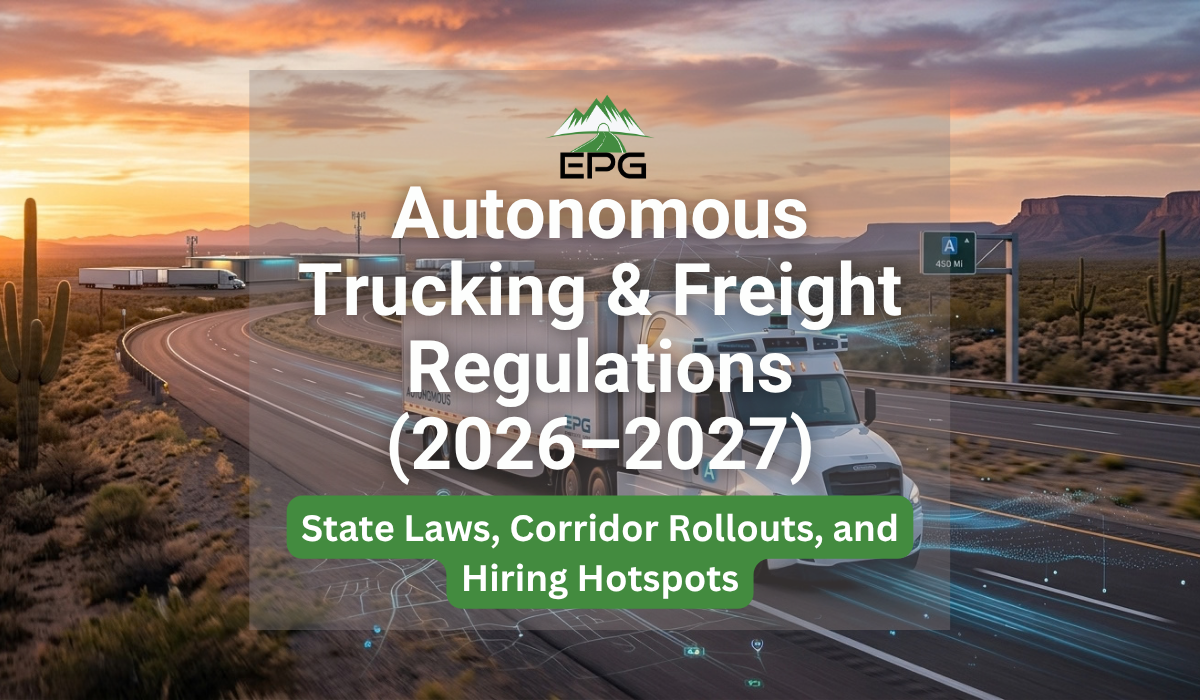
Autonomous heavy freight (Class 8 / >26,000 lbs) operates legally without human safety drivers across major Sun Belt and Midwest freight hubs under enabling state statutes (including Texas SB 2205 & SB 2807, Arizona HB 2813 (2021), Mississippi HB 1003 (2023), Alabama SB 226 (2024), Georgia Code § 40-8-11, and Florida HB 311 (2019)). While interstate corridors like the I-10 link major markets, cross-state operations navigate a blend of explicit statutory exemptions and state DOT administrative testing frameworks. Commercial deployments center on the “Hub-to-Hub” middle-mile model along key freight lanes (I-10, I-45, I-20, I-85). Consequently, recruitment is heavily concentrated in hubs like Dallas-Fort Worth, Phoenix, Atlanta, and Pittsburgh for specialized roles in terminal operations, functional safety (ISO 26262), fleet dispatch, and regulatory affairs.
Commercial heavy freight (Class 8, >26,000 lbs GVWR) has taken the lead as the primary driver of autonomous vehicle (AV) revenue. Following milestone commercial, zero-driver deployments across key Sun Belt and Midwest freight lanes, logistics executives, OEMs, and fleet operators are racing to build operational hubs where the law explicitly allows.
Because federal oversight under the FMCSA and NHTSA provides overarching vehicle safety guidelines rather than pre-empting state traffic rules, navigating the state-by-state statutory landscape, tracking interstate freight corridors, and identifying specialized technical talent are essential for scaling operations.
State-by-State Regulatory Breakdown for Heavy Freight (Class 8)
State statutory stances split into three operational tiers based on vehicle weight authorizations, safety driver mandates, and local preemption provisions.
1. Fully Authorized Commercial Driverless Deployment
These states have enacted explicit statutory frameworks permitting commercial Class 8 autonomous trucks to operate on public highways without a physical human safety driver in the cab, provided minimum financial responsibility and safety protocols are met.
-
Texas (Transportation Code Ch. 545, Subch. J / SB 2205 & SB 2807): The undisputed center of heavy AV freight. Explicitly permits fully driverless commercial operations statewide across all vehicle weight classes without special operational permits, prohibiting local municipalities from restricting AV access.
-
Arizona (HB 2813 / Act 117 & SB 1320): Core framework governed by HB 2813, legalizing driverless commercial freight across state highways. SB 1320 expanded coverage to autonomous agricultural and heavy machinery.
-
Mississippi (HB 1003 / MS FAVE Act – MS Code § 63-35): Enacted the Mississippi Fully Autonomous Vehicle Enabling Act, explicitly legalizing Level 4/5 driverless commercial motor vehicles on state highways. Requires operators to file a Law Enforcement Interaction Plan with the Department of Public Safety and carry $2M+ in motor carrier liability coverage.
-
Alabama (SB 226 / Act 2024-453 & SB 47): Formally legalized fully driverless commercial motor vehicles, establishing a statutory liability baseline, stripping municipal regulatory powers, and establishing liability thresholds ($2M+) for deployment.
-
Georgia (Ga. Code § 40-8-11): Exempts Automated Driving Systems (ADS) from traditional human licensing and physical driver requirements, serving as the Southeastern freight distribution anchor.
-
Florida (HB 311 / Florida Statutes § 319.145): Authorizes driverless operations statewide across all freight platforms. Under HB 425, the Florida Department of Transportation (FDOT) actively evaluates state highways for AV physical infrastructure compatibility.
-
Arkansas (HB 1561 / Act 468 & HB 1562): Authorizes fully autonomous vehicles on public highways under state program guidelines, with HB 1562 establishing mandatory motor carrier liability proof for autonomous commercial property transport.
-
Nevada (NRS 482A & AB 523): Early pioneer in driverless commercial vehicle operation, essential for Southwest-to-West Coast freight movement.
-
Iowa (SF 302): Permits driverless commercial freight operations across state highways, linking Midwest manufacturing and agricultural freight to southern corridors.
2. Conditional, Testing, & Evolving Frameworks
States in this category permit AV operations under specific agency oversight, phased permitting processes, or active legislative review.
-
California: Operates a dual regulatory environment. While passenger robotaxis under 10,000 lbs are permitted, commercial heavy trucks (>10,000 lbs) historically faced testing bans. DMV rulemaking updates have opened phased heavy-truck driverless permits (requiring a 500,000-mile safety operator buffer) amid ongoing labor and legislative debate.
-
Louisiana: Allows autonomous platoon testing and commercial freight evaluation under state DOT regulations, acting as a crucial transit link along the I-10 and I-20 corridors between Texas and Mississippi.
-
Indiana & Ohio: Both states permit autonomous testing and commercial platoon testing under state DOT oversight, capturing heavy industrial freight traffic along the I-70 and I-80 corridors.
-
Colorado & New Mexico: Permit AV testing and middle-mile deployments with statutory minimum risk condition requirements, bridging mountain and desert freight routes between Texas and Arizona.
3. Human Safety Driver Mandates & Weight-Restricted States
Jurisdictions enforcing explicit physical human safety operator mandates or statutory bans on driverless vehicles over 10,000–26,000 lbs.
-
Class 8 Weight Exclusions / Safety Operator Mandates: States like Delaware (SB 46), Maryland, and Massachusetts enforce or evaluate legislation requiring a licensed commercial driver (CDL holder) physically present in the cab for vehicles exceeding 10,000 to 26,000 lbs GVWR.
-
Restricted Jurisdictions: New York and Washington D.C. enforce strict in-cab safety operator mandates or specialized permitting that precludes driverless heavy freight deployments.
State Statutory Comparison Matrix: Sun Belt & Key Corridors
| State | Heavy Class 8 (>26k lbs) Driverless Legal? | Key Enacted Statutes / Regulations | Safety Operator Required? | Local Municipality Preemption? |
|---|---|---|---|---|
| Texas | Yes | Transportation Code Ch. 545, Subch. J / SB 2205 & SB 2807 | No (Fully Exempt) | Yes (State Preemption) |
| Arizona | Yes | A.R.S. § 28-9702 / HB 2813 (2021) / SB 1320 | No (Fully Exempt) | Yes (State Preemption) |
| Mississippi | Yes | HB 1003 (MS FAVE Act) / Code § 63-35 | No (Fully Exempt) | Yes (State Preemption) |
| Alabama | Yes | SB 47 / SB 226 (Act 2024-453) | No (Fully Exempt) | Yes (State Preemption) |
| Georgia | Yes | Ga. Code § 40-8-11 | No (Fully Exempt) | Yes (State Preemption) |
| Florida | Yes | Fla. Stat. § 319.145 / HB 311 / HB 425 | No (Fully Exempt) | Yes (State Preemption) |
| Arkansas | Yes | HB 1561 (Act 468) / HB 1562 | No (Fully Exempt) | Yes (State Preemption) |
| Nevada | Yes | NRS 482A / AB 69 / AB 523 | No (Fully Exempt) | Yes (State Preemption) |
| Iowa | Yes | SF 302 / Iowa Code §§ 321.514–321.519 | No (Fully Exempt) | Yes (State Preemption) |
| California | Conditional | SB 1298 / DMV Heavy Vehicle Framework | Yes (500k-mile testing buffer) | Partial (Caltrans/DMV rules) |
| Delaware | Yes (Current Rule) | SB 46 (Pending) | Proposed Mandate for >26k lbs | State Highway Rule |
Key Freight Corridors & Middle-Mile Deployment
Autonomous Class 8 trucking relies on the Hub-to-Hub (Middle-Mile) Model. Human drivers handle short-haul, complex urban routing from origin facilities to highway-adjacent AV freight terminals. Autonomous trucks handle the long-haul highway leg, transferring trailers back to human drivers at destination terminals.
Freight Logistics Flow
Autonomous Transfer Hub Network (Middle-Mile Automation)
Human
Local Roads
AUTONOMOUS
Highway Corridor
Human
Last Mile
Active Interstate Freight Corridors
-
The Unbroken Interstate 10 (I-10) Sun Belt Spine: Connecting Phoenix, El Paso, San Antonio, Houston, New Orleans, Biloxi, Mobile, and Jacksonville. Thanks to enabling statutes in Mississippi (MS FAVE Act) and Alabama (SB 226), carriers like Aurora Innovation, Kodiak AI, and Gatik operate along a continuous statutory lane across the Gulf Coast.
-
The Interstate 45 (I-45) Corridor (Dallas to Houston): The most densely mapped, high-frequency commercial deployment lane in North America, anchored heavily by high-volume freight transfers between Aurora, Kodiak, and major national logistics partners.
-
The Interstate 20 / 85 Southeastern Triangle: Links Texas freight through distribution networks in Atlanta, Georgia, extending to regional Atlantic ports with active fleet testing led by Torc Robotics and OEM technology partners.
Recruitment Hotspots: Where Capital & Hiring Are Concentrated
The shift from software validation to 24/7 commercial freight execution has shifted hiring priorities toward field execution, hardware reliability, and regulatory compliance.
| Hiring Hub | Operational Focus | Key Roles in High Demand |
|---|---|---|
|
📍
Dallas–Fort Worth, TX |
|
|
|
📍
Phoenix, AZ |
|
|
|
📍
Atlanta, GA |
|
|
|
📍
Pittsburgh, PA & Bay Area, CA |
|
|
Priority Roles for Technical & Operations Talent
1. Functional Safety & Systems Reliability Engineers
Transitioning away from human safety drivers requires hardware and software redundancy. Companies heavily recruit safety engineers experienced in ISO 26262, IEC 61508, and fault-tolerant architectural design (steering, braking, and dual compute backups).
2. Terminal Operations & Fleet Field Managers
Scale requires physical infrastructure management. Candidates are needed to manage high-throughput terminal intake, automated trailer coupling, sensor calibration, and remote vehicle inspection protocols.
3. AV Policy & Regulatory Directors
With state laws shifting annually, logistics networks rely on regulatory directors to secure multi-state operating permits, file required Law Enforcement Interaction Plans, manage state DOT relationships, and ensure cross-border statutory compliance.
Industry Summits & Workforce Development Pipelines
Scaling Class 8 autonomous fleets relies on continuous policy alignment, fleet electrification infrastructure, and workforce development programs alongside major trade corridors.
Key Industry Events & Conferences
-
EV Charging Summit & Expo: Focuses on high-power megawatt charging infrastructure, fleet depot power management, and electrification for autonomous heavy-duty fleets.
-
AUVSI XPONENTIAL: The primary gathering for uncrewed systems, autonomy, and heavy transport policy directors establishing operational standards.
-
ATA Management Conference & Exhibition (MCE): Crucial venue where motor carriers, fleet executives, and AV developers align on safety operator transitions and interstate regulatory compliance.
Academic Talent & Vocational Retraining Programs
-
Engineering Foundations: Universities like UT Austin, Texas A&M, Carnegie Mellon, and Georgia Tech supply core robotics, motion planning, and functional safety engineering talent.
-
Trade Certification & Workforce Retraining: Community colleges along the freight corridors have introduced specialized vocational programs. Institutions like Pima Community College in Arizona offer an Autonomous Vehicle Driver and Operations Specialist Certificate, while systems like Texas State Technical College (TSTC) partner with companies like Kodiak Robotics to train heavy diesel technicians on autonomous truck hardware, sensor maintenance, and system diagnostics.
Frequently Asked Questions (FAQs)
What states allow fully driverless commercial autonomous trucks?
States including Texas, Arizona, Mississippi, Alabama, Georgia, Florida, Arkansas, Nevada, and Iowa have statutory frameworks permitting fully autonomous Class 8 trucks to operate on public highways without a human safety driver.
Can autonomous trucks operate continuously from Texas to Florida?
Yes. Thanks to Mississippi’s MS FAVE Act (HB 1003) and Alabama’s SB 226, the entire Interstate 10 (I-10) corridor across the Gulf Coast states forms a continuous statutory lane for commercial Level 4 driverless freight.
How do state laws handle weight distinctions for autonomous freight?
Many states differentiate passenger AVs (<10,000 lbs) from commercial Class 8 trucks (>26,000 lbs GVWR). While states like Texas and Mississippi treat commercial motor vehicles under unified driverless statutes, states like California or Delaware enforce specific weight caps, testing buffers, or safety driver mandates for heavy vehicles.
What engineering certifications are most in demand for AV freight roles?
Top certifications and skill sets include functional safety standards (ISO 26262 and SOTIF / ISO 21448), system safety hazard analysis (HAZOP, FMEA), redundant compute systems engineering, and Commercial Vehicle Safety Alliance (CVSA) enhanced inspection compliance.
Scale Your Autonomous Operations & Engineering Teams
Deploying Class 8 autonomous fleets across state corridors requires specialized technical and operational leadership.
Whether you need functional safety engineers (ISO 26262), field operations directors, or state regulatory policy managers, EPG‘s technical recruitment team connects you with industry-proven talent.
-
Fill Out Our Quick Contact Form
About the Author: Parker Penn