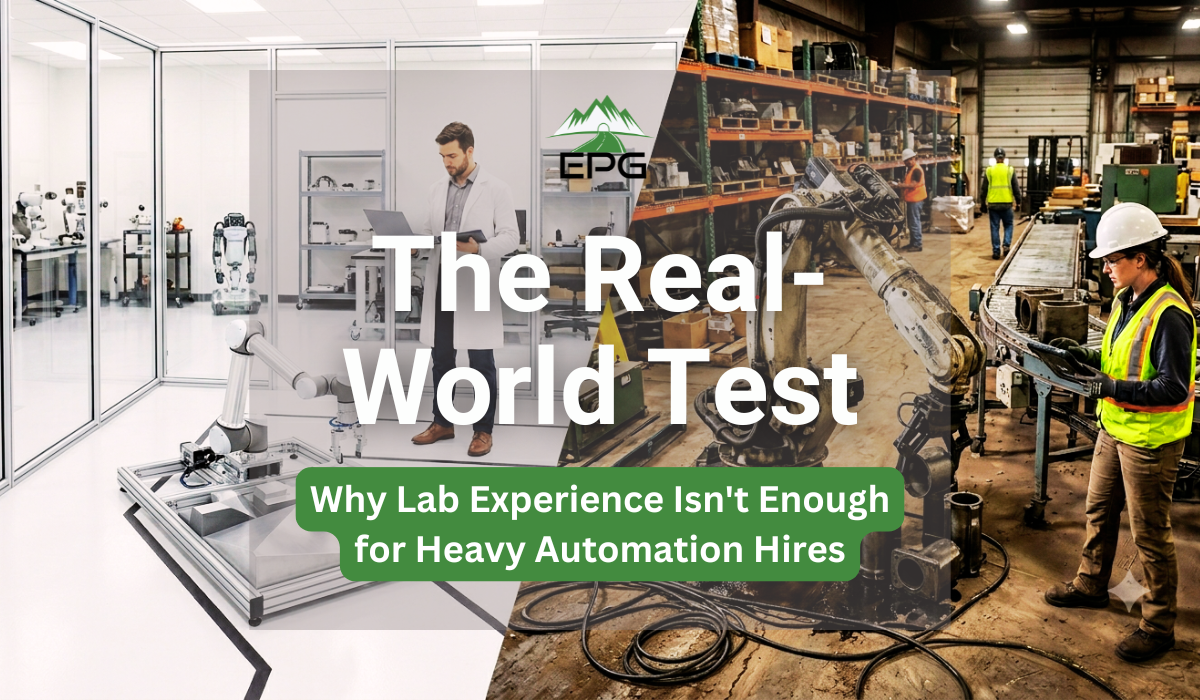
The Real-World Test: Why Lab Experience Isn’t Enough for Heavy Automation Hires
Key Takeaway
Why do robotics deployments fail in production? While “lab engineers” excel at building software simulations in controlled university environments, heavy industrial automation requires field readiness. Successful deployments demand mechatronics fluency—the ability to physically debug hardware, isolate vibrations, and manage dynamic sensor degradation on a live, unpredictable factory floor.
The transition from “Rule-Based Automation” to Physical AI has fundamentally changed what it takes to deploy a successful robotics initiative. According to the International Federation of Robotics (IFR), the current industrial landscape relies heavily on autonomous systems capable of adapting to complex, unmodeled environments in real-time.
Yet, many hiring managers face a recurring, costly bottleneck:
Recruiter pipelines are flooded with brilliant candidates who have built flawless robotic systems inside pristine, climate-controlled university labs or high-fidelity software simulators. But the moment that same system is deployed onto a dusty, vibration-heavy warehouse floor, an unmapped outdoor yard, or an unpredictable manufacturing line, it fails.
When the hardware breaks, a pure “lab engineer” often lacks the mechatronics fluency to diagnose the physical reality of the failure. For heavy automation, academic excellence and clean code are no longer enough. You need engineers built for the real world.
The Root of the “Simulation-to-Real” Talent Gap
While simulation and reality match perfectly in theory, they rarely do in practice. This persistent discrepancy is known across the robotics engineering community as the Sim-to-Real gap.
1. Software Simulation
Engineers write clean logic and validate code in perfect, idealized virtual sandboxes.
2. The Sim-to-Real Gap
Unmodeled real-world friction hits the machine: dust, dynamic vibrations, and physical wear.
3. Live Factory Floor
The system diverges from the code. A lab-bound engineer struggles to diagnose physical hardware constraints under pressure.
Engineers trained exclusively in academic or pure research settings are master integrators of digital logic. They understand how to build clean architectures in ROS 2 (Robot Operating System) and run predictive pathways in idealized virtual environments.
However, heavy automation operates in “brownfield” facilities—legacy plants with uneven floors, electrical noise, fluctuating ambient temperatures, and structural vibrations. A laboratory environment cannot replicate:
-
Dynamic Sensor Degradation: How dust buildup affects LiDAR accuracy or how ambient factory lighting blinds a computer vision system.
-
Mechanical Tolerances: How physical backlash, gear wear, and micro-slippage deviate from perfect mathematical code.
-
Operational Urgency: The high-stress reality of a down production line costing thousands of dollars per minute, requiring immediate physical triage rather than a code rewrite.
When you hire for heavy automation, you are not just hiring a software developer; you are hiring a physical systems problem-solver.
Shifting Focus to Real-World Vetting
To protect your deployment timelines and avoid costly retrofits, your technical screening process must evolve past algorithmic puzzles and simulation reviews.
The industry standard requires looking for Mechatronics Fluency – the specific intersection where digital logic meets physical actuators. The vetting strategy centers on uncovering concrete, hands-on troubleshooting experience:
How EPG Bridges the Industrial Automation Talent Rift
At EPG, we don’t use generic tech-recruiting templates. We understand that a candidate who shines in a pristine software sandbox may struggle when tasked with keeping a high-throughput logistics line operational.
Our specialized recruitment vetting process specifically filters for engineers who have earned their experience in the dirt. We bypass the surface-level keywords to look for the scars of real-world deployments – candidates who have spent nights on a factory floor debugging a stubborn communications bus, tracking down intermittent grounding issues, or redesigning an end-effector to handle unexpected real-world variations.
We connect you with “Plug-and-Play” talent possessing the rare blend of advanced software proficiency and industrial grit required to ensure your automation investments deliver measurable ROI from day one.
For a deeper look into how modern automation roles are evolving to bridge this gap across global manufacturing hubs, take a look at this insightful overview of Robotics Engineers on the Job. This video provides a realistic window into how top-tier industrial operations rely on engineers who actively bridge software logic with highly complex physical factory floors.
Frequently Asked Questions (FAQs)
1. Does this mean simulation experience is irrelevant for field robotics roles?
Not at all. High-fidelity simulation and Digital Twins are essential for modern robotics design. However, simulation should be viewed as a prerequisite, not the finish line. The ideal candidate uses simulation to validate core logic but possesses the physical insight to predict where the simulation will inevitably diverge from real-world physics.
2. How can I test for “field readiness” during a standard interview process?
Shift from abstract coding challenges to system-level failure recovery scenarios. Ask candidates to walk you through a time a physical system failed unexpectedly during deployment. Listen closely to how they diagnosed the issue: Did they immediately look at the software logs, or did they check the physical sensors, wiring harnesses, and mechanical alignments first?
3. What specific certifications indicate strong field-engineering capability?
Look for hands-on technical backgrounds or certifications in industrial automation, such as Fanuc/Kuka programming, Siemens/Beckhoff PLC certifications, and functional safety standards training (like TUV Rheinland for ISO 13849/IEC 62061). A background in competitive robotics formats like battlebots or Formula SAE also heavily correlates with exceptional physical prototyping and debugging skills under pressure.
4. Why is the shortage of field-ready engineers worse right now?
The rapid commercialization of autonomous mobile robots (AMRs), collaborative bots (cobots), and humanoid systems has caused a sudden demand spike. While universities are graduating record numbers of computer science and robotics students, these academic pipelines are heavily skewed toward software. The pool of engineers who understand software and have practical, hands-on industrial mechanical/electrical experience remains exceptionally tight.
Ready to Secure True Field-Ready Automation Talent?
Don’t let your automation projects stall out in the transition from prototype to production. Partner with a recruitment firm that speaks your technical stack and understands the brutal realities of industrial deployment.
Schedule a Consultation Call with EPG today to review your open technical pipelines, or fill out our Request Form below to tell us exactly what physical environment your machines are tackling. Let us find the engineers who can make them thrive there.
About the Author: EPG