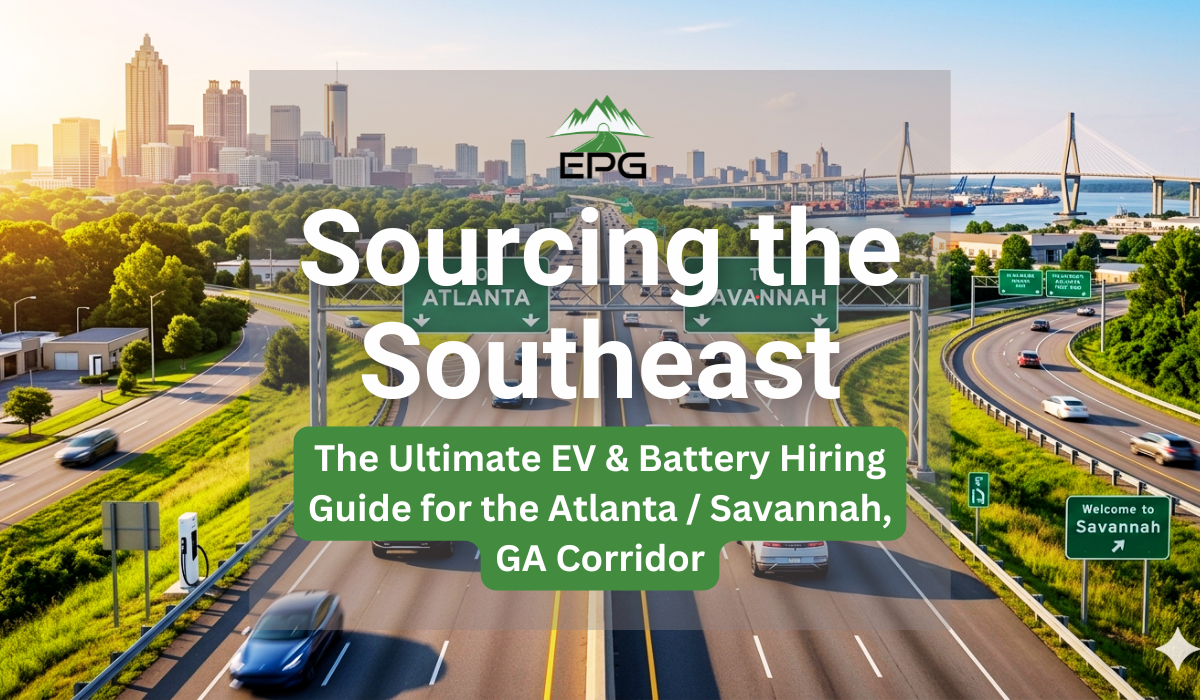
Sourcing the Southeast: The Ultimate EV & Battery Hiring Guide for the Atlanta / Savannah, GA Corridor
⚡ Quick Insights: Southeast EV & Battery Mandates
The Compliance Bottom Line: While current public job boards reflect a temporary pre-production lull, binding state economic development covenants legally obligate the region’s four major automotive and battery anchors to deliver a combined 16,630 permanent operational jobs.
Enforcement Deadlines: These contractually committed employment quotas carry rigid statutory compliance deadlines stretching between December 31, 2030, and late 2031.
Key Corporate Obligations: The hiring surges are anchored by Hyundai Metaplant America (8,500 direct roles by 2031) and Rivian Automotive (7,500 full-time roles by the end of 2030), running alongside critical parallel manufacturing ramp-ups at HL-GA Battery and Joon Georgia.
The Southeast has officially solidified its reputation as the ‘Battery Belt’ of North America. For talent acquisition teams and human resource leaders navigating EV recruitment in the Southeast, this boom brings an undeniable challenge: an unprecedented, localized crunch on technical labor. As multi-billion-dollar facilities pivot from construction to full-scale operations, the struggle to secure specialized talent is intensifying—especially across the bustling Atlanta / Savannah, GA corridor.
Understanding the regional ecosystem, recent market recalibrations, and what major players are offering is no longer just competitive intelligence; it is a requirement for survival.
The Current State of EV Recruitment in the Southeast
The localized pressure is most acutely felt in specialized advanced manufacturing sectors. Moving far beyond short-term vacancies, state-filed economic covenants legally bind the region’s major automotive and battery anchors to a combined total of over 16,600 permanent operational jobs slated for full attainment by 2030–2031. These are not general assembly jobs; they require highly precise skills in electrochemistry, cleanroom protocols, and automated quality control.
Because the skill set is so specific, employers can no longer rely on passive recruitment. Companies are forced to aggressively map pipelines from local technical colleges and out-of-state aerospace or chemical manufacturing hubs just to keep pace with demand.
Mapping the Competition & Market Pivots
To build an effective hiring strategy, talent teams must understand exactly who they are competing against for local headcount—and recognize that “EV hiring” has expanded into a broader energy transition ecosystem. The regional labor pool is being heavily shaped by four anchor commitments:
Geographic Talent Map
The Georgia I-16 Talent Pipeline Corridor
North Atlanta (Commerce / Bartow County)
Logistics & Tech Hub
Deepwater Port Base
Rivian Automotive
Social Circle, GA
Hyundai Metaplant & Kia Georgia
Bryan County & West Point, GA
Hyundai Motor Group (Metaplant America)
Located just outside Savannah in Bryan County, this massive smart-factory ecosystem is aggressively scaling its workforce for EV and hybrid lines. Backed by a multi-billion-dollar investment, Hyundai is fundamentally altering the coastal Georgia wage floor, driving immense demand for automated assembly and mechatronics talent.
Kia Georgia
Operating as a cornerstone of Georgia’s automotive legacy in West Point, Kia’s highly successful transition to localized EV assembly (such as the EV9) serves as the primary regional blueprint for workforce scaling. Their ability to rapidly upskill internal legacy manufacturing teams highlights the immense value of state-backed training infrastructure.
Rivian
With their planned footprint east of Atlanta in Social Circle, Rivian’s presence continues to draw high-level engineering, software, and consumer-tech automotive talent directly into the state, sustaining a highly competitive pipeline for cross-functional technical professionals.
SK On (SK Battery America)
Anchoring the northern end of the corridor near Commerce, as well as a massive 35 GWh joint venture plant in Bartow County, SK On has historically set the regional standard for cell manufacturing talent.
While SK Battery America executed a structural layoff of 958 production workers at its Commerce facility in March 2026 due to fluctuating automotive EV demand, HR leaders should not mistake this for a market exit. Instead, it marks a significant strategic pivot. SK On is aggressively diversifying into the Battery Energy Storage System (BESS) and stationary grid storage market, recently debuting its second-generation “Grid On” 5MWh storage technology.
The Talent Takeaway: The core competencies required for BESS manufacturing—electrochemistry, cleanroom operations, automated quality control, and advanced battery management systems (BMS)—are nearly identical to those used in automotive EV lines. SK On remains deeply committed to its $12 billion US manufacturing footprint. Rather than a pool of displaced labor, recruiters are facing an incumbent titan that is actively retaining its core technical brain trust to anchor its new grid-storage direction.
The Secret Weapon: Georgia Quick Start
When analyzing how anchors like Kia and Hyundai manage to rapidly onboard thousands of workers without bottlenecking operations, the answer invariably points to Georgia Quick Start. Consistently ranked as the nation’s top workforce training program, Quick Start provides customized, project-specific training algorithms at zero cost to qualified employers.
During Kia’s initial scaling and subsequent EV transitions, Quick Start went so far as to study operational best practices directly from overseas plants to replicate them in dedicated local training centers. For mid-tier and incoming Tier 1 suppliers, aligning your recruitment lifecycle with Quick Start’s infrastructure – and leveraging the technical colleges within the Technical College System of Georgia (TCSG) – is the fastest way to bridge the skills gap.
Regional Salary Benchmarks
To remain competitive against Tier 1 OEMs and massive cell producers, talent acquisition teams must align their compensation structures with verified regional baselines.
The following benchmarks reflect current market rates across the Atlanta/Savannah corridor.
| Job Role | Regional Salary Range | Key Skill Requirements |
|---|---|---|
| Battery Electrochemical Engineer | $95,000 – $130,000 Annual Base |
Cell degradation analysis, cathode/anode slurry chemistry, cycler testing. |
| Automation & Controls Engineer | $88,000 – $115,000 Annual Base |
PLC programming (Allen-Bradley/Siemens), SCADA systems, robotics integration. |
| Cleanroom Production Supervisor | $65,000 – $85,000 Annual Base |
ISO class environment protocols, dry room moisture monitoring, shift-log management. |
| BMS / Software Integration Engineer | $100,000 – $145,000 Annual Base |
Firmware design, CAN bus protocols, thermal management algorithms. |
| Specialized Battery Technician | $24.50 – $32.00 Per Hour |
Automated optical inspection (AOI), micro-precision welding, cleanroom safety. |
Data Methodology Note: Salary insights are synthesized from aggregated regional technical recruitment data, active localized manufacturing job board postings within the Georgia Department of Labor network, and corporate compensation filings across the automotive/energy storage sectors in the Southeast market.
3 Recruiting Strategies for EV & Battery Hiring Managers
To stand out against these industry titans, localized hiring teams need to evolve past generic job boards.
-
Leverage Joint Apprenticeships: Mimic the major players by embedding your brand directly into regional technical colleges. Don’t just show up to career fairs—fund specific certification pathways through the TCSG network to capture talent six months before graduation.
-
Offer “Cleanroom Clout” and Clear Career Ladders: Many traditional manufacturing or heavy industrial workers want to pivot to the cleaner, climate-controlled environments of modern battery facilities. Emphasize workplace safety, technical upskilling, and the long-term viability of the stationary BESS/EV storage sector to attract talent from legacy sectors.
-
Speed to Equity: With top candidates receiving multiple offers within days, shorten your interview loop. Implement automated technical assessments and offer transparent, milestone-based retention bonuses up front rather than back-loading compensation packages.
By treating workforce planning as a proactive, regional ecosystem strategy rather than a reactive HR function, companies can secure the specialized talent required to keep their production lines moving.
Frequently Asked Questions
Q: How many contractually committed jobs are mandated for the new Southeast battery and EV projects?
A: State-filed economic covenants legally bind the region’s major automotive and battery anchors to a combined total of 16,630 permanent operational jobs. While public vacancies currently show a temporary pre-production lull, these contractually obligated positions must be completely filled as factories scale to meet their statutory operation targets.
Q: What is the final hiring deadline for the Hyundai Metaplant and Rivian regional projects?
A: The legally mandated hiring quotas carry strict statutory compliance deadlines running through 2030 and 2031. Specifically, Rivian’s economic development agreement requires their 7,500 full-time jobs to be achieved by December 31, 2030, while Hyundai’s covenant targets 8,500 direct operations roles by 2031.
Q: Which manufacturing companies are legally bound by these regional economic development agreements?
A: The contractually obligated job quotas specifically govern four primary industrial anchors: Hyundai Metaplant America, the HL-GA Battery joint venture, Rivian Automotive, and Joon Georgia. Each entity is tied to distinct local infrastructure clawback provisions if their baseline hiring milestones are not met by the compliance window.
Master the Georgia EV & Battery Talent Market
Navigating the labor market of the Atlanta-to-Savannah corridor requires more than just standard sourcing tools. It requires a strategic talent partner who actively understands the local economic development mandates, state-sponsored training funnels, and shadow hiring trends playing out across the Battery Belt.
Whether you are looking to scale your technical team or simply want to discuss how these contractually bound hiring milestones will impact your 2026 workforce roadmap, EPG is here to help.
Choose Your Next Step:
-
Option 1: Schedule a Strategy Call — Click here to select a time on our calendar to discuss the local data, regional wage floors, and your next technical hire.
-
Option 2: Fill Out Our Growth Form — Submit your hiring challenges below, and our specialized automotive and energy storage team will build a custom pipeline assessment for your facility.
Let’s map the data, anticipate the trends, and secure your talent.
About the Author: EPG