Silicon Slopes, Titanium Infrastructure: Inside Salt Lake City’s Data Center Surge
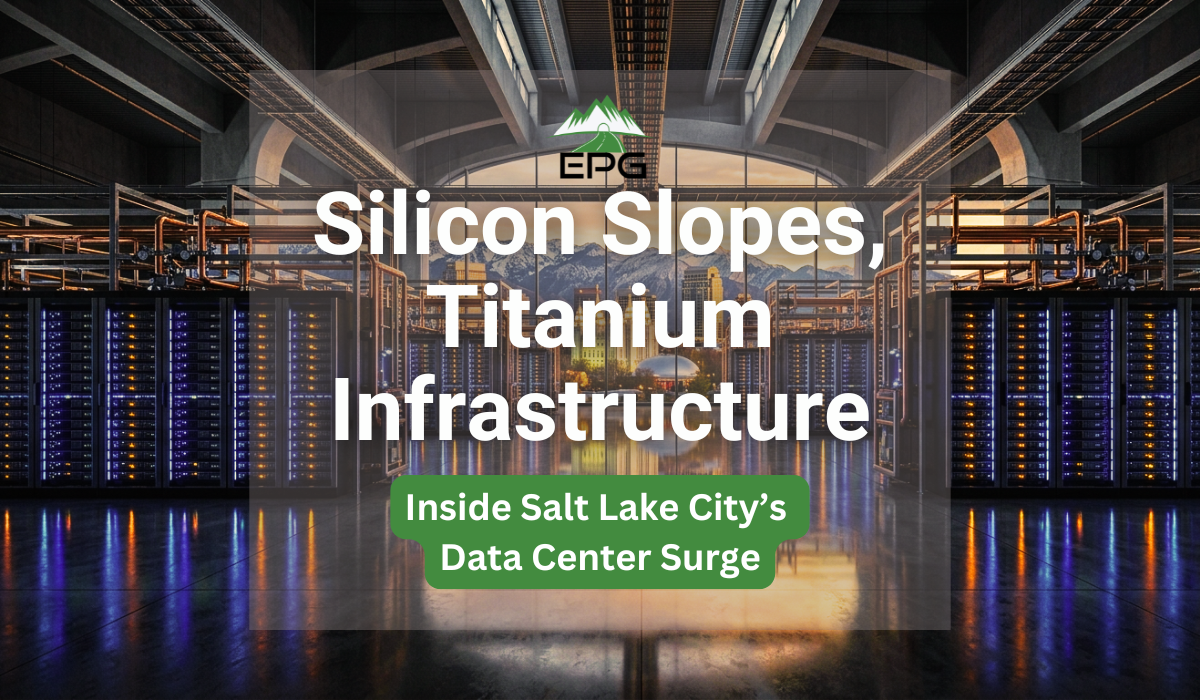
How high-density AI infrastructure, regional grid economics, and critical facilities talent constraints are transforming the Wasatch Front.
Summary
Executive Summary: Salt Lake City’s data center market is experiencing unprecedented multi-gigawatt growth, driven by shifting workloads to high-density AI computing and structural grid constraints. This comprehensive market overview details the operational footprint of leading colocation providers, hyperscalers, and network operators along the Wasatch Front, analyzing regional infrastructure advantages and acute talent gaps within critical facilities engineering, HVAC/cooling technology, and network operations.
The digital landscape of the Mountain West is undergoing a structural transformation. While Utah’s “Silicon Slopes” has long earned international recognition for its booming cloud software ecosystem and advanced semiconductor fabrication plants, a quieter, capital-intensive expansion is taking place just beneath the surface. Salt Lake City and its surrounding technical corridors – stretching from Downtown SLC to West Jordan, Bluffdale, and down to Eagle Mountain – have crystallized into one of the most vital, high-growth data center clusters in North America.
According to comprehensive data from the Kem C. Gardner Policy Institute, Utah currently anchors 48 operational data centers accounting for roughly 920 megawatts (MW) of critical IT capacity. However, the pipeline reveals the real scope of the market’s trajectory: ongoing development and planned hyperscale installations are projected to add an astonishing 2,602 MW of new capacity over the coming years. For infrastructure operators, enterprise teams, and talent acquisition leaders, this rapid scaling is altering the mechanics of regional capacity management.
Utah Data Center Critical Power Capacity (Megawatts)
Data Source: Kem C. Gardner Policy Institute Market Assessment
The AI Pivot: Designing for Dense, High-Thermal Compute
The primary vector driving this infrastructure acceleration is the industry-wide transition to Artificial Intelligence, large language models (LLMs), and high-performance computing (HPC) workflows. Legacy corporate architecture built over the past decade typically maximized floor layouts for power densities ranging between 5 kW and 15 kW per rack. In stark contrast, modern clusters running next-generation hardware demand an intense 30 kW to 100 kW+ per rack.
This massive leap in power density eliminates traditional cooling strategies. In Salt Lake City’s arid climate, leading operators are pioneering next-level engineering solutions to support these environments. Providers like Aligned, utilizing their highly adaptable, scalable cooling solutions across their extensive West Jordan footprint, allow tenants to seamlessly scale up to ultra-high densities without disruptive retrofits. Concurrently, groups like Novva Data Centers have established a blueprint for sustainable desert computing at their massive flagship campus in West Jordan, leaning heavily on waterless cooling arrays and advanced automated facility management.
Grid Stability and the Rise of Behind-the-Meter Power
As tier-1 power constraints continue to limit development timelines in traditional strongholds like Northern Virginia and Silicon Valley, Salt Lake City has capitalized on its competitive utility frameworks and geographical advantages. However, the sheer volume of megawatt capacity requested by hyperscalers means that grid access remains the ultimate bottleneck.
To circumvent utility delivery bottlenecks, developers along the Wasatch Front are moving toward innovative power delivery methods. Multi-tenant colocation giants like QTS Data Centers, which is scaling an immense hyperscale footprint in Eagle Mountain, and DataBank, anchoring the market with their highly connected Granite Point campus in Bluffdale, work in close concert with local utility partners to secure highly resilient, scalable power feeds. Enterprise operators like Oracle require similarly robust, low-fault power architectures to sustain localized cloud regions. The integration of independent power strategies, behind-the-meter generation, and dedicated substations is quickly separating dominant projects from speculative builds.
The Critical Backbone: Low-Latency Interconnection and Edge Computing
Raw power is only half of the equation; a data center requires deep, diversified network connectivity to remain viable. The Salt Lake City metro area benefits from an intersection of transcontinental long-haul fiber lines, providing exceptionally low-latency pathways to major coastal markets while remaining protected from coastal natural hazard zones.
This connectivity matrix relies on specialized network and fiber operators. Syringa Networks delivers specialized, high-availability transport infrastructure across the region, facilitating localized data transfer for regional enterprise accounts. Regional colocation footprints managed by Flexential – operating highly dependable facilities downtown and near Fair Park – bridge the gap between legacy corporate networks and dynamic multi-cloud fabrics. Furthermore, as edge networks grow to support localized real-time data processing, global innovators like Lumen Technologies and EdgeConneX are deploying advanced edge architectures and virtual routing protocols, frequently recruiting remote and field infrastructure experts out of Utah’s concentrated engineering talent pool.
The Operational Talent Bottleneck facing Hiring Managers
While the physical scale of Utah’s data center footprint is measured in millions of square feet, the ultimate long-term limiting factor is human capital. Building a multi-megawatt facility is a construction challenge; running it flawlessly with five-nines reliability (99.999% uptime) is an operational talent challenge.
Data center hiring managers across the Wasatch Front are encountering an exceptionally tight market for highly specialized infrastructure professionals. At EPG, our ongoing market tracking highlights structural talent deficits across three primary verticals:
- Critical Facilities Engineers (CFE) & Technicians: The professionals tasked with managing complex mechanical, electrical, and plumbing (MEP) systems, heavy power distribution units (PDUs), UPS arrays, and backup switchgear.
- Thermal & HVAC Systems Technicians: Individuals possessing highly specialized certifications in industrial liquid cooling, closed-loop glycol loops, and complex chillers required to sustain dense AI rack layouts.
- Network & Security Operations Operators: Cross-functional engineers capable of optimizing dense cross-connect platforms, handling complex edge routing, and strictly maintaining rigid compliance, physical access controls, and data sovereignty.
Because these facilities cannot tolerate downtime, data center operators can no longer rely on traditional broad-market job boards to find vetted talent. The struggle to secure qualified critical-environment professionals has elevated staffing from a basic human resources routine into an essential component of operational risk mitigation.
Frequently Asked Questions (FAQs)
1. Why is Salt Lake City seeing such rapid growth in data center development?
Salt Lake City offers a rare combination of structural and operational advantages: exceptionally low natural disaster risk, low-latency transcontinental fiber paths connecting coastal metros, business-friendly state tax exemptions on data center equipment, and relatively competitive power costs compared to tier-1 coastal markets. These factors make it an ideal alternative for hyperscalers and multi-tenant colocation operators looking to de-risk their infrastructure portfolios.
2. How is the rise of AI infrastructure changing data center engineering along the Wasatch Front?
AI application clusters require high-performance GPU architectures that demand up to 30 kW to 100 kW+ per rack, a steep increase from historical 5 kW enterprise baselines. This evolution requires facilities to pivot from standard forced-air cooling to highly specialized thermal strategies, including liquid-to-chip systems, closed-loop glycol architecture, and custom rear-door heat exchangers, while optimizing power distribution directly to the white space.
3. What are the most difficult roles to fill for data center operations in Utah?
The positions with the steepest talent shortages are Critical Facilities Engineers (CFEs) with direct
experience in live, mission-critical environments. Technicians who fully understand large-scale
industrial MEP systems, complex backup power structures, and modern high-density liquid cooling
infrastructure are under immense demand. Additionally, network engineers specializing in edge
architecture and low-latency cross-connects remain highly sought after.
4. Can data center providers utilize remote engineering talent to manage Utah facilities?
While top-tier network architects and security specialists can successfully manage logical network
routing, optimization, and edge compliance remotely, the physical reality of a data center requires a
highly skilled, hands-on, on-site workforce. Critical facilities engineering, preventative HVAC
maintenance, and physical hardware deployment demand a dedicated, localized team to guarantee
zero operational downtime.
Mitigate Your Operational Risk: Secure Elite Infrastructure Talent
As the Wasatch Front scales toward a multi-gigawatt ecosystem, a single vacant seat on your critical facilities team can directly impact your facility’s reliability, SLA compliance, and operational safety. Finding professionals who understand the delicate nuances of mission-critical environments requires more than a simple keyword search—it requires an expert recruitment partner who speaks the language of high-density infrastructure.
Similar to our dedicated talent advisory infrastructure across other data center corridors, EPG specializes in mapping, vetting, and delivering elite technical professionals explicitly tailored to your precise facility architecture.
Whether you are rapidly scaling a high-density AI build-out, expanding a multi-tenant colocation campus, or looking to build a highly responsive local team for remote network management, we ensure you stay fully staffed with vetted, reliable professionals.
Ready for an immediate talent market analysis? Schedule a Strategy Call with Our Critical Infrastructure Team.
To secure your mission-critical workforce, please complete our Contact Inquiry Form to outline
your technical specifications.
About the Author: EPG