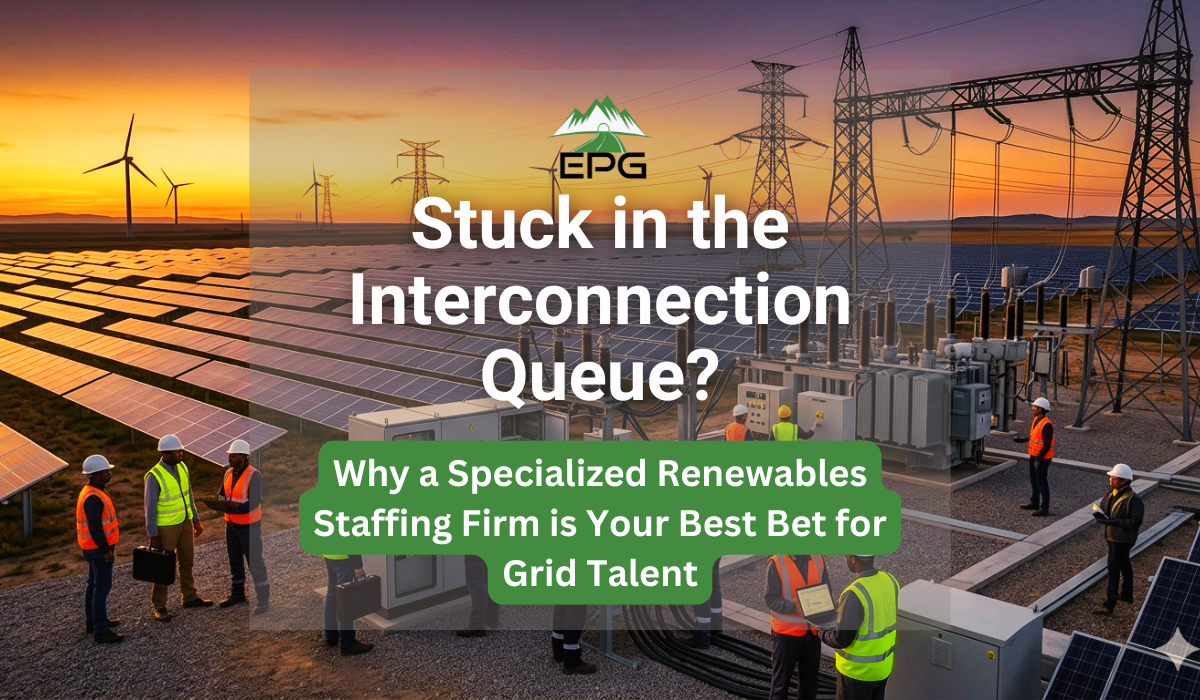
Stuck in the Interconnection Queue? Why a Specialized Renewables Staffing Firm is Your Best Bet for Grid Talent
Summary: Multi-megawatt renewable energy and energy storage projects face unprecedented delays in regional interconnection queues, with the bottleneck shifting from bureaucratic processes to a severe shortage of specialized high-voltage engineering talent. This article examines why the time-to-fill for specialized engineering and infrastructure roles frequently stretches between 60 to 120+ days, why generalist recruitment firms struggle to source these critical technical profiles, and how a specialized renewables staffing firm leverages passive talent networks to secure project timelines and mitigate development capital risks.
Clean energy developers face an environment where capital is ready, environmental permits are secured, and equipment is ordered. Yet, multi-megawatt solar, wind, and Battery Energy Storage Systems (BESS) projects sit idle.
The primary barrier to commercial operation dates (COD) is no longer capital or components; it is the grid. Nationwide, over 2.6 terawatts of generation and storage capacity are crammed into regional interconnection queues.
While regulatory overhauls like FERC Order 2023 attempt to transition grid operators to cluster studies, a deeper structural logjam remains unaddressed: the severe human capital deficit. Securing a spot in the queue requires highly specialized technical expertise, but the talent needed to clear these engineering hurdles is vanishingly scarce. To protect your portfolio from multi-year delays, relying on traditional hiring methods is a liability. Partnering with a specialized renewables staffing firm is the most effective mechanism to secure the critical grid talent your pipeline demands.
The 60-to-120-Day Visibility Gap
The grid integration bottleneck is fundamentally an engineering bottleneck. To advance a project through System Impact Studies, Facilities Studies, and substation design, developers require an elite class of technical professionals: Power Systems Engineers and Protection & Control (P&C) Engineers.
Because every developer, independent power producer (IPP), and utility is competing for the same limited pool of talent, hiring timelines have detached from historical norms. According to global talent acquisition data tracked by Workable, standard engineering roles already take an average of 62 days to fill – representing the longest vacancy period of any major occupational group.
When you elevate those requirements from general engineering to specialized utility-scale infrastructure roles, complex vetting and fierce market competition frequently push those searches out past the 90 to 120-day mark.
Average Time-to-Fill (Industry Benchmarks)
This extended vacancy window carries massive financial risk for clean energy portfolios. The Interstate Renewable Energy Council (IREC) reports in its national workforce data that nearly 90% of renewable energy employers face immense difficulty landing qualified workers, with senior project managers (47%) and engineers (30%) ranking as the absolute hardest positions to secure.
For a utility-scale asset, letting a grid integration engineering seat sit vacant for three to four months means risking critical regional study deadlines, which can result in lost power purchase agreements (PPAs) or being pushed back years in the regional interconnection queue.
Why General Engineering Recruiters Miss the Mark
When technical positions remain unfilled for months, corporate talent acquisition teams often outsource the search to large, generalist technical recruitment agencies. In the highly nuanced world of high-voltage transmission and distribution, this approach rarely succeeds.
Generalist agencies look at resumes through keyword matching rather than technical competence. Here is why that gap breaks down during the vetting process:
-
Software Sophistication vs. Basic Drafting: A general electrical engineer might be proficient in AutoCAD. However, an interconnection-grade Power Systems Engineer must possess deep, hands-on mastery of dynamic modeling and transient stability simulation using platform-specific suites like PSS/E, ETAP, or PSCAD.
-
Substation Complexity vs. Industrial Automation: General recruiters frequently confuse industrial automated controls with utility-scale Substation Protection & Control. A qualified P&C Engineer must understand complex relay coordination, SCADA integration, and telecommunications protocols specific to high-voltage interconnections.
-
Regional Market Variations: Interconnection rules are not uniform. An engineer who excels at navigating ERCOT’s rapid-load dynamics faces an entirely different regulatory framework when managing cluster studies within PJM or MISO. Generalist agencies lack the industry literacy to vet candidates for these specific regional market designs.
When generalist recruiters spend weeks presenting unviable profiles, it drains internal resources and delays project execution.
How a Specialized Renewables Staffing Firm Clears the Talent Bottleneck
A specialized renewables staffing firm treats talent acquisition as an ongoing infrastructure project rather than a reactive transaction. By aligning exclusively with the clean energy economy, niche recruiters mitigate hiring friction through specific methodologies:
1. Activating the Passive Market
The engineers capable of moving your project through an ISO’s queue are rarely actively browsing job boards or updating their public profiles. They are already employed by competing developers, utilities, or specialized consultancies. A dedicated renewable energy recruitment partner maintains direct communication channels with these passive candidates, understanding their career drivers, compensation benchmarks, and project timelines long before they consider a move.
2. Sourcing for “Time-to-Power” Metrics
In the current market, accelerating “time-to-power” is more valuable than optimizing price-per-megawatt. A specialized firm understands how to structure flexible talent solutions—such as deploying highly experienced contract Power Systems consultants to clear a specific study phase while concurrently conducting a retained search for a permanent Director of Interconnection.
3. Technical Credibility and Trust
High-voltage engineering talent is approached by recruiters daily. They routinely ignore messages that demonstrate a lack of industry knowledge. When a specialized consultant reaches out with a precise understanding of the project’s megawatt capacity, voltage class, and specific transmission constraints, candidates engage. Technical literacy builds the trust required to close critical talent gaps.
The Interconnection Takeaway: Navigating grid congestion requires a proactive talent strategy. Securing your engineering backbone concurrently with site control and early-stage permitting is essential to keep your projects bankable.
Frequently Asked Questions
Why has the time-to-hire for grid integration engineers increased so drastically?
The deployment of utility-scale solar, wind, and storage projects is outpacing the graduation rate of power engineering specialists. Additionally, the explosive power demand from industrial electrification and AI data centers has created intense competition for the exact same pool of high-voltage transmission and substation engineers.
What is the difference between a general engineering recruiter and a renewables staffing firm?
General engineering recruiters source broadly across civil, manufacturing, and basic electrical fields using keyword software. A specialized renewables staffing firm focuses exclusively on the clean energy asset lifecycle, possessing the technical literacy required to accurately vet candidates on specialized power modeling software, ISO-specific market rules, and utility-scale substation design.
Should we hire contract or permanent engineers to manage our queue strategy?
A balanced approach is usually best. For immediate, phase-specific deadlines like managing system impact studies or cluster responses, contract consultants can step in to keep the project moving. For long-term portfolio growth and managing ongoing utility relationships across multiple asset lifecycles, securing permanent, full-time engineering leadership is recommended.
Protect Your Project Timelines
Don’t let a vacant engineering seat stall your position in the interconnection queue. Whether you need to scale up contract engineering support to meet a looming study deadline or secure permanent technical leadership for your development team, we can help.
Ready to secure your project pipeline?
-
Schedule a Consultation Call with our energy recruitment directors to discuss your specific engineering needs.
-
Fill Out Our Talent Request Form to submit your open job requisitions directly to our technical vetting team.
About the Author: EPG