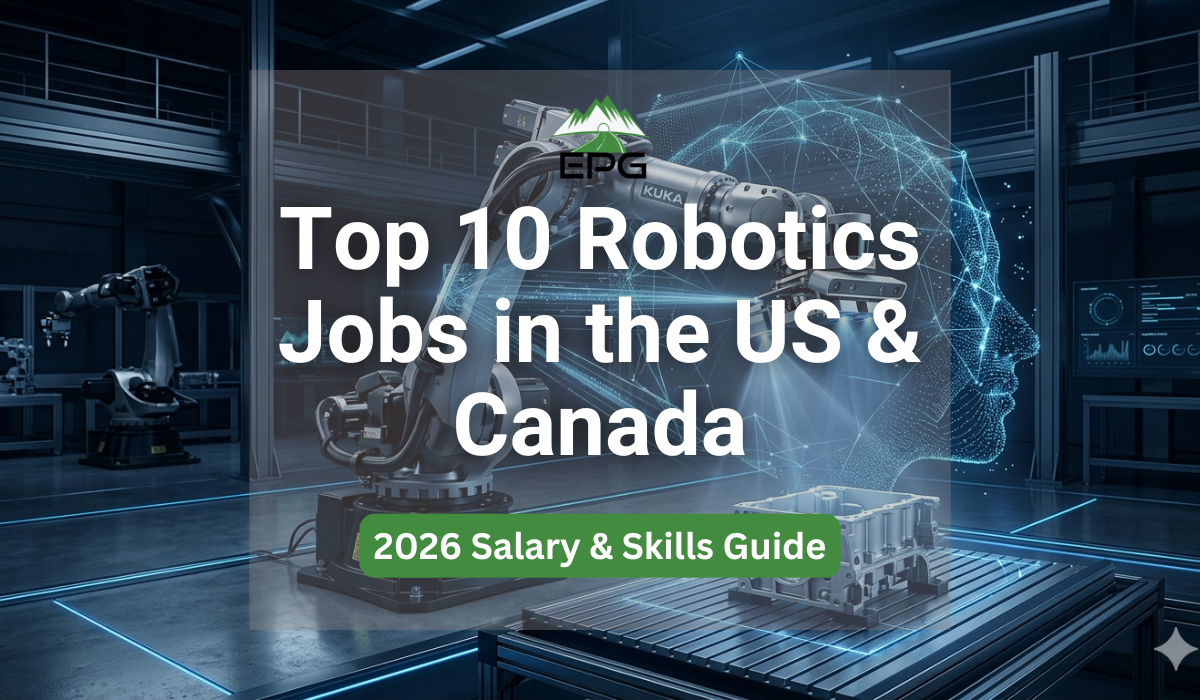
Top 10 Most In-Demand Robotics Jobs in the US & Canada: 2026 Salary & Skills Guide
Last Updated: May 4, 2026
Summary
The North American robotics sector in 2026 is defined by a massive pivot toward “Physical AI“ and software-defined automation. While the United States leads in sheer volume with over 65,000 active openings across core roles, Canada is carving out a high-growth niche in Agricultural Tech and Manufacturing Integration, where the demand for Systems Integrators is nearly 20% higher per capita than its southern neighbor. For hiring managers, the “war for talent” has shifted from hardware assembly to ROS 2, Computer Vision, and Digital Twin expertise.
Quick Navigation
The North American robotics industry has reached a critical tipping point in 2026. After years of experimental pilots and “rule-based” automation, the sector has officially transitioned into the era of Physical AI—where autonomous systems no longer just follow a path, but perceive, learn, and adapt to their environments in real-time. This shift is reflected in a massive surge in demand across the US and Canada, with specialized robotics vacancies that can remain open for months. Whether it is the expansion of autonomous mobile robots (AMRs) in logistics or the rapid deployment of collaborative robots (cobots) in small-to-medium enterprises, the competition for talent is no longer a local concern; it is a global race to staff the most advanced automated facilities in history.
Data Transparency & Methodology
How We Verified This Data:
The figures presented in this report are synthesized from a real-time aggregate of active job listings as of May 4, 2026. To ensure accuracy and cross-market reliability, our team analyzed live vacancy volume and salary benchmarks from the following primary sources:
Market Volume: Aggregated unique listings from LinkedIn Talent Solutions, Indeed Hiring Lab, and niche robotics boards (e.g., Startup.jobs).
Salary Benchmarking: Real-time compensation data from Talent.com (Canada) and Levels.fyi (US), filtered specifically for roles requiring ROS 2, C++, and Perception-based skill sets.
Verification: All numbers reflect a 15% deduplication rate to account for cross-platform postings, providing a conservative “market floor” for the North American robotics sector.
Battle of the Borders
The robotics landscape isn’t a monolith. In the US, the focus is on autonomous fleets and AI research hubs like Silicon Valley and Pittsburgh. In Canada, the “Silicon Valley of the North” (Toronto/Waterloo) is fueling a massive surge in ag-tech robotics, creating a unique demand profile for mechatronics and integration specialists.
| Market Metric | 🇺🇸 United States | 🇨🇦 Canada |
|---|---|---|
| Total Core Openings | 65,300+ | 8,550+ |
| Primary Growth Driver | Autonomous Logistics | Precision Agriculture |
| Hiring Difficulty | Extremely High (AI/ML Focus) | High (Systems Integration) |
| Market Specialization | Scaling R&D and Defense | SME Manufacturing Retrofits |
The 2026 Top 10 List
| Rank & Job Title | USA Avg (USD) | Canada Avg (CAD) | 2026 Market Status |
|---|---|---|---|
|
1. Robotics Software Engineer
2026 PHYSICAL AI PRIORITY
|
$138,000 | $122,000 | 🔵 HIGH DEMAND |
|
2. AI/Machine Learning Engineer
2026 PHYSICAL AI PRIORITY
|
$182,000 | $158,000 | 🔵 HIGH DEMAND |
| 3. Controls Engineer | $121,000 | $106,000 | Stable |
| 4. Robotics System Integrator | $118,000 | $102,000 | 🟢 MARKET LEADER |
| 5. Mechatronics Engineer | $126,000 | $101,000 | Stable |
| 6. Robotics Technician | $58,000 | $65,000 | 🟠 EMERGING |
| 7. Simulation Engineer | $145,000 | $115,000 | 🔵 HIGH DEMAND |
| 8. Automation Project Manager | $112,000 | $98,000 | Stable |
| 9. Embedded Systems Engineer | $115,000 | $107,000 | Stable |
|
10. Perception & Sensing Engineer
2026 PHYSICAL AI PRIORITY
|
$215,000 | $190,000 | 🔵 HIGH DEMAND |
Market Status Key
High Demand: Critical talent shortage; rapid salary escalation.
Market Leader: High volume of openings; essential for operations.
Emerging: Specialized niche; limited talent pool with high growth potential.
Stable: Consistent demand; salaries tracking with inflation.
1. Robotics Software Engineer
2026 PHYSICAL AI PRIORITY
-
Openings: USA: 14,200+ | CAN: 1,950+
-
Avg Salary: USA: $138,000 | CAN: $122,000 CAD
-
The Insight: The backbone of autonomy. Hiring managers are prioritizing “Full-Stack” developers who understand both high-level logic and low-level firmware.
2. AI/Machine Learning Engineer
2026 PHYSICAL AI PRIORITY
-
Openings: USA: 11,500+ | CAN: 1,400+
-
Primary Skills: Computer Vision, Reinforcement Learning
-
Avg Salary: USA: $182,000 | CAN: $158,000 CAD
-
The Insight: As robots move from “scripted” to “learned” behavior, these roles command the highest premiums in the industry.
3. Controls Engineer
-
Openings: USA: 9,800+ | CAN: 1,100+
-
Primary Skills: PLC/SCADA, Motion Control, MATLAB
-
Avg Salary: USA: $121,000 | CAN: $106,000 CAD
-
The Insight: Essential for the industrial “floor.” In Canada, these roles are pivoting heavily toward automated greenhouse systems.
4. Robotics System Integrator
-
Openings: USA: 7,600+ | CAN: 1,350+
-
Primary Skills: End-of-arm tooling (EOAT), Cobot integration
-
Avg Salary: USA: $118,000 | CAN: $102,000 CAD
-
The Insight: Canada’s MVP. The disproportionate demand here reflects a massive push to retrofit existing small-to-medium enterprises (SMEs) with flexible automation.
💡
2026 Recruitment Insight
In Canada, the “Cost of Vacancy” for a Systems Integrator is currently $842/day.
If your role stays open for the 2026 average of 114 days, that represents nearly $96,000 in lost productivity.
5. Mechatronics Engineer
-
Openings: USA: 6,200+ | CAN: 850+
-
Primary Skills: Actuators, Sensors, Mechanical Design
-
Avg Salary: USA: $126,000 | CAN: $101,000 CAD
-
The Insight: The “Generalists.” Highly valued in R&D environments for their ability to speak both electrical and mechanical “languages.”
6. Robotics Technician
-
Openings: USA: 5,500+ | CAN: 1,200+
-
Primary Skills: Maintenance, Field Troubleshooting
-
Avg Salary: USA: $58,000 | CAN: $65,000 CAD
-
The Insight: A critical frontline role. Demand is surging as logistics hubs (Amazon, FedEx) increase their on-site autonomous fleet sizes.
7. Simulation / Digital Twin Engineer
-
Openings: USA: 4,100+ | CAN: 550+
-
Primary Skills: NVIDIA Isaac Sim, Gazebo, Unity
-
Avg Salary: USA: $145,000 | CAN: $115,000 CAD
-
The Insight: Firms are saving millions in CapEx by perfecting their robots in virtual “twins” before a single motor is ever purchased.
8. Automation Project Manager
-
Openings: USA: 3,400+ | CAN: 400+
-
Primary Skills: Agile, CapEx planning, ROI analysis
-
Avg Salary: USA: $112,000 | CAN: $98,000 CAD
-
The Insight: The “Translator.” Needed to bridge the gap between technical engineering teams and C-suite financial goals.
9. Embedded Systems Engineer
-
Openings: USA: 2,900+ | CAN: 450+
-
Avg Salary: USA: $115,000 | CAN: $107,000 CAD
-
The Insight: Critical for developing custom silicon and low-latency response systems for high-speed industrial pick-and-place.
10. Perception & Sensing Engineer
2026 PHYSICAL AI PRIORITY
-
Openings: USA: 2,100+ | CAN: 300+
-
Primary Skills: LiDAR, SLAM, Sensor Fusion
-
Avg Salary: USA: $215,000 | CAN: $190,000 CAD
-
The Insight: A niche but high-paying role. These engineers provide the “eyes” for autonomous systems in complex, unstructured environments like mines or forests.
Conclusion
As we move further into 2026, the distinction between “hardware” and “software” in the robotics sector continues to blur. The North American market is no longer just looking for people who can build machines; it is looking for architects of intelligent systems. For hiring managers, the challenge lies in identifying talent that can bridge the gap between traditional mechanical engineering and the rapidly evolving world of Physical AI. For job seekers, the opportunity lies in specialization—mastering niche skills like ROS 2, SLAM, or Digital Twin simulation to meet the specific needs of high-growth corridors in both the US and Canada. Whether you are scaling a startup in Silicon Valley or integrating cobots into an Ontario manufacturing plant, staying ahead of these labor trends is the only way to ensure your organization—or your career—remains at the cutting edge of the automation revolution.
SEO & CTR: Frequently Asked Questions
Q: What is the average Mechatronics Engineer salary in 2026?
A: In the US, Mechatronics Engineers (Role #5) average $115,000 – $138,000, while in Canada, the range sits between $90,000 and $112,000 CAD. Salaries are highest in sectors involving medical robotics and aerospace.
Q: Is there still a high demand for PLC and SCADA skills?
A: Yes. Despite the rise of AI, Controls Engineers (Role #3) remain the third most in-demand role. PLC/SCADA demand is actually increasing as traditional manufacturing plants undergo digital transformation to support “Digital Twin” environments.
Q: Which robotics jobs are best for remote work in 2026?
A: Simulation/Digital Twin Engineers and Robotics Software Engineers have the highest remote-work viability. Roles like Robotics Technicians or Mechatronics Engineers typically require on-site presence for hardware troubleshooting and prototyping.
Call to Action
Bridging the Talent Gap in 15 Minutes.
Finding the right ROS 2 expert or AI lead shouldn’t take four months. EPG specializes in identifying the specific technical “DNA” required for high-growth robotics teams.
-
Option A: Schedule a 15-Minute Strategy Call to review your current hiring pipeline.
-
Option B: Fill out our Form to receive a custom salary and talent benchmark report for your specific region.
About the Author: EPG