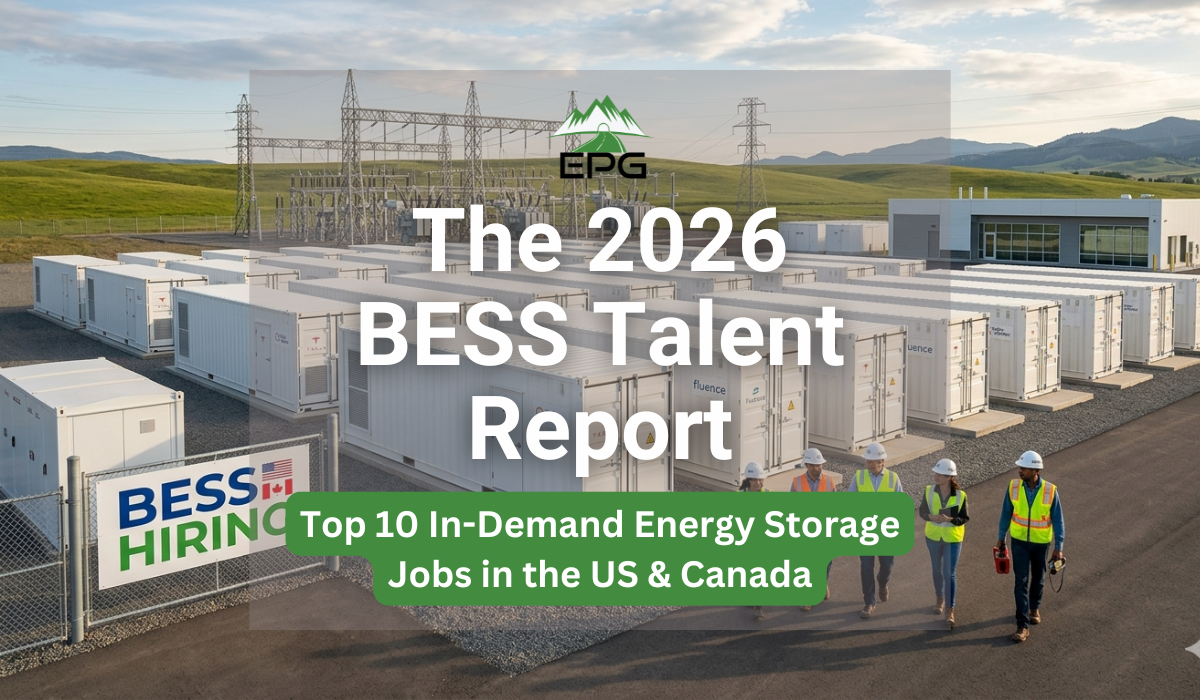
The 2026 BESS Talent Report: Top 10 In-Demand Energy Storage Jobs in the US & Canada
Summary
The Battery Energy Storage System (BESS) sector in 2026 is defined by a striking structural talent shortage that directly impacts project lifecycles. This comparative report analyzes current talent data across the United States and Canada, identifying critical engineering and management hiring bottlenecks. While the US leads in raw job volume, Canada exhibits disproportionately high demand relative to its overall market size, driven by massive provincial clean energy procurements and stringent regulatory environments. Managing project risk in 2026 requires understanding these regional labor dynamics and capitalizing on cross-industry transferable skill pipelines.
Quick Navigation
The Battery Energy Storage System (BESS) sector across the United States and Canada is experiencing unprecedented deployment acceleration. However, this historic build-out faces a critical point of failure: a severe, structural shortage of specialized talent. For hiring managers, executive leaders, and talent acquisition teams, understanding these workforce dynamics is no longer just a human resources objective—it is a core project risk management strategy.
This report outlines the top 10 in-demand BESS roles across North America, mapping active job openings based on literal, exact-match job board listings, core technical micro-niches, and cross-industry transferable skill pipelines to help organizations stabilize their talent supply chains.
Data Transparency & Methodology
How We Verified This Data:
The figures presented in this report are synthesized from a real-time aggregate of active job listings as of June 2026. To ensure accuracy and cross-market reliability, our team analyzed live vacancy volume and salary benchmarks from the following primary sources:
Market Volume: Aggregated unique listings from LinkedIn Talent Solutions, Indeed Hiring Lab, and niche clean energy tech recruiting channels.
Salary Benchmarking: Real-time compensation data from self-reported engineering platforms (such as Levels.fyi and 6figr), filtered specifically for utility-scale BESS deployments requiring SCADA, LFP sourcing, and multi-modal thermal management skill sets.
Verification: All numbers reflect a 15% deduplication rate to account for cross-platform postings, providing a conservative “market floor” for the North American BESS hiring landscape.
Battle of the Borders: The 2026 Regional Talent Benchmark
The following visual comparison details active, exact-match job board listings across major North American job aggregates. While the United States controls the absolute volume, the Canadian labor market shows intense talent competition. Notably, Canada’s ratio of open job listings to active megawatts under development significantly outpaces the US in field operations, compliance, and systems engineering.
BESS Job Openings: USA vs. Canada
| Market Metric | 🇺🇸 United States | 🇨🇦 Canada |
|---|---|---|
| Total Core Openings | 7,150+ | 960+ |
| Primary Growth Driver | Utility-Scale Grid Interconnection & Data Center Demands | Provincial Clean Energy Procurements & Remote Grid Instability |
| Hiring Difficulty | Extremely High (Power Systems & Field Hardware) |
High (Cross-Border Compliance Specialists) |
| Market Specialization | SCADA, High-Voltage Substation Integration & Asset Management | NFPA 855 Certification, Indigenous Co-Ownership, & Severe Weather O&M |
Market Deep Dive: Core Profiles, Salaries, and Transfer Pipelines
| Rank | Job Title | USA Avg (USD) | Canada Avg (CAD) | 2026 Market Status |
|---|---|---|---|---|
| 1 | Energy Storage Project Manager 2026 PRODUCTION PRIORITY | $150,000 | $137,500 | 🔴 Production Priority |
| 2 | BESS Commissioning Engineer 2026 PRODUCTION PRIORITY | $165,000 | $142,500 | 🔴 Production Priority |
| 3 | Field Service Technician (BESS) | $90,000 | $82,500 | ⚙️ Infrastructure Expansion |
| 4 | Battery Management System (BMS) Eng. | $160,000 | $132,500 | ⚙️ Infrastructure Expansion |
| 5 | Interconnection Engineer | $155,000 | $136,500 | 💎 Specialized Scarcity |
| 6 | BESS Applications Engineer | $130,000 | $115,000 | 📈 Commercial Scale-Up |
| 7 | Safety & Quality Engineer | $140,000 | $125,000 | 🛡️ Compliance Target |
| 8 | BESS Procurement Manager | $140,000 | $122,500 | 📦 Supply Chain Buffer |
| 9 | Asset Management Director | $190,000 | $167,500 | ⏳ Lifecycle Priority |
| 10 | Thermal Management Engineer | $147,500 | $132,500 | 🔥 Engineering Niche |
💵 Currency & Compensation Note: Salary distributions correspond to local market currencies (USD for United States listings; CAD for Canadian listings) based on aggregated 2026 hiring metrics across LinkedIn, Indeed, and clean energy sector databases. Reported brackets represent base salary distributions from the 25th to 75th percentiles and do not account for equity incentives, project milestone bonuses, field mobilization per diems, or remote travel premiums.
BESS Market Status Key
The Canadian Demand Anomaly
While Canada’s total installed utility storage capacity is smaller than that of the US, the Canadian pipeline is scaling with extreme velocity. Rapid provincial clean energy procurements (such as Ontario’s multi-gigawatt build-outs) have triggered a localized talent crunch. Because Canadian projects face unique environmental constraints and high rates of Indigenous co-ownership, roles like Energy Storage Project Managers and Safety & Quality Engineers require highly specialized local policy expertise, making them harder to fill than generic equivalents in the US.
1. Energy Storage Project Manager
2026 PRODUCTION PRIORITY
-
Primary Skills: EPC contract management, MS Project/Primavera P6, multi-stakeholder permitting, change-order tracking, utility interconnection sequencing.
-
Salary Benchmarks (2026):
-
USA: $130,000 – $170,000 USD Base
-
Canada: $120,000 – $155,000 CAD Base
-
-
Transferable Skills Pipeline: Project managers from utility-scale solar (PV), traditional wind energy, or heavy civil infrastructure transition smoothly into BESS, provided they are upskilled on battery safety parameters.
2. BESS Commissioning Engineer
2026 PRODUCTION PRIORITY
-
Primary Skills: System Acceptance Testing (SAT), Factory Acceptance Testing (FAT), high-voltage testing tools, PSS®E, substation automation.
-
Salary Benchmarks (2026):
-
USA: $140,000 – $190,000 USD Base (plus field mobilization bonuses)
-
Canada: $125,000 – $160,000 CAD Base (plus remote travel premiums)
-
-
Transferable Skills Pipeline: Look to automation specialists and field engineers from traditional oil & gas, pulp and paper, or heavy mining sectors who are highly adept at complex industrial field deployments.
SCADA & Grid Synchronization
The requirement for SCADA demand literacy is a major hurdle in both nations. A commissioning engineer must possess deep knowledge of utility-scale Supervisory Control and Data Acquisition (SCADA) programming to ensure that massive battery assets synchronize safely with the grid without triggering regional voltage instability.
3. Field Service Technician (BESS)
-
Primary Skills: Preventive maintenance (O&M), high-voltage electrical troubleshooting, component-level replacement, thermal loop fluid checks, arc flash safety.
-
Salary Benchmarks (2026):
-
USA: $75,000 – $105,000 USD Base
-
Canada: $70,000 – $95,000 CAD Base
-
-
Transferable Skills Pipeline: Industrial electricians, military avionics technicians, wind turbine technicians, and heavy equipment mechanics possess the baseline high-voltage safety practices required for field diagnostic work.
4. Battery Management System (BMS) Engineer
-
Primary Skills: Embedded C/C++, firmware architecture, functional safety (ISO 26262), hardware-in-the-loop (HIL) testing, cell configuration profiles.
-
Salary Benchmarks (2026):
-
USA: $135,000 – $185,000 USD Base
-
Canada: $115,000 – $150,000 CAD Base
-
-
Transferable Skills Pipeline: Target software and firmware developers from the passenger electric vehicle (EV) sector, consumer electronics, or aerospace industries who understand low-level code and embedded hardware interfaces.
State of Charge (SOC) Optimization
BMS positions require specialized expertise in State of Charge (SOC) and State of Health (SOH) algorithm development. Accurate SOC estimation directly impacts cell longevity, system safety, and the commercial monetization of the asset.
5. Interconnection Engineer
-
Primary Skills: Utility compliance engineering, power flow modeling, ISO/RTO queue navigation, IEEE 1547-2018 standards, transient stability studies.
-
Salary Benchmarks (2026):
-
USA: $130,000 – $180,000 USD Base
-
Canada: $118,000 – $155,000 CAD Base
-
-
Transferable Skills Pipeline: Power systems engineers working directly for regional utilities, transmission organizations, or traditional thermal power plants have the exact baseline needed to run transmission capacity models.
6. BESS Applications Engineer
-
Primary Skills: System sizing, MATLAB/Simulink modeling, commercial proposal generation, augmentation strategy mapping, technical sales support.
-
Salary Benchmarks (2026):
-
USA: $115,000 – $145,000 USD Base
-
Canada: $100,000 – $130,000 CAD Base
-
-
Transferable Skills Pipeline: Technical sales engineers from industrial HVAC systems, commercial solar developers, or power distribution hardware manufacturers.
7. Safety & Quality Engineer
-
Primary Skills: NFPA 855 compliance management, UL 1973/UL 9540 hazard mitigation, fire suppression system auditing, root-cause failure analysis (RCFA).
-
Salary Benchmarks (2026):
-
USA: $125,000 – $155,000 USD Base
-
Canada: $110,000 – $140,000 CAD Base
-
-
Transferable Skills Pipeline: Risk assessment and environment, health, and safety (EHS) specialists from chemical manufacturing, oil refineries, or data center operations are highly proficient in handling complex fire suppression and hazard mitigation architectures.
NFPA 855 Compliance & Fire Suppression
Total mastery of NFPA 855 (Standard for the Installation of Stationary Energy Storage Systems) and testing standards like UL 1973 is non-negotiable. Professionals with these credentials hold significant leverage in the current labor market.
8. BESS Procurement Manager
-
Primary Skills: Strategic cell/enclosure sourcing, EPC equipment contract negotiation, vendor risk logistics, global shipping tracking.
-
Salary Benchmarks (2026):
-
USA: $120,000 – $160,000 USD Base
-
Canada: $105,000 – $140,000 CAD Base
-
-
Transferable Skills Pipeline: Supply chain professionals from the automotive EV market, semiconductor procurement, or global electronics manufacturing who are used to managing fragile cross-border vendor ecosystems.
LFP Sourcing & FEOC Realities
US procurement is highly focused on navigating Foreign Entity of Concern (FEOC) restrictions to lock down domestic clean energy tax credits, while Canadian sourcing managers focus heavily on global supply chains for Lithium Iron Phosphate (LFP sourcing). Both markets demand absolute verification of trace-back documentation to ensure regulatory compliance.
9. Asset Management Director
-
Primary Skills: Portfolio ROI optimization, battery degradation modeling, market dispatch strategy analytics, capacity guarantees management.
-
Salary Benchmarks (2026):
-
USA: $160,000 – $220,000 USD Base
-
Canada: $145,000 – $190,000 CAD Base
-
-
Transferable Skills Pipeline: Financial analysts or operational managers from independent power producers (IPPs), digital infrastructure/data center portfolios, or quantitative energy trading desks.
10. Thermal Management Engineer
-
Primary Skills: Liquid cooling loop optimization, Computational Fluid Dynamics (CFD), ANSYS/Star-CCM+ tools, structural heat transfer evaluation.
-
Salary Benchmarks (2026):
-
USA: $130,000 – $165,000 USD Base
-
Canada: $115,000 – $145,000 CAD Base
-
-
Transferable Skills Pipeline: Thermal engineers from high-performance aerospace computing, automotive EV powertrain cooling, or liquid-cooled data center server architectures.
Liquid Cooling & CFD Modeling
Expertise in liquid cooling loop design and high-level CFD modeling is essential to optimize enclosure airflow and temperature uniformity across thousands of cells, directly preventing localized degradation.
🏢 The Major Players: Who is Hiring in 2026?
The technical recruitment landscape is anchored by a mix of utility-scale project developers, independent power producers (IPPs), clean-tech hardware integrators, and software innovators transforming how power interacts with the grid.
🇺🇸 The United States Powerhouses
In the US, hiring is heavily concentrated around massive commercial scaling, multi-gigawatt-hour site engineering, and advanced algorithmic dispatch software designed to interface with regional grids like ERCOT and CAISO.
-
Tesla Energy: A massive, non-stop hiring engine for its Megafactory operations. Tesla continuously pulls elite Quality Systems Engineers, Battery Thermal Management Specialists, and Manufacturing Controls Engineers to scale its utility-grade Megapack production and deploy its proprietary asset trading software.
-
Fluence Energy: A pure-play powerhouse formed as a joint venture between Siemens and AES. Bolstered by a record-breaking multi-billion-dollar backlog, Fluence is a primary employer for Power Systems Engineers, Grid-Forming Tech Experts, and Software Developers tasked with advancing their AI-driven bidding platforms.
-
NextEra Energy Resources: As the largest renewable developer globally, NextEra is a constant vacuum for engineering talent. They actively recruit BESS Interconnection Engineers, High-Voltage Substation Specialists, and Project Managers capable of executing massive hybrid solar-plus-storage infrastructures.
-
FlexGen Power Systems & Vistra Corp: Key giants driving physical grid optimization. FlexGen, having aggressively scaled after acquiring Powin’s asset portfolio, frequently recruits Integration Engineers, SCADA Specialists, and Lifecycle Service Technicians, while Vistra consistently hires for asset optimization, power trading, and battery plant operations.
🇨🇦 The Canadian Hubs of Innovation
Hiring in Canada is centered tightly around massive capacity procurements in Ontario (via the IESO), merchant market growth in Alberta, and clean-tech engineering hubs specialized in battery lifecycles and cold-weather integration.
-
Brookfield Renewable Partners: A global infrastructure titan based in Toronto. Brookfield is aggressively expanding its domestic and international storage footprint, acting as a premier destination for Project Developers, Asset Managers, and Grid Integration Leads.
-
TERIC Power, Capital Power & TransAlta: The driving forces of Western Canada’s merchant energy market. Calgary-based TERIC is a major destination for power systems innovators, while traditional power generation leaders Capital Power and TransAlta continuously hire local Electrical Engineers and Regulatory Compliance Specialists to manage large-scale grid hybridization.
-
EVLO Energy Storage (Hydro-Québec): A specialized utility-scale technology developer operating out of Quebec. Backed by the institutional weight of Hydro-Québec, EVLO heavily recruits Power Electronics Engineers, Mechanical Designers, and Software Integration Leads to deliver large-scale, high-safety LFP systems.
-
Moment Energy: A high-growth Vancouver clean-tech standout focused on circular economy solutions. Moment is a premier employer for BMS (Battery Management System) Software Developers, Compliance Engineers, and Manufacturing Technicians dedicated to repurposing retired EV batteries into commercial-grade storage.
Conclusion
As we navigate through 2026, the boundaries defining grid-scale physical infrastructure and advanced battery optimization software continue to blend. The North American market is no longer looking for generalist engineers; it requires architects of highly complex, integrated energy systems.
For hiring managers, the primary obstacle remains finding talent that bridges the gap between low-level hardware safety constraints and high-level grid integration software. For candidates, the key to building career leverage lies in mastering specific niche tools—whether that means NFPA 855 compliance architectures, high-performance liquid cooling systems, or advanced SCADA telemetry. Staying attuned to these cross-border talent flows is the only definitive way to keep your energy storage organization at the cutting edge of the clean energy revolution.
FAQs
What is driving the high SCADA demand in the 2026 BESS sector?
As utility grids integrate a higher percentage of intermittent renewables (solar and wind), regional operators demand faster response times from energy storage facilities. SCADA systems serve as the primary communications interface. Professionals who can program complex SCADA logic for multi-megawatt systems are crucial for preventing grid sync failures and ensuring compliance with modern ISO/RTO telemetry standards.
What is the average BESS Commissioning Engineer salary in 2026?
In 2026, the average base salary for a mid-to-senior BESS Commissioning Engineer in the United States is $140,000 to $190,000 USD. In Canada, base salaries range from $125,000 to $160,000 CAD. Due to a severe national shortage of field validation talent, these roles frequently include lucrative field mobilization bonuses, per diems, and retention incentives that can increase total compensation by 20% to 30%.
How do BESS job openings in the USA vs. Canada compare in terms of candidate availability?
While the United States has a higher total volume of absolute job openings, Canada features a tighter talent market relative to its overall grid size. Rapid utility-scale procurement waves in provinces like Ontario and Alberta have outpaced the organic growth of the local clean-energy workforce. Consequently, Canadian developers must rely more heavily on cross-industry talent transfers from the oil, gas, and mining sectors compared to their US counterparts.
Secure Your 2026 BESS Talent Pipeline
Mitigating project risk means securing specialized talent long before your commissioning dates arrive. Whether you are dealing with critical engineering vacancies or preparing your regional EPC execution strategy, EPG knows your talent acquisition approach must be data-driven.
Ready to stabilize your workforce pipeline?
-
Option 1: Schedule a direct, 15-minute consultation with our energy storage workforce experts to map out your localized hiring strategy.
-
Option 2: Submit your specific hiring goals using our secure Talent Intake Form below to receive a curated assessment of available candidate pipelines in your immediate region.
About the Author: EPG