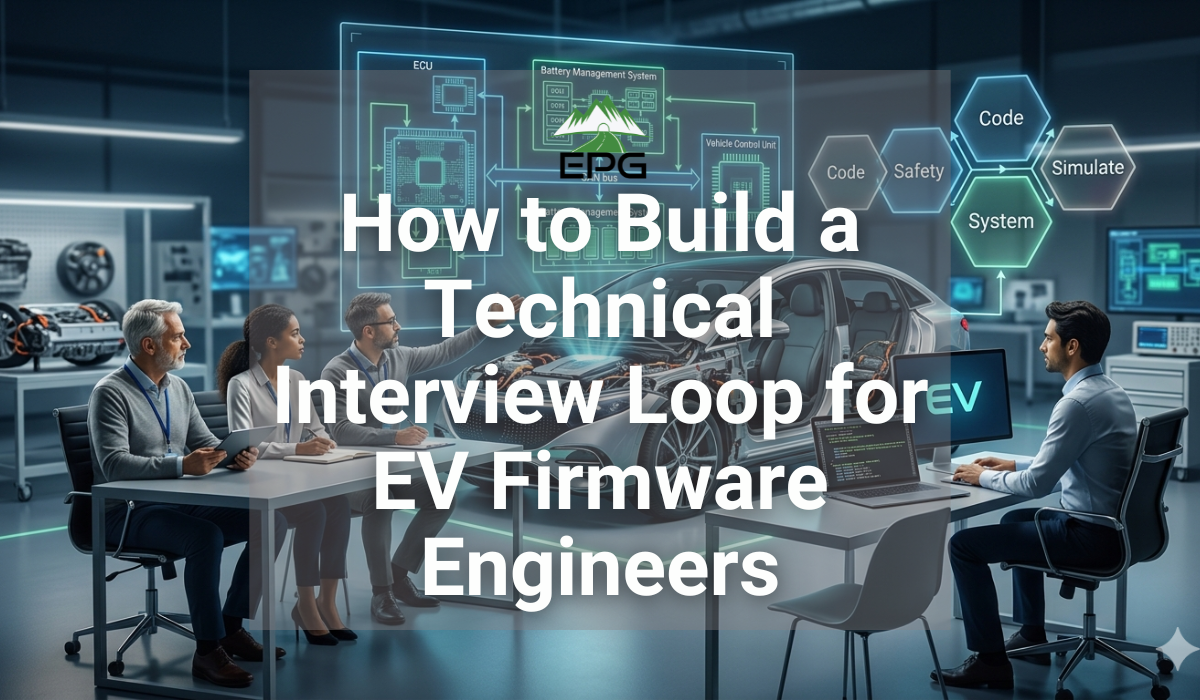
How to Build a Technical Interview Loop for EV Firmware Engineers
Snapshot: Hiring EV Firmware Engineers in 2026
The 2026 automotive market is defined by a “Structural Skills Gap” as vehicles transition into “Physical AI” platforms. Software and firmware faults have become the leading cause of high-risk recalls, with over 8.6 million vehicles affected in Q4 2025 alone. For HR and hiring managers, the challenge is no longer just finding a coder; it’s identifying “bilingual” talent proficient in both low-level C++ and the rigorous safety standards required to prevent multi-billion dollar liabilities.
In the current landscape of Software-Defined Vehicles (SDVs), the “brain” of the car—the firmware—is what differentiates a market leader from a catastrophic recall statistic.
As of February 2026, we are seeing the real-world consequences of firmware gaps. Ford recently issued a massive recall of 4.38 million vehicles (including the F-150 and Maverick) due to a software defect in the Integrated Trailer Module (ITRM). The glitch causes a communication loss at startup, potentially disabling trailer brakes and lights. This is a vivid reminder: in the EV sector, a “minor bug” is a major safety crisis.
At EPG, we’ve seen this talent convergence firsthand. To hire successfully, your interview process must be designed to filter for engineers who can prevent these specific failures. Here is how to build a high-signal interview loop for the 2026 market.
Phase 1: The “Bilingual” Technical Screen (45 Minutes)
The goal is to determine if the candidate understands the “handshake” between hardware and software. EV firmware must be deterministic; if a brake command is sent, it cannot wait for a UI update.
Key 2026 Competencies:
-
RTOS & Determinism: Ask, “How do you handle interrupt latency in a mission-critical system to ensure real-time execution?”
-
Memory Management: In resource-constrained environments, “spaghetti code” leads to system crashes. Evaluate their use of static vs. dynamic memory allocation.
-
Communication Protocols: Ask them to describe how they would implement a CAN message priority map to ensure a powertrain signal isn’t delayed by a non-critical command.
Phase 2: The “Edge Case” Audit (Safety & Standards)
This is where you separate the generalists from the automotive professionals. In light of recent 2026 recalls, your engineers must live and breathe ISO 26262.
- The Startup Scenario: Referencing the recent Ford ITRM recall, ask: “How do you validate communication integrity between a peripheral module and the central Gateway during a ‘cold boot’ or startup sequence?”
- The ASIL-D Deep Dive: EV firmware engineers should be able to categorize risks using ASIL (Automotive Safety Integrity Level). A senior candidate must explain how they design a “Fault Flow” that drives a vehicle into a safe state if a watchdog timer detects a freeze in the High Voltage Battery system.
Phase 3: The Work Sample (Simulation & Debugging)
Rather than abstract puzzles, give them a scenario that mirrors 2026 technical challenges, such as AI-assisted debugging or OTA (Over-the-Air) regression testing.
Example Exercise: The BMS Optimization
-
The Prompt: “You have a Battery Management System consuming too much power during ‘Sleep Mode.’ Walk us through your process for implementing a low-power wake-up mechanism using GPIO interrupts.”
-
What to evaluate: Did they mention DMA (Direct Memory Access) to save CPU cycles? Did they consider the thermal management implications of their code?
Phase 4: The Cross-Functional “V-Model” Collaboration
Modern EV development follows the V-Model, where firmware sits between hardware designers and cloud teams.
The Scenario Interview: Evaluate their ability to explain technical root causes—like a race condition or memory leak—to non-technical stakeholders. In a world where Software-Defined Vehicles are the norm, a firmware engineer must be able to collaborate with UX designers and hardware engineers simultaneously.
2026 Hiring Trends: The Cost of the Wrong Hire
With software-related recalls surging by over 35% in the last two years, the “cost per hire” is nothing compared to the “cost per recall.” High-performing EV firmware engineers are often off the market in 10 days. A streamlined, 4-phase loop allows you to move at the speed of the market without sacrificing the technical rigor required for the road.
Frequently Asked Questions
1. How do I know if a candidate actually understands ISO 26262?
Ask them to describe a “Safety Case” they have built. If they cannot discuss HARA (Hazard Analysis and Risk Assessment) or defining “Safety Goals,” they likely lack the experience for safety-critical roles.
2. Why is the “Integrated Trailer Module” recall so relevant for firmware hiring?
It highlights a “startup communication” failure – a classic firmware edge case. Testing for these specific startup sequences is a benchmark for a high-quality firmware engineer.
3. Is C++ still the standard in 2026, or is Rust taking over?
While C remains vital for low-level drivers, modern SDVs are increasingly moving toward modern C++ and Rust for better memory safety. Look for candidates who understand why memory-safe languages are becoming a requirement for ISO 26262 compliance.
4. Should we prioritize “Domain Experience” over “General Coding”?
In 2026, you need both. However, it is easier to teach an expert coder the specifics of the CAN bus than it is to teach a hardware engineer how to write modern, scalable software architectures.
Ready to Scale Your EV Engineering Team?
Building the loop is only half the battle; finding the talent to put into that loop is the real challenge. At EPG, we specialize in sourcing the “bilingual” engineers who prevent recalls before they happen.
Want to discuss 2026 hiring trends or need help refining your technical interview process?
Schedule a Strategy Call with EPG
Fill out our Recruitment Inquiry Form
About the Author: EPG