Powering the Peach State: Why Georgia’s BESS Boom Demands Specialized Commissioning and O&M Talent
Summary
Georgia is rapidly emerging as a premier battery energy storage system (BESS) hub, driven by utility mandates, load growth, and heavy data center expansion. However, scaling multi-megawatt assets, such as Georgia Power’s 260-MW Wadley installation, regional projects by Southern Company, and manufacturing operations led by companies like Stryten Energy and Qcells, relies heavily on specialized talent. This article examines why traditional engineering expertise falls short in utility-scale storage, details the critical need for Commissioning and Operations & Maintenance (O&M) professionals, outlines compliance and asset protection strategies, and provides hiring managers with a blueprint for securing elite technical talent.
Introduction: The Utility-Driven Power Surge
Unlike merchant markets defined by spot-price volatility, Georgia’s energy storage landscape is rooted in long-term reliability and grid modernization. Propelled by Georgia Power’s Integrated Resource Plans (IRPs), aggressive capacity RFPs, and an unprecedented surge in data center and industrial demand, the Peach State has transformed into a premier hub for utility-scale deployment. However, breaking ground on these multi-megawatt assets is only half the battle; the true differentiator for asset owners is securing specialized Georgia BESS talent capable of navigating complex commissioning, stringent safety compliance, and long-term operations and maintenance (O&M).
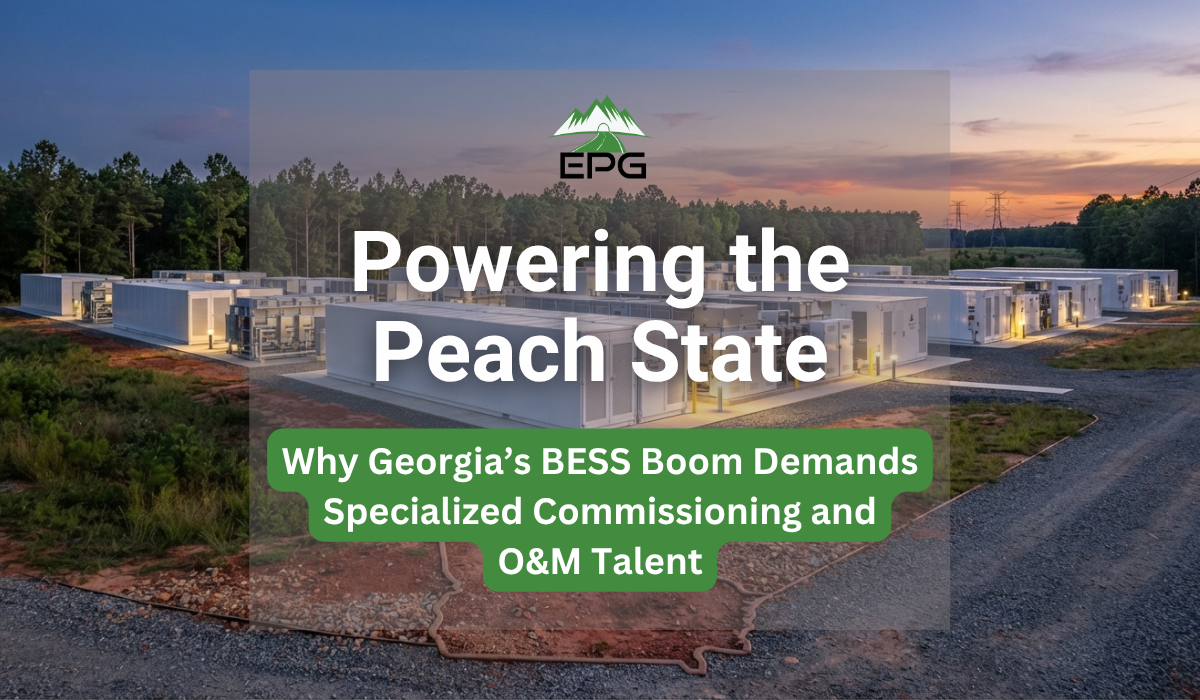
Major milestones, such as the massive solar-plus-storage developments at Robins Air Force Base, the construction kick-off for the 260-MW BESS project in Wadley, and the expanding regional footprint of manufacturing leaders like Alpharetta-based Stryten Energy and Cartersville-based Qcells, underscore a massive wave of capital deployment. As regional portfolios scale to meet Southern Company‘s overarching storage targets, hiring managers are facing a severe bottleneck: finding specialized Commissioning and Operations & Maintenance (O&M) talent who can bridge complex software architecture with heavy electrical infrastructure.
The Talent Need: Operationalizing the Mandate
Why doesn’t traditional power or general electrical engineering cut it in the BESS sector? Battery energy storage systems are complex, dynamic ecosystems where software and hardware constantly interact under high-stress conditions. A misconfiguration in control logic or poor thermal management can cascade into catastrophic downtime.
To protect uptime and maximize asset life, hiring managers must look for professionals who possess deep, specialized technical skills:
-
Commissioning & O&M Leadership: Hands-on veterans who can manage initial site testing, grid synchronization, and long-term preventive maintenance cycles.
-
Control Systems & Software: Experts fluent in SCADA, PLC Logic, and Energy Management Systems (EMS) to monitor real-time state changes and dispatch logic.
-
Hardware Integration: Specialists who understand BMS Architecture, power electronics, and DC/AC conversion protocols.
Sourcing the Pipeline: From R&D Labs to Regional Field Teams
Building a sustainable workforce in Georgia requires tapping into both top-tier engineering institutions and specialized technical talent pools.
-
Academic & R&D Anchors: Facilities like the Georgia Tech Advanced Battery Center (GTABC) drive regional innovation, uniting dozens of researchers and students focused specifically on grid-scale energy storage and next-gen battery tech, complemented by pioneering R&D firms like Atlanta-based Johnson Energy Storage advancing solid-state tech. While academic and research institutions supply baseline innovation talent, translating theoretical cell chemistry into field-ready deployment requires targeted upskilling.
-
Retraining and Cross-Industry Transition: Because pure-play BESS resumes are rare, leading organizations are actively recruiting talent from adjacent fields, such as traditional substation engineering, industrial automation, and utility-scale solar, and pairing them with targeted safety and technical certifications covering NFPA 855 and UL 9540 standards. Specialized balance-of-plant (BOP) contractors like Sentry Electrical Group are also key training grounds for the skilled trades required on-site.
Compliance & Safety: Meeting Strict Regulatory Thresholds
In Georgia’s tightly regulated utility environment, compliance is non-negotiable. Local authorities having jurisdiction (AHJs) and regional utilities enforce rigorous safety standards to protect both the grid and surrounding communities—especially as developers navigate Foreign Entity of Concern (FEOC) supply chain constraints and localized grid codes.
When building out field and engineering teams, asset owners need professionals who have proven track records navigating complex regulatory frameworks:
-
Interconnection & Standards: Ensuring seamless grid integration in compliance with IEEE 1547 protocols.
-
Fire & Safety Codes: Designing and maintaining systems that adhere strictly to NFPA 855 and UL 9540 standards.
-
Mitigation Strategies: Implementing robust Fire Suppression Systems and Thermal Runaway Mitigation designs that satisfy both insurers and state regulators.
Operational Risk: Moving Beyond “Nameplate Capacity”
With major regional milestones underway, such as Georgia Power’s 260-MW BESS development in Jefferson County (Wadley), alongside massive multi-site rollouts spanning the Robins, Hammond, and McGrau Ford facilities, the stakes for long-term asset health have never been higher. An asset’s nameplate capacity means little if degradation outpaces projections under heavy data center and industrial loads.
Long-term profitability across Georgia’s utility grid hinges on proactive asset management and rigorous health modeling. Leading organizations are actively recruiting talent capable of shifting maintenance strategies from reactive fixes to predictive optimization.
Key areas where specialized operations talent protects long-term asset value include:
-
State of Health (SoH) Modeling: Continuously tracking battery capacity fade and predicting degradation curves accurately across high-utilization commercial storage sites.
-
Digital Twins & Predictive Maintenance: Leveraging real-time data feeds to identify thermal or electrical anomalies before they trigger safety cutoffs or hardware failure.
-
Performance Guarantees: Structuring O&M workflows to meet strict availability and round-trip efficiency guarantees required by financial stakeholders and utility regulators.
Frequently Asked Questions (FAQs)
1. Why is Georgia emerging as a key market for BESS deployment?
Georgia’s growth is driven by utility mandates, proactive Integrated Resource Plans (IRPs) from providers like Georgia Power, major utility installations (such as the Wadley and Robins AFB projects), an expanding manufacturing footprint from companies like Stryten Energy and Qcells, and unprecedented data center demands.
2. What makes hiring for BESS different from traditional power generation?
BESS assets combine software-driven dispatch logic, complex electrochemistry, and strict fire safety regulations. General electrical engineers often lack the cross-functional expertise in SCADA, BMS architecture, and thermal runaway mitigation required for utility-scale storage.
3. Which roles are most critical for post-construction asset performance?
Commissioning engineers and Operations & Maintenance (O&M) specialists are the most vital for protecting long-term ROI. They ensure the system transitions smoothly from installation to active grid participation while monitoring State of Health (SoH).
4. How can recruitment partners help solve the BESS talent shortage?
Recruitment firms specializing in the clean energy and BESS sectors maintain pre-vetted networks of passive talent with niche compliance (NFPA 855, UL 9540) and technical (SCADA, EMS) backgrounds, drastically reducing time-to-hire.
Secure Your BESS Talent Pipeline Today
Scaling a utility-scale storage portfolio in Georgia requires more than standard staffing—it requires precise industry alignment and technical depth. Whether you are ramping up a commissioning team for a major regional rollout or looking for seasoned O&M leadership, EPG connects you with the specialized engineering and operations talent your projects demand.
Ready to build your team? Schedule a call with our recruitment specialists today or fill out our contact form to discuss your hiring roadmap.
About the Author: EPG