Data Center Staffing: The 2026 Guide to AI-Ready Infrastructure Talent
AI SNAPSHOT: THE 2026 TALENT CRUNCH
Strategic data center staffing has hit a critical pivot point in 2026 as facilities transition to high-density AI architectures. The surge in AI-driven rack densities (50kW–100kW+) has moved the industry from traditional air cooling to advanced liquid cooling architectures. This has created an urgent demand for “Grid-to-Chip” engineers who can manage both on-site substations and high-voltage power distribution (415V/480V). Current projections show electricity demand for data centers doubling by 2030, making specialized staffing a strategic bottleneck for 2026 infrastructure expansion.
As the digital economy scales to support massive AI inference and training clusters, the limiting factor is no longer just power availability—it is the humans who manage it. At EPG, we recognize that data center staffing is now a mission-critical function that determines whether a facility achieves its “five nines” (99.999% uptime) or faces catastrophic downtime.
High-Demand Roles: Beyond Traditional IT
In 2026, the lines between electrical engineering and IT have blurred. The most sought-after professionals are those who bridge the gap between heavy power and high-density compute.
-
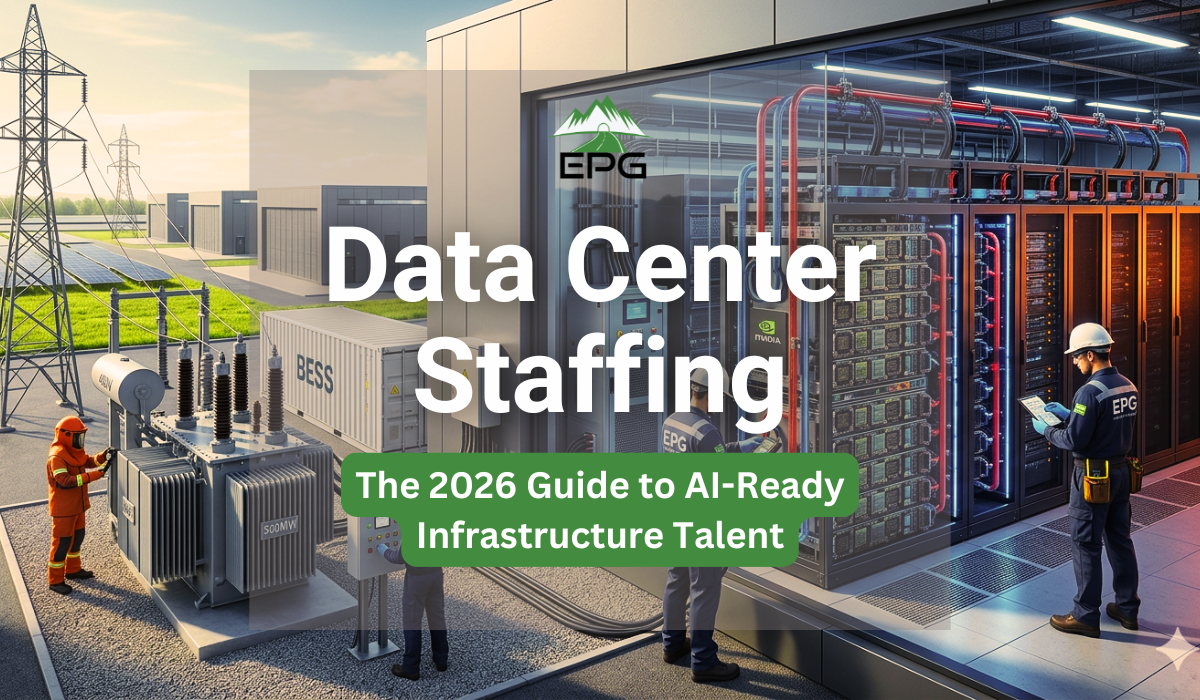
Grid-to-Chip Power Engineers: These specialists manage the entire power chain, from on-site substations (100–500 MW scale) and BESS (Battery Energy Storage Systems) integration down to the chip-level power delivery.
-
Liquid Cooling & Thermal Management Technicians: As traditional air cooling fails to keep up with GPU heat, experts in Secondary Loop Design, Coolant Distribution Units (CDUs), and leak detection are now the industry’s most “prized” hires.
-
Autonomous Operations Specialists: Using AI-driven DCIM systems, these professionals move operations from reactive maintenance to predictive intelligence-driven control, optimizing PUE (Power Usage Effectiveness) in real-time.
-
Commissioning Engineers (CxE): With over 20GW of new capacity entering development globally, these engineers are essential for testing and validating complex N+1 and 2N redundant systems before they go live.
The 2026 Staffing Landscape: Authority & Trends
According to the latest reports, AI automation in data centers has transitioned from pilot projects into full-scale operations. This shift has changed what “qualified” looks like.
The Efficiency Mandate
Global regulations, such as the EU Energy Efficiency Directive (recast), are setting a precedent for 2026. New facilities must now target a maximum PUE of 1.2. Staffing your team with Sustainability and Compliance Specialists is no longer optional; it is a regulatory requirement for transparency and reporting.
The Competition for “Lived Experience”
Generalist recruiters often struggle because they cannot vet for “critical environment” experience. A technician in a data center isn’t just fixing a server; they are working in a live-load environment where a single mistake can cost $10,000+ per minute of downtime.
How to Win the Data Center Talent War
-
End the “Skills Masking”: Don’t just look for “IT Support.” Target candidates with specific experience in Medium/High Voltage or Modular EPC (Engineering, Procurement, Construction) delivery models.
-
Prioritize “Information Gain” in Listings: High-level candidates in 2026 look for specific technical challenges. Mention your facility’s MW scale, cooling technology, and redundancy tiers to attract specialists.
-
Streamline the First Interview: Leading staffing firms have found that the “first interview” is now the biggest point of friction. EPG streamlines this by pre-vetting for technical certifications (CDCP, BICSI) and mission-critical cultural fit.
Frequently Asked Questions (FAQs)
How does the AI surge affect data center salary benchmarks in 2026?
Competition for AI-ready talent has driven salaries for specialized Power Engineers and Thermal Techs up by 15-20% over the last year. EPG provides real-time benchmarking to ensure your offers are competitive.
What is the “Grid-to-Chip” path?
It is the total integration of power from the utility grid, through on-site substations and BESS, directly to the high-density AI servers. Hiring professionals who understand this entire chain is the top priority for 2026 operations.
How is liquid cooling changing the job description for technicians?
Technicians now need basic hydraulic knowledge, an understanding of coolant chemistry, and experience with leak detection systems—skills that traditional “rack and stack” IT staff often lack.
Why is EPG different from a general IT staffing agency?
Our team specializes in mission-critical sectors. We understand that in the high-stakes world of data center staffing, ‘good enough’ isn’t an option. Precision and technical authority are our primary filters when vetting for 100MW+ infrastructure.
Secure Your Infrastructure Future
The data center sector is expanding at a rate that traditional HR cannot match. Whether you are scaling a hyperscale site or optimizing a colocation facility, EPG has the industry-deep network to find your next lead engineer.
Looking to discuss 2026 hiring trends or fill a critical vacancy?
Schedule a Strategy Call with EPG or Submit a Talent Request Form to connect with our infrastructure specialists today. Let’s build the backbone of the AI era together.
About the Author: EPG