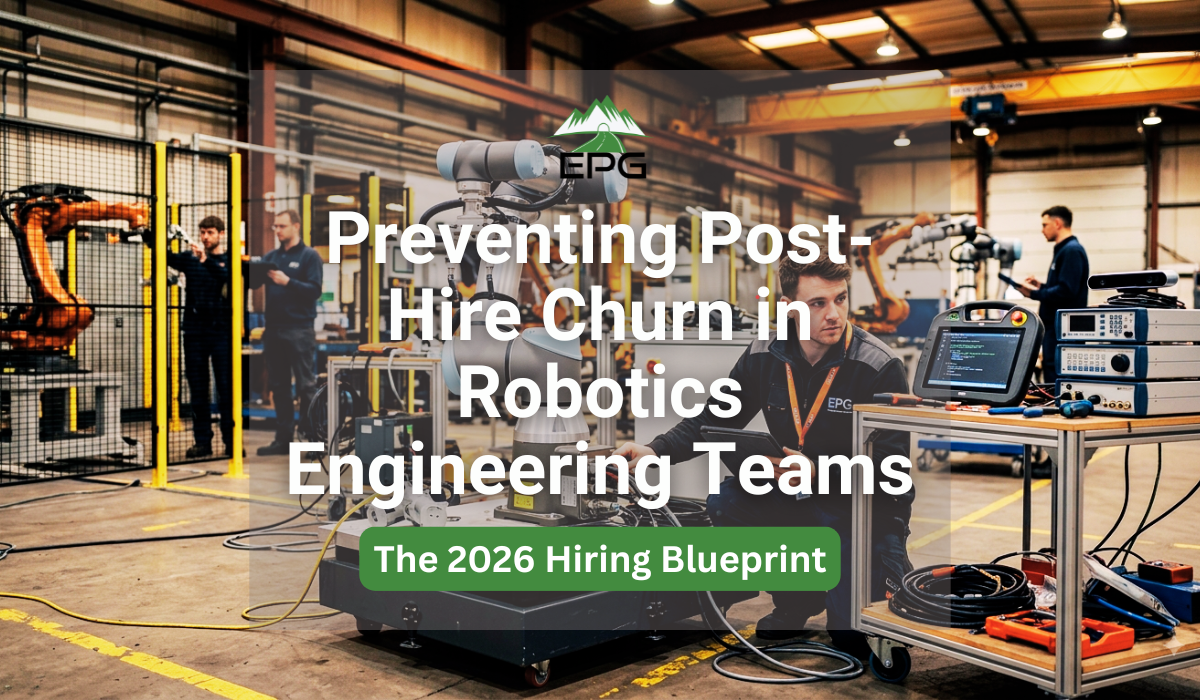
Preventing Post-Hire Churn in Robotics Engineering Teams: The 2026 Hiring Blueprint
Key Takeaways
The Problem: A major driver of talent loss in robotics engineering is “over-qualified, fast-bounce” churn – where candidates with heavy R&D backgrounds or advanced degrees accept mid-level implementation or plant commissioning roles, only to quit within 6 to 12 months out of boredom.
The Cost: Replacing a senior or mid-level robotics engineer in today’s market costs 1.5 to 2 times their salary when factoring in recruiting fees, transition costs, lost deployment velocity, and ramp-up time.
The Strategy: High-retention engineering teams align interview protocols around trajectory matching rather than pure technical prestige, distinguishing between R&D curiosity and production-line execution energy.
Robotics and automation are seeing unprecedented capital deployment. Between the acceleration of Physical AI, autonomous mobile robots (AMRs) in logistics, and the widespread adoption of collaborative systems across manufacturing, finding candidates with deep-tech credentials feels like a victory.
However, many hiring managers in the automation space encounter a costly trap: The “Over-Qualified, Fast-Bounce” Risk.
You extend an offer to an exceptionally credentials-heavy candidate – perhaps someone holding a PhD or a background in theoretical R&D – to lead a mid-level implementation, PLC/ROS 2 deployment, or plant commissioning project. On paper, it looks like a talent win. But 6 to 12 months later, after facing the grit of real-world hardware integration, field calibration, and production deadlines, they grow disengaged and quit to return to an academic lab or pure research role.
According to the Bureau of Labor Statistics, the median tenure for mid-career technical professionals (ages 25–34) is 2.7 years, but in fast-moving fields like robotics, early-stage churn often strikes much faster. According to industry compensation and retention data, replacing a specialized engineer costs 6 to 9 months of their fully-loaded compensation once lost project velocity, recruiting costs, and onboarding time are combined.
Preventing this churn requires a fundamental shift in how robotics teams evaluate, interview, and integrate engineering talent.
Why Theoretical Talent Bounces from Production Roles
To solve post-hire churn, hiring managers must understand the psychological disconnect between Theoretical R&D and Production Implementation.
When an R&D-focused engineer is assigned to a plant commissioning role, their daily tasks consist of field debugging, cabling checkouts, edge-case mitigation, and functional safety compliance. If their primary career motivation is theoretical novelty, the gap between expectations and reality creates rapid burnout and disengagement.
The 3-Step Interview Framework to Ensure Long-Term Trajectory Alignment
To prevent fast-bounce churn, your hiring process must evaluate career motivation alongside technical competency. Use a specialized behavioral and technical interview framework designed to screen for production longevity.
1. The “Wrench vs. Model” Orientation Probe
Early in the interview, isolate where the candidate derives job satisfaction.
-
Ask: “Can you describe a project where your clean theoretical model or simulation failed when deployed on physical hardware? How did you resolve it, and how did that experience shape your approach?”
-
What to listen for: Candidates who enjoy production engineering will speak passionately about the grit of physical debugging, hardware-in-the-loop validation, and shipping a system that works in the real world. Candidates at high risk of bouncing will express frustration over operational constraints and gloss over the physical integration work.
2. Deconstruct the Candidate’s 24-Month Career Horizon
Over-qualification becomes a hazard when a candidate views a commissioning role as a temporary placeholder while waiting for a pure AI/R&D role to open up.
-
Ask: “In this role, 70% of your first year will be spent on-site getting hardware deployed, integrated with fieldbus protocols, and meeting strict customer timelines. What specific aspects of this execution phase align with your 2-to-3-year personal growth goals?”
-
What to listen for: Look for answers that connect execution work to concrete mastery—such as scaling fleet deployments, mastering ROS 2 field stability, or learning industrial compliance standards. If they struggle to articulate why implementation excites them, they are a flight risk.
3. Practical Simulation over Theoretical Whitewashing
Rather than standard whiteboard algorithmic challenges, present candidates with a real-world commissioning scenario.
Give them a scenario involving a simulated robot arm or AMR encountering sensor noise, network latency, or safety interlock faults in a factory environment. Candidates who thrive on practical robotics will dive into fault-finding logic, safety trade-offs, and pragmatic workarounds. Those seeking pure research will often attempt to over-engineer the system with complex, non-viable models that ignore real-world constraints.
Retention Architecture: Structuring Parallel Growth Tracks
Even when you hire the right candidate, retention requires structured technical growth. Research shows that 69% of engineers list career growth ceiling as a primary reason for leaving a company, surpassing compensation.
To retain ambitious robotics talent without pushing them into unwanted management roles or theoretical R&D, establish a Dual-Track Technical Career Ladder:
-
The Architecture Track: Allows senior individual contributors (ICs) to own system design, hardware-software abstraction, and cross-team platform standards without leaving production execution.
-
The Field Systems Leadership Track: Focuses on deployment mastery, complex plant integrations, and mentoring junior automation engineers.
By giving engineers clear ownership over real-world operational milestones, you satisfy their drive for technical impact while keeping your deployment pipeline moving.
Frequently Asked Questions (FAQs)
How do I balance hiring for immediate production needs without scaring away highly educated applicants?
Be completely transparent in the job description and intake process about the ratio of field/execution work versus design work. Frame production implementation as a vital step for mastering hardware systems before moving into high-level architecture roles.
What is the financial impact of post-hire churn on a robotics engineering team?
Beyond the direct replacement cost (typically 6 to 9 months of an engineer’s fully-loaded salary), early resignations stall commissioning schedules, delay customer deliveries, increase burnout among remaining team members, and disrupt project continuity.
Should we avoid hiring PhDs or research-heavy candidates for implementation roles entirely?
Not necessarily. The key is screening for motivation rather than degree title. A candidate with an advanced degree who is genuinely passionate about seeing physical machines operate in production can be an asset. However, if their primary passion remains theoretical research, placing them in an execution-heavy role carries high churn risk.
Build a High-Retention Engineering Team with EPG
Hiring in the robotics and automation space isn’t just about finding candidates who meet technical requirements on paper—it’s about finding the exact match for your project’s lifecycle, culture, and execution requirements.
At EPG, we bring proven experience in specialized technical placements, helping engineering leadership secure high-performing talent built for long-term retention.
Ready to eliminate hiring drag and secure the right talent for your team?
-
Submit Your Hiring Requirements via Our Form
About the Author: EPG