Robotics Recruiting Models: RPO vs. Staffing vs. Direct Placement (2026 Guide)
Key Takeaways for Search
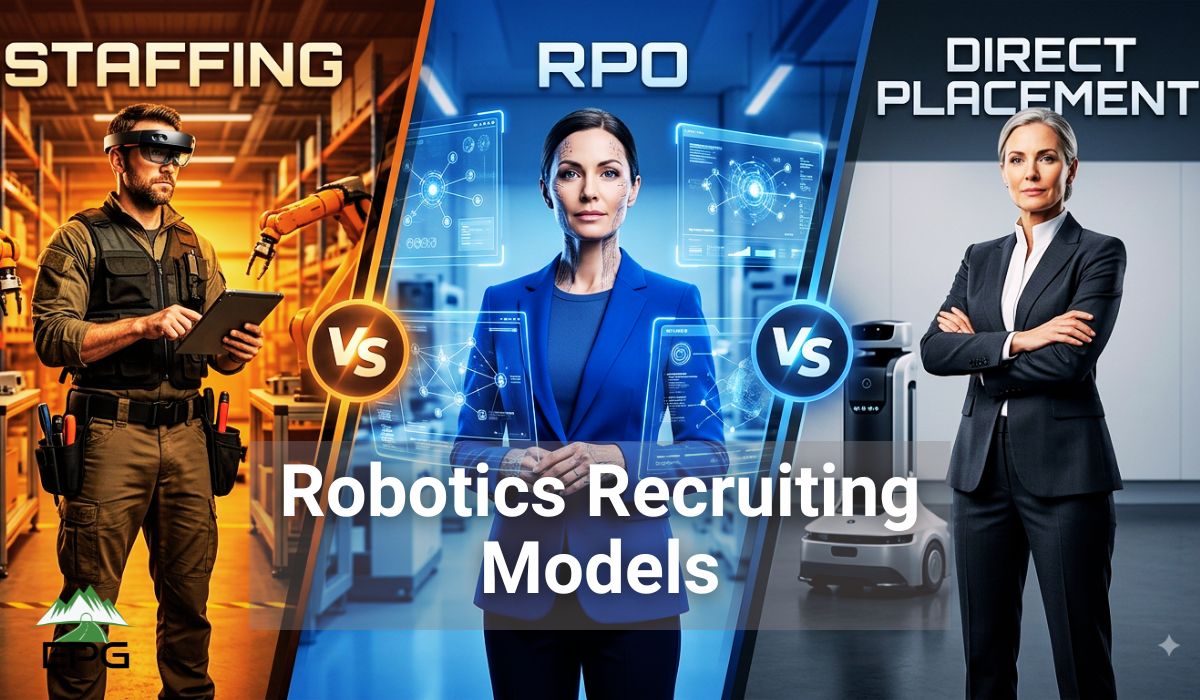
Direct Placement: Best for niche, executive, or sporadic high-level individual contributor hires (e.g., Principal Controls Engineers, Chief Robotics Architects). High speed per role, success-fee or retained structure.
Staffing (Contract / Temp-to-Hire): Ideal for fluctuating capacity needs, short-term integration projects, and field deployment support. Lower initial commitment, hourly billing.
Recruiting Process Outsourcing (RPO): A strategic, end-to-end partnership where an external specialist manages part or all of your talent acquisition pipeline under your employer brand. Best for high-growth scaling, reducing cost-per-hire, and closing complex specialized roles in sub-sectors like Physical AI, ROS 2, and Digital Twins.
EPG Announcement: EPG now provides scalable RPO Services custom-tailored to the robotics, electric vehicle, and automated hardware sectors.
The 2026 Robotics Talent Bottleneck
The global robotics and industrial automation market has surged past $16.7 billion, driven by rapid adoption across non-automotive sectors like life sciences, logistics, and electronics. However, as the industry transitions from traditional rule-based robotics to Physical AI, embodied intelligence, and software-defined automation, engineering and talent acquisition leaders face a critical bottleneck: the Automation Gap.
Specialized roles – ranging from ROS 2 middleware architects and Sim-to-Real simulation engineers to OT/ICS cybersecurity specialists – frequently sit vacant for months, creating costly project delays due to candidate scarcity and extended technical assessment loops. Traditional generic job boards and transactional recruitment methods are no longer sufficient to attract passive engineering talent.
To scale effectively, hiring managers must select the appropriate talent acquisition architecture. Below is a comprehensive breakdown comparing Direct Placement, Staffing, and Recruiting Process Outsourcing (RPO) – and how to select the model that aligns with your operational stage.
1. Direct Placement (Contingency & Retained Executive Search)
What It Is
Direct Placement involves partnering with a specialized recruiting firm to source, evaluate, and place full-time permanent employees. The agency handles candidate sourcing and initial vetting, handing off qualified candidates directly to your internal interview loop.
Key Characteristics
-
Fee Structure: Percentage of the candidate’s first-year base salary (typically 20%–30%), paid upon successful hire (contingency) or structured via milestones (retained).
-
Speed to Hire: Fast for individual, urgent requisitions.
-
Brand Identity: Candidates are approached under the agency’s banner before being introduced to your organization.
Best Used For
-
One-off niche roles: When you need a singular specialized expert (e.g., a Lead Perception Engineer or Director of Systems Engineering).
-
Executive Leadership: C-suite or VP-level executive searches requiring discrete market outreach.
-
Low-volume, unpredictable hiring: When your company hires fewer than 5–10 engineers per year.
2. Traditional Staffing (Contract & Temp-to-Hire)
What It Is
Staffing agencies provide temporary or contract workers to fulfill immediate project requirements. In many cases, the contract professional remains an employee of the staffing agency while delivering work under your operational direction.
Key Characteristics
-
Fee Structure: Hourly bill rate incorporating candidate compensation, taxes, benefits, and agency margin.
-
Engagement Duration: Tactical and project-based (typically 3 to 12 months).
-
Flexibility: High flexibility to scale headcount up or down based on capital expenditure and project milestones.
Best Used For
-
Field Deployment & Commissioning: Surge capacity needed for facility bring-ups, hardware retrofits, or site-acceptance testing (SAT).
-
Short-Term Capacity Gaps: Covering parental leaves, sudden surges in system integration contracts, or temporary prototype testing runs.
-
Proof-of-Concept Projects: Evaluating talent on a contract basis before committing CapEx to full-time headcount.
3. Recruiting Process Outsourcing (RPO)
What It Is
RPO is a strategic, long-term talent acquisition model where an external specialist embeds directly into your organization to manage all or a defined segment of your recruitment ecosystem. Unlike transactional agencies, an RPO partner operates as an extension of your internal HR/Talent team—utilizing your company email, ATS, and employer brand to build dedicated talent pipelines.
Key Characteristics
-
Fee Structure: A predictable monthly management fee plus a reduced per-placement cost, significantly lowering total cost-per-hire compared to traditional agency fees.
-
Brand Alignment: Fully integrated under your employer brand, raising candidate response rates among passive engineering talent.
-
Technology & Process Ownership: Implements automated sourcing workflows, candidate nurturing pipelines, and standardized interview scoring frameworks.
Best Used For
-
Rapid Multi-Role Scaling: When opening new R&D labs, launching a new robot platform, or scaling manufacturing capacity requiring 10+ technical hires annually.
-
Reducing High Recruitment Costs: Companies spending heavily on ad-hoc direct placement fees seeking a predictable, cost-effective structure.
-
Building Long-Term Talent Pipelines: Establishing ongoing relationships with top passive engineering talent in specialized fields (e.g., C++, Python, ROS 2, Motion Control, Edge AI).
Direct Comparison Matrix
| Feature / Metric | Direct Placement | Staffing (Contract) | Recruiting Process Outsourcing (RPO) |
|---|---|---|---|
| Primary Focus | Speed for single positions | Temporary capacity & flexibility | Scalable, long-term TA architecture |
| Engagement Type | Transactional (per position) | Short-to-medium term contract | Strategic partnership (6–24+ months) |
| Cost Model | % of annual base salary (success-based) |
Hourly bill rate mark-up | Monthly retainer + reduced per-hire success fee |
| Candidate Quality & Fit | Focus on immediate skill match | Rapid availability focus | Holistic cultural, technical, & retention fit |
| Employer Branding | Recruiter-branded outreach | Agency-branded outreach | 100% Client-Branded outreach |
| Tech & Process Integration | External to your team | External to your team | Embedded in your ATS, tools, & processes |
| Scalability | Low (costs scale linearly) |
Medium (project-dependent) |
High (agile scaling up/down) |
How to Select the Best Model for Your Robotics Organization
When evaluating your hiring strategy, ask your leadership team these three diagnostic questions:
Role Type?
Internal Robotics TA?
-
What is your 12-month projected volume?
-
Under 5 hires/year: Direct Placement keeps overhead zero until a successful hire is made.
-
10 to 50+ hires/year: RPO typically reduces total recruitment expenditure by 30%–50% compared to contingent agency fees while standardizing candidate experience.
-
-
Is the requirement permanent R&D or project-based deployment?
-
If you are ramping up field technicians or system integrators for a 6-month plant installation, Staffing provides the necessary flexibility.
-
If you are building core IP—such as proprietary motion planning or autonomous navigation algorithms—Direct Placement or RPO ensures long-term retention and alignment with your engineering culture.
-
-
Does your internal team possess domain-specific robotics expertise?
-
Generalist corporate recruiters often struggle to evaluate the nuances between PLC controls developers, ROS 2 middleware software engineers, and mechatronic design specialists. An industry-focused RPO partner bridges this technical gap without the overhead of building an internal technical sourcing team from scratch.
-
Why EPG is Expanding into RPO Services
Building on our foundation in autonomous vehicles, mobility, and advanced automated technology, EPG is proud to officially offer Recruiting Process Outsourcing (RPO) Services customized for the robotics and industrial automation sectors.
As hardware and software continue to converge into Software-Defined Robotics and Physical AI, hiring requirements have fundamentally transformed. Robotics companies cannot afford to rely on generic staffing tactics that fail to convey their employer value proposition.
Our RPO solution delivers:
-
Embedded Technical Recruiters: Dedicated recruiters who understand technical stacks (e.g., C++, ROS 2, Gazebo/Isaac Sim, NVIDIA Jetson, ISO 10218 safety standards).
-
Employer Brand Enhancement: Sourcing talent natively under your company name to build long-term talent equity in competitive markets.
-
Data-Driven Sourcing: Leveraging advanced candidate re-engagement and active outbound outreach to passive engineering communities.
-
Flexible Engagement Models: Modular RPO packages designed for growing startups, middle-market integrators, and global OEMs scaling product lines.
Frequently Asked Questions (FAQs)
1. What is the main cost difference between RPO and Direct Placement?
Direct Placement charges a contingency percentage (e.g., 20%–25%) per candidate base salary upon hire. RPO utilizes a hybrid structure—a fixed monthly management fee alongside a significantly reduced per-placement fee. For organizations hiring 10 or more technical personnel annually, RPO typically results in a substantially lower average cost-per-hire alongside higher long-term candidate retention.
2. Can RPO integrate with our existing Applicant Tracking System (ATS)?
Yes. One of the core tenets of RPO is seamless integration into your existing infrastructure. An embedded RPO team utilizes your ATS, calendar tools, communication channels, and brand identity, ensuring complete operational transparency and full ownership of applicant data.
3. How does RPO help attract passive robotics engineers?
Top-tier robotics and Physical AI developers rarely apply through traditional public job boards. An industry-specialized RPO partner leverages direct outbound sourcing, technical developer communities, and specialized engineering databases. Reaching out under your brand builds genuine rapport and higher response rates compared to third-party agency solicitations.
4. Is RPO suitable for early-stage robotics startups?
Yes. Seed and Series A/B robotics startups scaling from initial prototypes to production runs often lack the internal HR capacity to handle sudden hiring spikes. RPO allows startups to scale candidate sourcing rapidly without incurring permanent internal HR payroll costs.
Ready to Optimize Your Robotics Hiring Strategy?
Whether you are scaling a production team, building out an R&D lab, or evaluating your current talent acquisition costs, choosing the right recruitment model is critical to maintaining momentum in today’s competitive automation ecosystem.
Let’s discuss what recruitment architecture makes sense for your growth timeline.
-
📅 Schedule a Call with the EPG Technical Talent Team to review your current requisitions, salary benchmarks, and hiring goals.
-
📝 Fill out our Contact Form below to request a customized RPO proposal for your organization.
About the Author: EPG