The 2026 EV Salary Guide: Benchmarks for the Future of Mobility
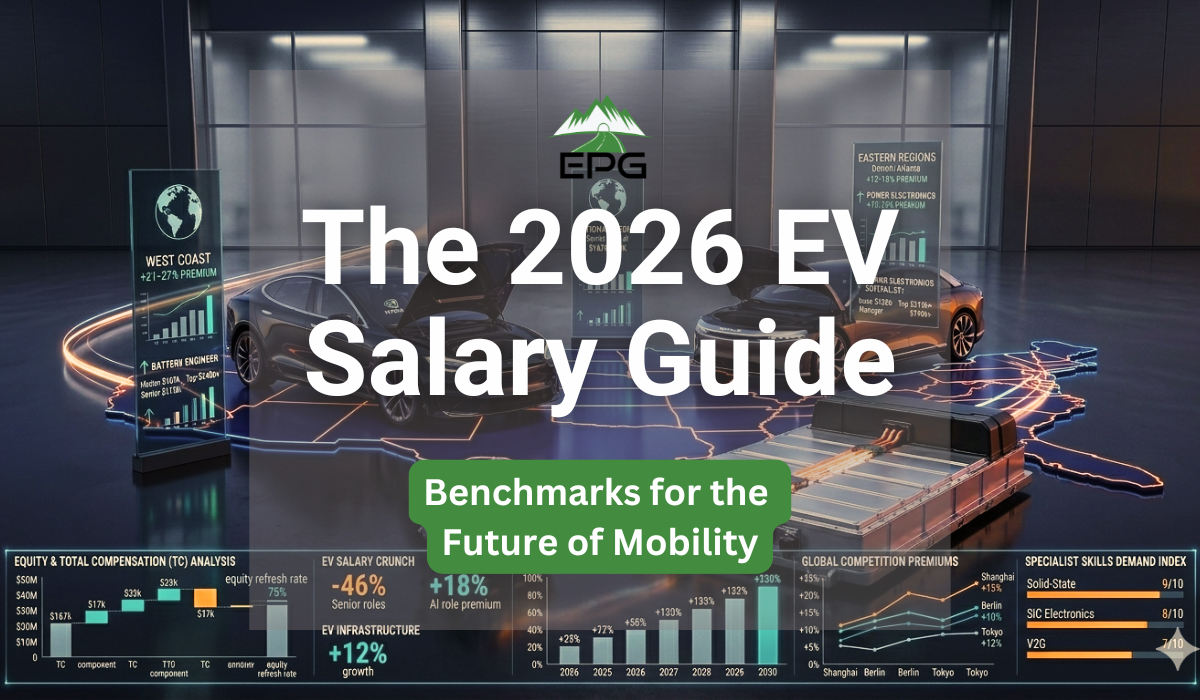
Snapshot: The 2026 EV labor market is defined by a “skills-premium” surge. While entry-level roles have stabilized, specialized engineering positions—specifically in battery chemistry, power electronics, and thermal management—are seeing salary increases of 18-22% year-over-year. As of March 2026, the median EV salary for a Senior Battery Engineer in the U.S. has reached $167,000, with top-tier specialists in autonomous systems and grid infrastructure exceeding $260,000 in total compensation.
The electric vehicle sector has moved past its “early adoption” phase and into a period of industrial scaling. For hiring managers and candidates alike, the most critical metric in 2026 is no longer just “years of experience,” but the mastery of specific technical stacks.
At EPG, we’ve observed a fundamental shift: companies are moving away from generalist mechanical engineers in favor of niche specialists who can optimize energy density, autonomous safety, and charging infrastructure. This guide breaks down the current EV salary benchmarks to help your organization stay competitive.
2026 EV Salary Benchmarks by Core Role
Compensation in 2026 is heavily influenced by regional “Giga-clusters” and the complexity of hardware-software integration.
1. Battery & Energy Storage Engineers
The “heart” of the EV continues to command the highest premiums as the industry pivots toward Solid-State and Silicon-Anode technologies.
-
Average Base Salary: $140,000 – $162,000
-
Senior/Lead Roles: $167,000 – $239,000+
-
Key Premium Skills: BMS (Battery Management System) algorithms and cell-to-pack (CTP) design.
2. Autonomous Driving & ADAS Software Engineers
With the 2026 push toward Level 3 and Level 4 autonomy, software engineers specializing in computer vision and deep learning are seeing massive total compensation (TC) packages.
-
Average Total Compensation: $134,496 – $262,000
-
Expert Level (8+ years): $192,422 (Base) to $350,000+ (TC)
-
Key Premium Skills: LiDAR integration, sensor fusion, and real-time path planning.
3. EV Infrastructure & Grid Integration Engineers
The bottleneck of EV adoption is the grid. Engineers who can design megawatt-scale charging stations and manage vehicle-to-grid (V2G) protocols are in high demand.
-
Average Base Salary: $129,281
-
Top 10% Percentile: $164,716 – $222,000
-
Key Premium Skills: Level 3 DC Fast Charging architecture and smart grid interoperability.
4. Supply Chain & Procurement Managers
As mineral scarcity dominates headlines, professionals who can navigate the “circular economy” and secure stable battery material pipelines are vital.
-
Average Base Salary: $130,235
-
Senior Manager/Director: $170,813 – $212,636
-
Key Premium Skills: Sustainable sourcing, risk mitigation, and circular supply chain logistics.
5. Power Electronics & Thermal Management
As charging speeds increase, managing heat and power conversion efficiency is the primary frontier of range extension.
-
Power Electronics Specialist: $138,834 – $213,500
-
Thermal Management Lead: $130,700 – $208,000
-
Key Premium Skills: Silicon Carbide (SiC) inverters and CFD modeling.
Market Trends Shaping EV Compensation
-
The “Experience” Gap: There is currently a 46% shortage of mid-to-senior level engineers with 5+ years of direct EV experience, leading to aggressive equity refreshes.
-
The Skills-Based Premium: Companies are now paying a 15% “competency bonus” for candidates who pass hands-on technical assessments in niche fields like battery recycling or V2X communication.
-
Regional Dominance: San Jose and San Francisco remain the highest-paying hubs, offering a 21-27% premium over the national average to account for talent density.
Frequently Asked Questions (FAQs)
1. What is the average entry-level EV salary in 2026? For new graduates in hardware or software engineering, starting salaries typically range from $81,000 to $118,000, depending on the specific discipline and internship experience.
2. How does geography affect an EV salary? Location is a massive factor. Roles in tech hubs like San Jose or Austin pay significantly more, but we are seeing a 10% rise in salaries in “Battery Belt” states like Georgia and Michigan as manufacturing ramps up.
3. Which EV role has the highest growth potential? Autonomous Driving Systems and Grid Infrastructure roles are currently seeing the fastest salary acceleration, with year-over-year increases of 4-6%.
4. How can I increase my salary as an EV engineer? Specializing in BMS Integration, ISO 26262 (Functional Safety), or SiC Inverter design are currently the fastest paths to the 90th percentile of earners.
Optimize Your 2026 Hiring Strategy
The transition to electric mobility is no longer a “future” trend—it is the current standard. Whether you are looking to benchmark your team’s compensation or secure a specialist for a critical engineering role, data-driven decisions are your best asset.
Ready to discuss the 2026 hiring landscape or need help filling a critical role?
Schedule a Strategy Call with EPG or Fill out our Recruitment Inquiry Form to learn how our firsthand experience in the BESS and EV sectors can help you secure top-tier talent.
About the Author: EPG