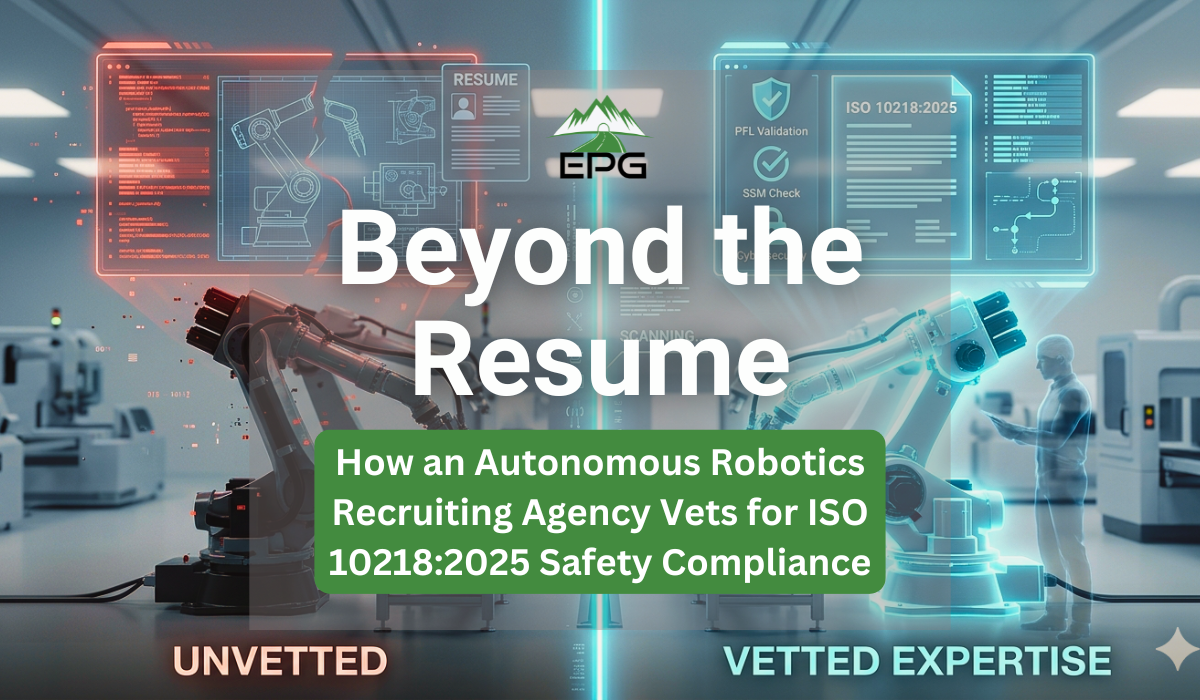
Beyond the Resume: How an Autonomous Robotics Recruiting Agency Vets for ISO 10218:2025 Safety Compliance
Overview: ISO 10218:2025 and Robotics Recruitment
In 2026, the transition to ISO 10218:2025 (harmonized as ANSI/A3 R15.06-2025) marks the most significant regulatory shift in industrial robotics in over a decade. This update mandates stricter functional safety, explicit cybersecurity for connected systems, and refined biomechanical limits for collaborative tasks. For organizations, this shift transforms hiring from a general search for “robotics engineers” into a specialized hunt for compliance-fluent experts who can navigate Performance Level (PLr) and Sim-to-Real validation to avoid the “Automation Gap”—where specialized roles now remain vacant for an average of 114 days.
The industrial landscape of 2026 has moved past the era of simple, caged automation. We have entered the age of Physical AI, where autonomous systems perceive, learn, and adapt in real-time. However, with this intelligence comes a new layer of regulatory complexity.
The release of ISO 10218:2025 (Parts 1 and 2) has fundamentally changed how robots are designed, integrated, and, most importantly, staffed. For a modern enterprise, a “good” engineer is no longer just someone who can code in ROS 2; they must be a practitioner of functional safety who understands the legal and technical nuances of the new 2025 standards.
As a specialized autonomous robotics recruiting agency, EPG has identified that the most critical skill gap in 2026 isn’t programming—it’s compliance-ready engineering.
The 2025 Shift: From “Robot” to “Application”
A key distinction in the updated ISO 10218:2025 standard is the shift in focus from the “robot system” to the “robot application.” The standard recognizes that a robot is only as safe as its intended task, its end-effectors, and its environment.
When EPG vets candidates for top-tier robotics roles, we look beyond the resume to evaluate their understanding of these four pillars of the 2025 update:
1. Functional Safety and PL (Performance Level)
The 2025 revision makes functional safety requirements explicit rather than implied. Candidates must demonstrate proficiency in defining safety functions—such as Monitored Standstill and Safe Limited Speed (SLS).
-
The EPG Benchmark: We prioritize engineers who can document Performance Level (PLr) requirements as specified in the new Annex C, ensuring that emergency stops and protective measures meet the mandatory PLd or SIL 2 thresholds.
2. Collaborative Application Validation (PFL & SSM)
The terms “collaborative robot” have been replaced by “collaborative application.” Safety is now determined by biomechanical limit values.
-
Authoritative Data: According to the International Federation of Robotics (IFR), collaborative robots reached a market share of 10.5% of all industrial robots installed worldwide in 2023.
-
Vetting Logic: We vet for engineers who can use calibrated force-sensing equipment to measure Quasi-Static and Transient contact forces, ensuring they align with the 2025 pressure limits.
3. The Cybersecurity-Safety Convergence
For the first time, cybersecurity is formally integrated into the safety standard via the Cyber Resilience Act and ISO 10218:2025. A hacked robot is an unsafe robot.
-
Industry Trend: 2026 data shows that OT/ICS Cyber Security is now a top-three priority for 77% of manufacturing leaders.
-
The EPG Approach: We evaluate a candidate’s ability to implement “least-privilege” access and segment networks to protect safety PLCs from unauthorized access.
4. Sim-to-Real (Digital Twin) Proficiency
In 2026, the “Simulate-then-Procure” model is the industry standard. ISO 10218:2025 emphasizes the importance of validation before deployment.
-
Efficiency Metric: Utilizing high-fidelity simulators like NVIDIA Isaac Sim or Gazebo Harmonic to validate safety distances and response times can reduce physical deployment risk by up to 40%.
Why Expertise Trumps General Experience
In a sector as new as autonomous robotics, “10 years of experience” is often a myth. Instead, EPG focuses on proven technical literacy. We seek out the “Agentic AI” specialists and mechatronics experts who are already building the “Silicon Prairie” and driving the $16.7 billion global market in industrial robotics.
Partnering with an autonomous robotics recruiting agency means you aren’t just getting a recruiter; you are getting a partner who understands that a single oversight in ISO 10218 compliance can lead to millions in stalled production and safety audits.
Frequently Asked Questions (FAQs)
1. What is the biggest difference between ISO 10218:2011 and ISO 10218:2025?
The 2025 version introduces two specific Robot Classes based on mass and force, incorporates cybersecurity as a mandatory safety component, and replaces the content of ISO/TS 15066 to provide a single, unified framework for collaborative applications.
2. Why should I use an autonomous robotics recruiting agency instead of a general tech recruiter?
General recruiters often fail to vet for functional safety (ISO 13849) or specific middleware mastery (ROS 2 / ROS Jetty). A specialized agency like EPG understands the technical stack—from Sim2Real transfer learning to Edge AI deployment—ensuring candidates are “plug-and-play” ready.
3. Does ISO 10218:2025 apply to humanoid robots in warehouses?
Yes. As humanoid pilots transition to production reality in 2026, they must meet the safety levels, durability criteria, and consistent performance metrics outlined in the updated industrial standards to operate in shared human environments.
4. How does EPG vet for “Physical AI” expertise?
We look for candidates who have successfully bridged the gap between digital logic and physical actuators. This includes verifying their experience with sensor fusion, low-latency control (5G/Edge), and their ability to perform a standard-compliant risk assessment using ISO 12100 methodologies.
Build Your Automated Future with EPG
The race for robotics talent is tighter than ever, and the cost of a “bad hire” in a high-stakes safety environment is astronomical. Whether you are looking to discuss the latest hiring trends in Agentic AI or need to staff a team capable of meeting ISO 10218:2025 standards, we are here to help.
Schedule a Call with our Robotics Recruiting Team OR Fill Out Our Talent Needs Form
Let’s discuss how we can secure the expertise you need to lead the 2026 automation surge.
About the Author: EPG