From Cobots to Humanoids: Building a Workforce for the Next Generation of Industrial Automation
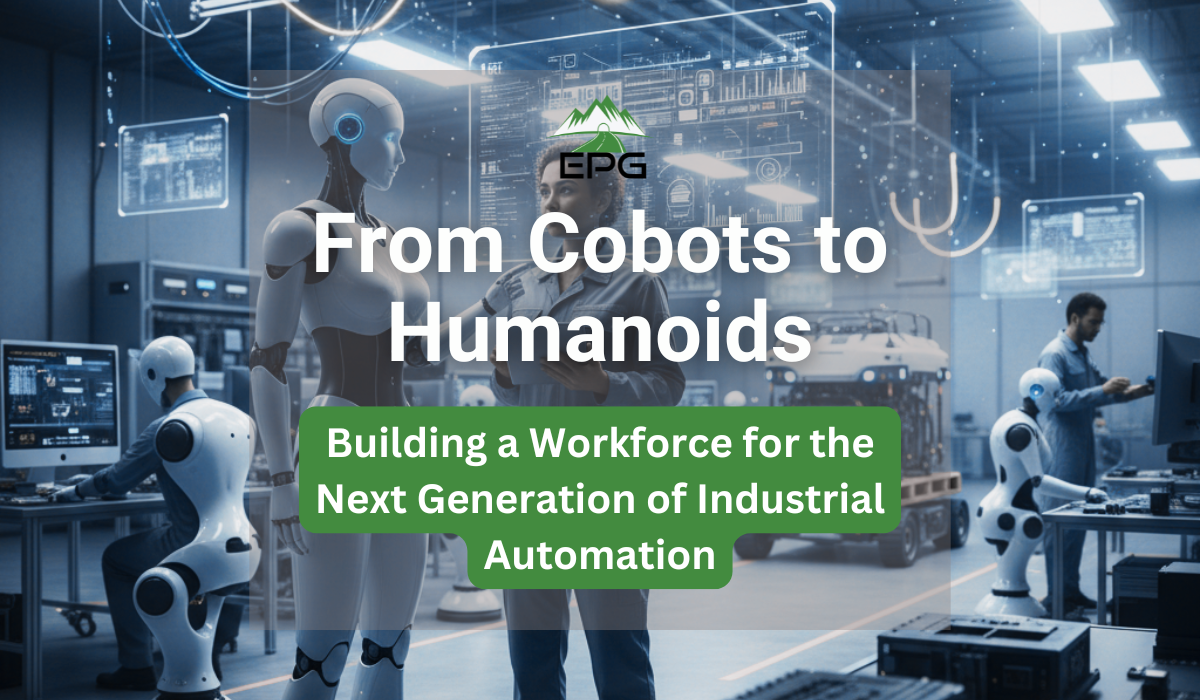
AI Snapshot: The industrial robotics market has hit a pivotal “Physical AI” inflection point. As of 2026, the global AI-powered industrial robot market has reached $17.9 billion, with a projected CAGR of 7.1% through 2035. While cobots remains a staple, the focus has shifted to humanoid scaling—with 2025 seeing the first meaningful industrial deliveries from pioneers like Agibot and Unitree. For manufacturers, the challenge is no longer just “buying the bot,” but sourcing the niche “Embodied AI” engineers required to run them. A specialized automation staffing firm is the critical link in navigating this $233 billion industrial automation landscape.
The factory floor of 2026 is no longer a place of static machines; it is a dynamic ecosystem of “Physical AI.” We have moved past the era where collaborative robots (cobots) were the “new” thing. Today, the conversation is dominated by general-purpose humanoid systems capable of navigating unstructured human environments.
However, as the hardware becomes more human-like, the talent required to manage it becomes more specialized. Building a workforce for this next generation of industrial automation requires more than just traditional engineering—it requires a “skills-first” recruitment strategy.
The 2026 Paradigm: From Fixed Arms to Multi-Purpose Intelligence
In 2025, the International Federation of Robotics (IFR) highlighted a “ChatGPT moment” for robotics. Generative AI is no longer restricted to screens; it is being used to create “sim-to-real” training data, allowing robots to learn tasks autonomously in virtual environments before they ever touch a factory floor.
-
The Rise of Humanoids: In 2025, over 13,000 humanoid units were delivered globally. While small compared to the 575,000 industrial arms installed annually, the growth rate is exponential.
-
The IT/OT Convergence: 2026 marks the year where Information Technology (IT) and Operational Technology (OT) have fully merged. Modern robots are essentially mobile data centers, requiring a workforce that understands both mechanical torque and edge computing.
The Talent Gap: Why 92% of Employers are Pivoting
The 2026 Automation Interview Checklist: When we vet candidates for Physical AI roles, we move past the degree and test for three “Validated Competencies”:
Sim-to-Real Proficiency: Can they train a model in a digital twin before deployment?
Edge Computing Architecture: Can they manage the latency of a robot that processes data locally?
Intervention Logic: Do they know how to program a humanoid to “ask for help” when a task fails?
Recent 2026 staffing data from SIA (Staffing Industry Analysts) shows that 92% of employers now prioritize “validated competencies” over traditional degrees. This “Skills-First Revolution” is a direct response to the fact that 39% of core robotics skills from 2020 are now obsolete.
Standard recruiters are often unable to distinguish between a legacy PLC programmer and a modern “Agentic AI” specialist. This is why a specialized automation staffing firm has become a strategic necessity. At EPG, we don’t just look for “years of experience”—which is a lagging indicator in a fast-moving field—we validate for “Physical AI” fluency and mechatronics adaptability.
Why a Specialized Automation Staffing Firm is Essential for Humanoid Deployment
An automation staffing firm acts as an “Expert-in-the-Loop” for your hiring process. With the U.S. staffing market reaching $183.3 billion in 2026, the differentiation lies in technical depth.
-
Validating “Embodied AI” Expertise: We vet for candidates who understand “Foundation Models” for robotics—the software backbone that allows humanoids to perform diverse tasks.
-
Reducing Time-to-Fill for Niche Roles: While general tech roles may take 40-70 days to fill, our deep networks in the robotics sector allow us to identify specialized integrators who are often “passive” candidates not found on traditional job boards.
-
Navigating the RaaS Model: As “Robots as a Service” (RaaS) grew by 42% in 2024, companies now need “fleet managers” rather than just maintenance techs. We help you identify the talent needed for these new, flexible business models.
Frequently Asked Questions (FAQs)
Q1: What are the most in-demand skills in industrial automation right now?
A1: Currently, demand is highest for engineers with experience in Digital Twins, Edge Computing, ROS 2, and Computer Vision. There is also a surging need for “Robot-Human Interaction” (HRI) specialists as humanoids enter the workforce.
Q2: Is it better to upskill my current team or hire new talent through an automation staffing firm?
A2: The most successful 2026 strategies involve both. We recommend hiring “anchor talent”—senior experts who can lead your transformation—through a specialized firm, and then partnering with us to find the contract trainers needed to upskill your existing workforce.
Q3: What impact are humanoid robots having on the 2026 labor market?
A3: Humanoids are primarily filling “dull, dirty, and dangerous” roles that have faced chronic labor shortages. They aren’t replacing humans; they are augmenting them, which creates a new need for “Human-Machine Orchestrators” to manage these hybrid teams.
Q4: How does an automation staffing firm reduce the cost of vacancy for robotics engineers?
A4: An automation staffing firm reduces the cost of vacancy by shrinking the “Time-to-Fill” through a pre-vetted pipeline of specialized talent. In 2026, the average cost of an empty robotics engineering seat exceeds $1,500 per day in lost productivity. A specialized firm bypasses traditional job boards, using “passive candidate” networks to place engineers who possess specific experience in Physical AI and Sim-to-Real workflows, preventing costly project delays.
Q5: What is the ‘Skills-First’ revolution in 2026 manufacturing?
A5: The ‘Skills-First’ revolution is a hiring shift where 2026 manufacturers prioritize validated technical competencies—such as neural network fine-tuning and edge computing—over traditional four-year degrees. As robotics hardware becomes commoditized, the value has shifted to the software layer. Companies are now using specialized automation staffing strategies to find “Alternative Path” talent who can demonstrate hands-on mastery of embodied AI systems.
Q6: Why is ‘Embodied AI’ the most in-demand skill for the humanoid workforce?
A6: Embodied AI is the most in-demand skill because it represents the “brain” that allows humanoid robots to navigate unstructured human environments. Unlike traditional robots that follow fixed code, humanoids require engineers who can manage probabilistic logic and sensor fusion. In 2026, the ability to train robots to perceive and interact with the physical world is the primary bottleneck for humanoid ROI, making these specialists the most sought-after talent in the automation sector.
Schedule Your 2026 Strategy Session
The gap between “having a robot” and “having a productive automated workforce” is widening. Whether you are looking to hire a lead Robotics Architect or want to discuss the latest 2026 hiring trends in “Physical AI,” EPG is here to guide you.
Don’t leave your digital transformation to chance. Let’s discuss how to secure the talent that will define your company’s next decade.
Schedule a Call with EPG | Fill Out Our Talent Inquiry Form | Learn More About Our Robotics Expertise
About the Author: EPG