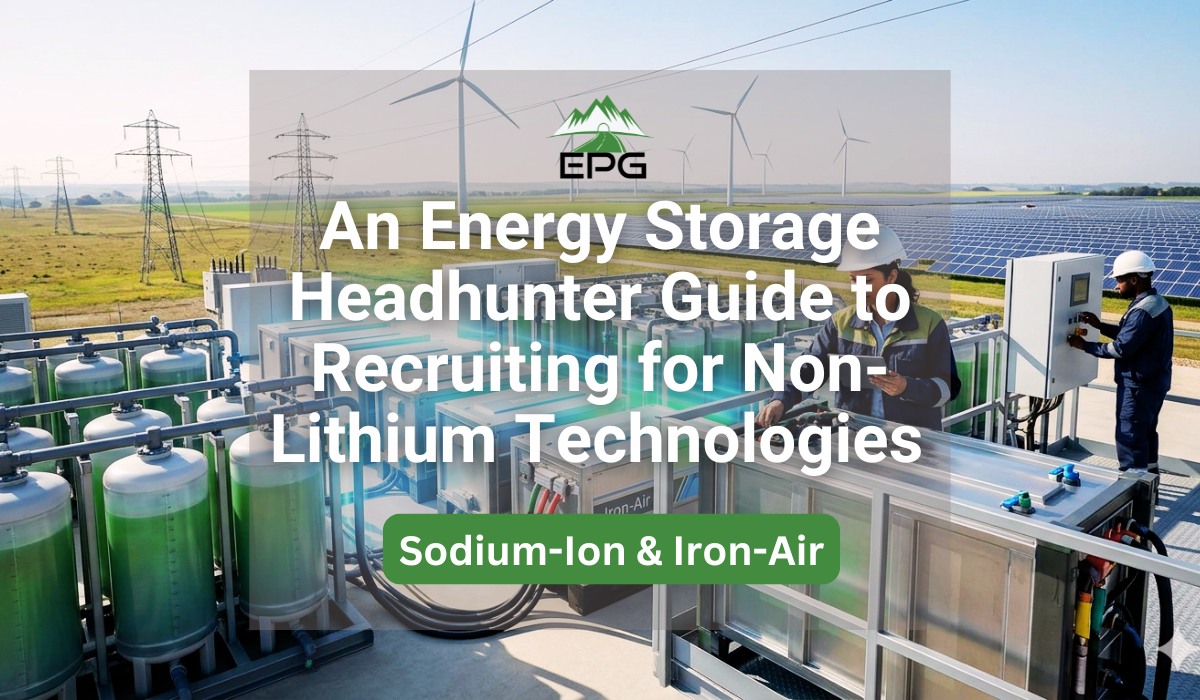
An Energy Storage Headhunter Guide to Recruiting for Non-Lithium Technologies (Sodium-Ion & Iron-Air)
Snapshot: Navigating the BESS Talent Gap for Non-Lithium Technologies
The global shift toward renewable energy is driving massive growth in the BESS sector, specifically within emerging non-lithium technologies like Sodium-Ion and Iron-Air. However, a structural talent shortage has emerged; IEA data from early 2026 shows that while the power sector is now the world’s largest energy employer, graduations from relevant technical programs are lagging behind demand by nearly 50%. This article explores how a specialized energy storage headhunter provides a competitive edge by leveraging deep industry networks to secure the rare “grid-forming” and chemical engineering talent required to scale 2026’s specialized storage solutions.
The Battery Energy Storage System (BESS) sector has officially entered the “Age of Electricity.” According to the IEA World Energy Employment 2025/2026 report, the electricity sector is now the largest employer in the global energy industry, surpassing fuel supply for the first time in history.
As the market matures, the spotlight has shifted from standard Lithium-ion to long-duration and cost-effective alternatives. BloombergNEF (BNEF) recently confirmed a historic milestone in March 2026: the global benchmark cost for battery storage projects has plummeted 27% year-on-year to $78/MWh. This price collapse, driven by manufacturing overcapacity and improved system design, has made non-lithium technologies like Sodium-Ion and Iron-Air not just viable, but economically s0uperior for grid-scale stability. In fact, the real news in 2026 is the “100-hour” breakthrough of Iron-Air, which is reaching costs as low as $20–$35/kWh – roughly one-tenth the cost of lithium.
However, as these technologies scale, a “Technical Cliff” has emerged. Data indicates that while economy-wide demand for applied technical workers grew by 16%, graduations from vocational and specialized engineering programs increased by only 9%. For companies at the forefront of this transition, the challenge is no longer just finding “engineers”—it is finding the rare specialists capable of navigating a non-lithium world. This is where the strategic role of an energy storage headhunter becomes indispensable.
The 2026 Talent Crisis: Why “Generalist” Recruiting Fails
Recruiting for Sodium-Ion or Iron-Air isn’t a lateral move from traditional BESS. It requires a specific convergence of disciplines that are currently in high demand across the globe:
-
The Rise of Grid-Forming Requirements: As of January 2026, major markets like Germany (under VDE FNN regulations) and Australia have begun mandating “grid-forming” capabilities for BESS to ensure grid stability. This has created a 180% surge in demand for power electronics engineers who can design inverters that provide synthetic inertia.
-
Sodium-Ion Specialization: With Sodium-ion reaching price parity, firms like CATL and Peak Energy are aggressively expanding. This has led to a fierce “war for talent” in solid-state chemistry and materials science – skills that are currently being drained from the semiconductor and EV sectors.
-
The AI Data Center Bottleneck: Wood Mackenzie reports that in 2026, data centers are co-locating BESS to manage “training loads” that jump from 10% to 90% capacity in milliseconds. This requires a specific type of engineer who understands high-cycling resilience and millisecond-response power blocks.
-
The Iron-Air Frontier: The most significant development in 2026 is the deployment of Iron-Air technology to solve the “AI power crisis.” In March 2026, Google and Xcel Energy announced the world’s largest battery project by energy capacity—a 30 GWh Iron-Air system in Minnesota designed to provide 100 hours of continuous discharge. Managing these ramps requires a specific type of engineer who understands:
-
The Chemistry of Rust: Iron-Air batteries operate on “reversible rusting” – absorbing oxygen to create rust (discharge) and removing it to revert to iron (charge).
-
LDES Orchestration: Recruiting for these roles requires finding talent from niche metallurgy, aerospace thermal management, and chemical processing labs where this expertise is currently “embedded.”
-
Why an Energy Storage Headhunter is the Strategic Solution
In a market where professionals are approached an average of 6.26 times per year regarding new roles (GETI 2026), standard job boards are ineffective. A specialized energy storage headhunter acts as a technical intermediary, providing:
-
Access to Passive Talent: 70% of the high-level engineers required for Iron-Air or Flow Battery development are not actively looking; they are already embedded in R&D labs. A headhunter maintains the long-term relationships needed to move these “pioneer” candidates.
-
Cross-Sector Identification: Identifying that a materials scientist from a niche metallurgy firm possesses the exact “oxidation-cycle” expertise needed for an Iron-Air project.
-
Vetting for Grid-Forming Expertise: With new 2026 regulations, a headhunter ensures candidates are not just “familiar” with inverters, but are capable of achieving the specific certifications (like the German inertia service market standards) required for project bankability.
Frequently Asked Questions (FAQs)
1. Why is 2026 a turning point for Sodium-Ion recruitment?
In early 2026, BloombergNEF reported that Sodium-ion costs hit a $78/MWh benchmark. This has led to a massive influx of capital into the sector, creating an immediate need for engineers who understand non-lithium electrochemistry—a pool that is significantly smaller than the traditional Li-ion workforce.
2. What is “Grid-Forming” technology, and why is it a hiring priority?
Unlike traditional “grid-following” batteries, grid-forming inverters can stabilize the grid’s voltage and frequency independently. As coal and gas plants retire, regulators in Europe and Australia now mandate this capability, making engineers with this specific skill set the most “approached” professionals in the 2026 talent market.
3. How does an energy storage headhunter find talent for such new technologies?
We utilize “Information Gain” mapping. We look for transferable skills in adjacent high-tech industries—such as aerospace thermal management or semiconductor materials design—and vet them against the specific technical requirements of your BESS project.
4. What are the salary trends for BESS professionals in 2026?
According to the 2026 Global Energy Talent Index (GETI), pay optimism remains high. Over 73% of professionals expect salary increases this year, particularly in “Transitional Energy” roles like Transmission & Distribution (T&D) and specialized BESS engineering.
5. How are data centers impacting the BESS talent search?
The “Race for Electrons” to power AI has led data centers to hire heavily from the BESS sector. They need engineers who can integrate storage to manage massive power ramps. This has increased competition for talent, making it harder for pure-play storage developers to hire without a dedicated headhunting partner.
Ready to Scale Your BESS Team?
The race for the next generation of energy storage won’t be won by technology alone—it will be won by the teams who build it. Whether you are seeking a Lead Scientist for Sodium-Ion development or a VP of Engineering to navigate the new grid-forming regulations, EPG is here to bridge the gap.
Schedule a call with our specialist team today to discuss 2026 hiring trends or fill out the form below to begin your search.
-
Inquire About Specialized Recruitment Services
About the Author: EPG