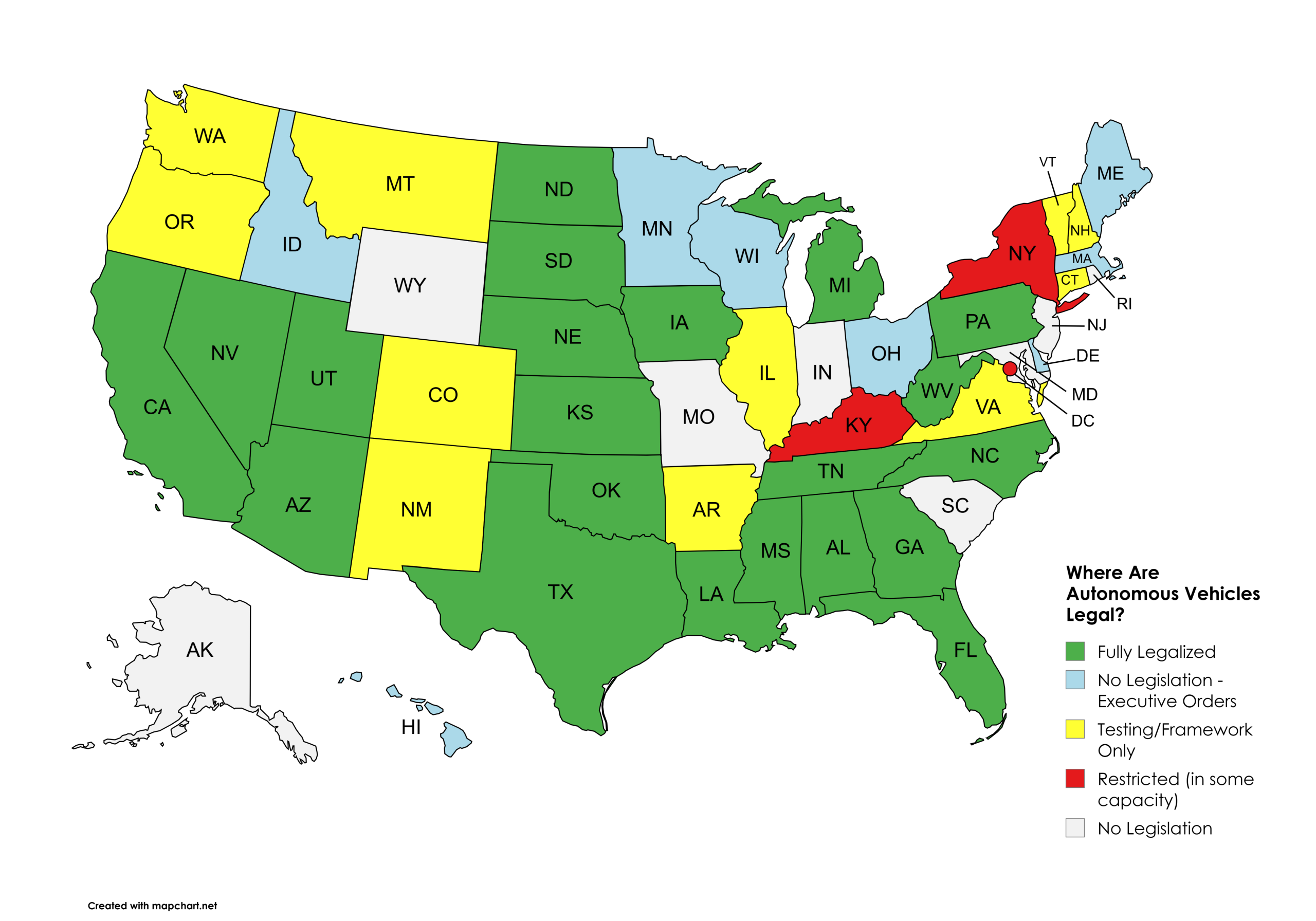
Where Are Autonomous Vehicles Legal?
Last updated: July 20, 2026
Autonomous vehicles are fully legal for driverless commercial and personal operation in 21 U.S. states, including major deployment hubs like Texas, California, Florida, Arizona, Georgia, and Michigan. Another 11 states permit testing under specific frameworks or pilot programs, while only a small minority – including Kentucky, New York, and Washington D.C. – enforce strict human safety driver mandates or heavy restrictions.
The National Conference of State Legislatures (NCSL) has a comprehensive database that shows real-time information about which of the 50 states, Washington DC, and US Territories have enacted legislation and/or executive orders related to autonomous vehicles. The full database can be reviewed here. Some quick facts include:
- 8 states have issued only executive orders
- 35 states, including DC, have enacted legislation
- 8 states have not issued executive orders or enacted legislation
- 43 states, including DC, have either enacted legislation or issued executive orders
- In 2011, Nevada became the first state to authorize the operation of autonomous vehicles
Commercial Freight & Autonomous Trucking Regulations
State legislation regarding autonomous vehicles varies significantly between passenger robotaxis and heavy Class 8 commercial trucks. While 21 states permit full driverless operation across all vehicle classes, several jurisdictions enforce specific insurance minimums (such as California’s $5 million requirement or Alabama’s $2 million motor carrier liability mandate) or restrict heavy-duty freight testing.
As major long-haul freight corridors expand across Texas, Florida, Arizona, and Iowa, state legislatures are increasingly adopting specialized truck platooning and commercial transport exemptions to support autonomous logistics.
As of July 20, 2026, you can find complete information from each state in the table below.
| State | Enacted Statutes | Current Status | Current Operational Meaning |
|---|---|---|---|
| Alabama | SJR 81 (2016) SB 125 (2018) SB 47 (2019) SB 226 (2024 / Act 2024-453) |
Fully Legalized | Permits both commercial freight and personal-use autonomous vehicles to operate completely driverless. SB 226 established a $100k personal liability baseline and stripped local municipalities of all taxing and regulatory power over AVs. |
| Alaska | None enacted. (HB 217 / SB 148 pending in 2026 session) |
No Specific AV Legislation | No operational state statutes on the books. HB 217 passed the House floor in early 2026 and remains under Senate review; if passed, it will strictly mandate a physical human safety operator for commercial AV cargo under 10,000 lbs. |
| Arizona | HB 2159 (2017) HB 2422 (2018) HB 2813 (2021 / Act 117) SB 1333 (2022 / Act 256) SB 1320 (2025 / Act 19) |
Fully Legalized | Core framework governed by HB 2813. Fully legalizes complete commercial and personal driverless rollouts. 2025 Addition: SB 1320 expanded coverage to “implements of husbandry,” legalizing completely autonomous agricultural/farm machinery on state roads. |
| Arkansas | HB 1754 (2017 / Act 797) HB 1561 (2019 / Act 468) HB 1822 (2019 / Act 1052) HB 1562 (2021 / Act 619) HB 1321 (2023 / Act 94) |
Testing & Framework Only | Operations are restricted to State Highway Commission approved pilot programs. HB 1562 locked in mandatory motor carrier liability proof for autonomous commercial properties, while the 2023 revision officially defined advanced driver-assistive systems. |
| California | SB 1298 (2012) AB 1592 (2016) AB 87 / AB 1184 (2018) SB 500 / SB 570 (2021) SB 1398 (2022) AB 96 (2023) AB 1777 (2024 / Ch. 682) |
Fully Legalized | Expanded & Strictly Regulated: Permits fully driverless commercial robotaxis, and as of a landmark May 1, 2026 DMV rule update, opens state roads to driverless heavy trucks and transit fleets (following a 500k-mile safety driver testing buffer). Under AB 1777 (effective July 1, 2026), manufacturers face a zero-tolerance first-responder safety regime featuring mandatory 2-minute emergency geofence clearing and moving-violation citations routed directly to the corporate builder. |
| Colorado | SB 213 (2017 / Act 277) SB 239 (2019 / Act 387) SB 260 (2021 / Act 250) |
Testing & Framework Only | Authorizes AV operations if the onboard system can autonomously align with all state/federal traffic laws (otherwise requires CDOT and State Patrol oversight). The state holds exclusive regulatory preemption. Corrects past errors: heavy autonomous freight is not restricted by statute; labor-backed attempts to legally mandate an in-cab human CDL operator were sequentially vetoed by Gov. Polis via HB25-1122 (2025) and HB26-1286 (May 28, 2026). |
| Connecticut | SB 260 (2017 / Act 17-69) SB 924 (2019 / Act 19-119) |
Testing & Framework Only | Strictly confined to a limited, municipality-vetted pilot structure capped at 4 testing zones. Under current codification (CT Gen. Stat. § 13a-260), the legal definition of an “operator” explicitly requires a physical human presence inside the cabin to engage or monitor the automated driving system, structurally barring complete “no-one-onboard” commercial operations. Legislative expansions (e.g., HB 6486) have repeatedly failed. |
| Delaware | Executive Order 14 (2017) (SB 46 pending/carryover in 2026) |
Executive Order Only | No operational state statutes have been enacted to explicitly permit or ban driverless operations; the state continues to defer to the 2017 advisory framework. Corrects past table errors: SB 46 is not an enacted law. It remains a heavily contested labor-backed push seeking to mandate a human driver in all Class A heavy-duty autonomous trucks. |
| District of Columbia | Autonomous Vehicle Act (2012) Act A26-0035 (2025 Emergency Patch) (B26-0684 active in July 2026 hearings) |
Restrictive / Permit Required | The permanent baseline remains the 2012 Act, requiring an in-cab human ready to intervene. This has been reinforced by a continuous chain of serial emergency/temporary permit laws (most recently Act A26-0035). Active Transition: The permanent commercial ban is under heavy debate; B26-0684 (Autonomous Vehicle Deployment Authorization Act) officially advanced to public committee hearings on July 13, 2026, mapping a path toward legalizing commercial, driverless robotaxi operations via a DDOT permit program. |
| Florida | HB 1207 (2012) HB 7027 (2016) HB 311 (2019) HB 1289 (2021) HB 425 (2023 / Act 2023-197) |
Fully Legalized | Permits fully driverless operations statewide across personal, commercial, and freight platforms without an intrusive state testing mandate (codified by HB 311). Low-speed delivery robots are fully legal on paths up to 45 mph (via 2021 law). Addition: HB 425 (2023) legally requires FDOT to systematically grade the state highway system for AV optimization and physical compatibility. A 2026 attempt to force human safety operators onto localized commercial delivery runs (SB 1258) failed. |
| Georgia | HB 472 (2017 / Act 267) SB 219 (2017 / Act 214) |
Fully Legalized | Full driverless operations are completely authorized under Ga. Code § 40-8-11, completely exempting fully autonomous systems from typical mechanical or physical driver license constraints provided basic insurance metrics are maintained. This stable context has paved the way for active commercial robotaxi networks in Atlanta and automated heavy freight corridors running along the Dallas–Atlanta path. Alternate equipment overhauls (HB 249) and formal code review studies (HR 1371) have failed. |
| Hawaii | Executive Order 2017-07 (HCR 220 study enacted 2019) |
Executive Order Only | Lacks a permanent statutory framework for testing or deployment, continuing to rely on Governor Ige’s 2017 directive. The 2019 adoption of HCR 220 only established an advisory legal task force under the Attorney General. Defensive Pushback: A strong labor-backed effort in early 2026 via HB 1797 sought to mandate human supervisors on all commercial passenger AVs but failed in committee. Past severe proposals, including a Class C felony for automated transit interference (HB 1725), have consistently stalled. |
| Idaho | None (Executive Order 2018-01) | Executive Order Only | No active state statutes govern, permit, or restrict autonomous deployments on public roads. Testing operates informally under Executive Order 2018-01, which tasks an autonomous vehicle working group to review safety frameworks and coordinate testing. Corrects past table errors: there is no statutory permission panel or case-by-case permit system; testing remains broad and largely unregulated across the state. |
| Illinois | HB 791 (2017 / Act No. 352) (SB 3392 / HB 4663 pending in 2026) |
Testing & Framework Only | The standalone legal anchor remains the 2017 law (HB 791), which strips local municipalities and home-rule units of the power to ban autonomous testing on local roads. Active 2026 Tension: The state is facing a massive wave of competing proposals. Labor and local interests are aggressively pushing SB 3392 and HB 4663, which remain pending in committee and seek to confine pilot operations strictly to massive metropolitan areas (counties with over 1 million residents, effectively isolating pilots to Cook County/Chicago). Comprehensive commercial frameworks like the Automated Driving Systems Development Act (HB 4789) remain deadlocked. |
| Indiana | HB 1290 (2018 / Act No. 185) (HB 1377 failed 2025) |
No Specific AV Legislation | Lacks any overarching statutory guidelines or permit systems for autonomous passenger cars. The only signed law is a tiny carve-out within the 2018 transportation finance package (HB 1290) that exempts commercial truck platoons from following-too-closely traffic violations. Broad deployment bills (HB 1341) have failed. Labor Pushback: Recent attempts to actively hinder freight development, including 2025’s HB 1377 which aimed to mandate a fully licensed human operator inside all autonomous tractor-trailers, adjourned without passing. |
| Iowa | SF 302 (2019 / Enacted) (HB 2375 / HB 2673 failed 2026) |
Fully Legalized | Completely legalizes full, driverless operational deployment on public highways across commercial, freight, and passenger platforms via SF 302, provided minimum insurance liabilities and federal safety benchmarks are sustained. Defeated Rollbacks: The state’s permissive environment faced major friction in early 2026. A coordinated legislative push introduced HB 2375 (mandating physical human drivers in all AVs) and HB 2673 (banning driverless vehicles from transporting hazardous materials). Both restrictive updates were successfully defeated and adjourned, leaving Iowa’s open framework completely intact. |
| Kansas | SB 313 (2022 / Enacted) (SB 379 / SB 546 failed) |
Fully Legalized | Bypasses testing-only limits to authorize full driverless operations on public roads under SB 313. It establishes an active Autonomous Vehicle Advisory Committee to oversee regulatory changes and rules that the owner of an automated driving system is considered the vehicle operator for traffic compliance. Corrects past table errors: SB 379 failed to pass; the framework is entirely grounded in SB 313. |
| Kentucky | HB 7 (2024 / Veto Overridden) (SB 116 platooning 2018 / 2025–2026 rollbacks failed) |
Actively Restricted | Imposes a highly constrained operating environment following a historic legislative veto override of HB 7. While lightweight passenger vehicles are technically permitted to test without a driver, the framework enforces a strict statutory mandate requiring a physical human operator inside all heavy autonomous commercial vehicles exceeding declared weight thresholds. Defeated Extensions: Additional union-backed attempts to expand these restrictions to completely ban localized autonomous student transport and school buses (HB 252, HB 223) uniformly failed in committee. |
| Louisiana | HB 455 (2019 / Act 232) SB 453 (2022 / Act 268) (HB 308 platooning 2018) |
Fully Legalized | Operates a highly permissive commercial and passenger ecosystem under HB 455, requiring a simple written self-certification statement to be filed with the DOTD. This baseline was heavily advanced by SB 453 (2022), which statutorily exempts custom driverless designs from human-centric equipment mandates (e.g., throwing out requirements for steering wheels, physical brakes, or mirrors). Routine administrative updates regarding state highway shoulders (2026 SB 133) and wireless device rules (2025 HB 519) maintain proper agency oversight without disrupting deployment. |
| Maine | Executive Order 2018-001 (HP 1204 study enacted 2018) |
Executive Order Only | Lacks a permanent statutory framework to explicitly permit or license autonomous vehicle fleets. Operations are governed strictly under Executive Order 2018-001, which tasks the Highly Automated Vehicles (HAV) Advisory Committee with evaluating deployments. Companies are strictly required to clear a state evaluation and obtain an active pilot permit prior to running any driverless systems on public ways. Enacted HP 1204 (2018) serves solely as a study directive; comprehensive statutory rules like the Automated Driving Safety Act (HB 1222) failed to pass. |
| Maryland | SB 685 / HB 806 (2023 / Enacted) (2025–2026 deployment bills failed) |
No Specific AV Legislation | Maintains no active testing permit or general deployment licensing framework for standard passenger autonomous cars. However, SB 685 (Act 500) establishes a distinct commercial carve-out, formally authorizing autonomous vehicle converters to buy, alter, and lease automated fleets strictly intended for commercial or industrial applications. Defeated Frameworks: The state faces a brick wall for consumer rollouts. Massive cross-filed deployment bills mapping out permanent rules and linking vehicle data to the Online Data Privacy Act (SB 909 / HB 1295) uniformly failed and adjourned in early 2026, alongside defeated union-backed attempts to pass permanent human safety operator mandates (2025 HB 439). |
| Massachusetts | None (Executive Order 572) | Executive Order Only | Maintains zero permanent statutory laws due to a multi-year legislative gridlock stretching from 2017 through 2026. Public road operations are strictly managed under Executive Order 572, requiring testers to enter into a formal Memorandum of Understanding (MOU) with the MassDOT AV Working Group. Stalled Mandates: The legislature remains deadlocked on an aggressively recurring environmental proposal (pushed across consecutive years via HB 3417, HB 3434, and HB 3649) that attempts to statutorily restrict all autonomous vehicle capabilities exclusively to zero-emission and electric vehicles. |
| Michigan | SB 995–998 (2016) SB 706 (2022 / Enacted) HB 6369 (2022 / Enacted) |
Fully Legalized | Maintains arguably the nation’s most permissive environment, legally permitting driverless deployment without in-cab operators via the 2016 SAVE Act. This framework was heavily expanded by SB 706 (2022), which formally integrated automated vehicles into state traffic rules and HOV lanes. Local Prohibitions Preempted: Moving to explicitly protect robotaxi deployments, HB 6369 strips local units of government of regulatory control, banning local municipalities from enforcing separate regional fees, licensing, franchises, or operating restrictions on autonomous ride-hailing networks. |
| Minnesota | HB 6 (2019 / Act No. 3) (Executive Order 19-18 / 2026 bills failed) |
Executive Order Only | Lacks a comprehensive permanent statutory permitting system for consumer autonomous cars, choosing instead to handle operational frameworks via MnDOT under Executive Order 19-18. This directive empowers the Governor’s Advisory Council on Connected and Automated Vehicles to safely coordinate pilot projects. The 2019 passage of the omnibus transport package (HB 6) serves as the primary legislative base for funding state automated vehicle integration studies. 2026 Friction: The state legislature witnessed a massive gridlock during the 2026 session; competing union-backed bills seeking to impose heavy criminal penalties on driverless commercial trucks (HB 3810) and commercial fleet frameworks trying to legalize automated rideshare deployments (HB 4521) all uniformly failed to cross the finish line. |
| Mississippi | HB 1003 (2023 / Enacted) SB 2269 (2026 / Enacted) (HB 1343 platooning 2018) |
Fully Legalized | Formally transitions into a highly permissive environment via the Mississippi Fully Autonomous Vehicle Enabling (MS FAVE) Act of 2023 (HB 1003). The statute completely authorizes driverless passenger and commercial freight operations across public roadways without a conventional operator inside the cab. To maintain compliance, entities must pre-submit a structured law enforcement interaction plan to the Department of Public Safety—a key mandate explicitly renewed and extended via SB 2269 in early 2026. Commercial truck platooning operates broadly under historical 2018 frameworks (HB 1343). |
| Missouri | None (All historical bills failed) |
No Specific AV Legislation | |
| Montana | SB 67 (2025 / Enacted) HB 97 (2025 / Enacted) (HB 339 failed 2023) |
Testing & Framework Only | Establishes a highly distinct, tightly supervised environment under the Montana Automated Driving Systems Act of 2025 (SB 67). While the statute grants open access to Level 1 through Level 3 systems, it subjects full Level 4 and Level 5 driverless commercial fleets to strict agency gatekeeping. The law grants the MDT sweeping authority to actively suspend or restrict driverless vehicles during predicted or active periods of hazardous weather or dangerous road conditions, unless a company proves unique all-weather safety compliance. Commercial freight platooning is similarly monitored under HB 97 (2025), which mandates a formal safety study and a state-issued special permit system for connected operations. |
| Nebraska | LB 989 (2018 / Enacted) (2019–2022 liability bills pending) |
Fully Legalized | Bypasses strict testing limits to completely legalize full driverless deployment under LB 989. The statute authorizes public transit, commercial delivery, and on-demand rideshare networks to run driverless vehicles without human operators. Crucially, the act enforces a heavy preemption clause banning any political subdivisions or local cities from creating special regional taxes, custom permitting rules, or operational constraints targeted at autonomous configurations. Subsequent efforts to modify structural automated vehicle liability (LB 142) stalled out in committee. |
| Nevada | AB 511 (2011) / AB 69 (2017) SB 288 (2021) / SB 182 (2023) AB 523 (2025 / Enacted) |
Fully Legalized | The original pioneer of automated vehicle legislation. Enacted AB 511 and AB 69 to authorize comprehensive driverless commercial operations across passenger taxicabs, local package logistics, and heavy commercial truck fleets. This permissive foundation was heavily advanced by SB 288 (2021), which permitted autonomous networks to integrate directly into commercial rideshare apps, and SB 182 (2023), which exempted manufacturers from traditional physical dealership/franchise mandates. Moving into late 2025, the state passed AB 523 to systematically refine TNC insurance liabilities for monitored autonomous providers, while successfully defeating a major protectionist attempt via SB 395 that sought to impose human driver prerequisites. |
| New Hampshire | SB 216 (2019 / Act No. 2019-310) (HB 314 vetoed / HB 1459 died) |
Testing & Framework Only | Maintains an active, controlled pilot environment under SB 216, which legally created the Automated Vehicle Testing and Deployment Commission and authorized structured state testing programs. Broader frameworks attempting to legalize unconstrained commercial deployments and consumer licensing options were aggressively curbed when HB 314 was officially Vetoed by the Governor. Prohibitions Blocked: Industry interests successfully defeated early protectionist efforts via HB 1459, which explicitly sought to pass a blanket statutory ban on all autonomous systems operating on public state highways. |
| New Jersey | AJR 164 (2019 / Act No. 2019-2) (2022–2026 pilot and training bills pending) |
No Specific AV Legislation | Lacks an active statutory permitting framework or general deployment licensing track for autonomous passenger fleets. Enacted AJR 164 (2019) established the Advanced Autonomous Vehicle Task Force to systematically review regulatory conflicts. Though the panel completed its research in 2020, the legislature never codified its findings. Stagnant Docket: The state remains stuck in a multi-year legislative loop; an endless stream of proposals for specialized driver license endorsements (NJ A 1187), police interaction training (NJ A 958), and state-permitted pilot frameworks (NJ S 1677 / NJ A 3968) have continuously stalled in committee through mid-2026. Severe legacy hurdles, including a bill forcing all autonomous cars to carry physical breathalyzer interlocks (2017 HB 554), similarly died. |
| New Mexico | HB 270 (2021 / Act No. 114) (SJM 3 study adopted 2018 / 2025 bills failed) |
Testing & Framework Only | Formally structures a supervised, permit-gated environment following the successful 2021 enactment of HB 270 (Act 114). This legislation permanently integrated automated technology definitions directly into the state’s Motor Vehicle Code, authorizing localized testing and commercial motor vehicle platooning strictly under a mandatory state-issued permit system, with no human operator required if the vehicle is fully autonomous. Stalled Restriction Attempt: A 2025 bill backed by the Teamsters (HB 148) sought to move the opposite direction — it would have mandated a licensed human operator physically present behind the wheel of every autonomous vehicle until 2036 and limited commercial AV operation to NHTSA-approved testing, rolling back the driverless allowances under HB 270. Opposed by AV industry groups, it died without passing its first committee. A separate 2023 bill to mandate in-cab human drivers for all commercial platforms (HB 378) also failed. |
| New York | SB 2005 (2017 / Act 55) AB 9508 (2018 / Act 58) (2023–2026 fleet bills pending) |
Actively Restricted | Imposes an exceptionally constrained operating environment, utilizing a continuous chain of state budget bill alterations (SB 2005 and AB 9508) to enforce strict, multi-agency DMV permitting guidelines that heavily complicate commercial scaling. Testing remains tightly bound to mandatory in-cab human safety operators and active police supervision corridors. Freight & Taxi Stalemate: The legislature continues to heavily restrict commercial models; union-backed efforts through mid-2026 (SB 7956 / SB 7758) seek to permanently ban driverless heavy freight over 10,01 lbs, while competing urban proposals (SB 10413 / SB 2688) aim to lock autonomous taxi and livery networks behind separate, highly restricted New York City TLC license mandates. Standard commercial legalization measures (SB 344) remain frozen. |
| North Carolina | HB 469 (2017 / Act 2017-166) HB 716 (2017 / Act 2017-169) HB 814 (2021 / Act 2021-179) |
Fully Legalized | Establishes an exceptionally open and permanent statewide deployment ecosystem under HB 469. The baseline statute completely authorizes fully driverless operations across all public highways, explicitly asserting that an active automated driving system is considered the legal driver, thereby exempting fleet vehicles from human driver licensing criteria. Commercial freight platooning runs broadly under HB 716. Automated Delivery Expansion: Advancing past basic passenger car allowances, the state enacted HB 814 to formally authorize the commercial operation of neighborhood occupantless delivery vehicles, creating explicit structural equipment rules and legal exemptions for pilot-less logistics systems on regional roadways. Minor safety restrictions include a strict minimum age requirement of 12 years old for any unaccompanied minor riding solo. |
| North Dakota | HB 1202 (2017 / Act 388) HB 1418 (2019 / Act 302) (HB 1199 platooning 2019 / 2025 truck bans failed) |
Fully Legalized | Maintains an open statewide operational environment centralized under the sole jurisdiction of NDDOT. Early testing frameworks under HB 1202 were rapidly scaled by the passage of HB 1418, which formally legalized automated vehicle network companies and authorized driverless passenger fleet networks on public ways. Commercial truck platooning distance rules are explicitly relaxed via HB 1199. Permissive Support: Solidifying its supportive position, the state enacted 2023 HB 1519 to supply active state funding grants for autonomous and uncrewed tech, while successfully defeating a major protectionist effort in early 2025 via HB 1614 that attempted to pass strict human operator rules for automated truck tractors. |
| Ohio | EO 2018-04K (2018) EO 2019-26D (2019) (HB 26 2017 AV rider line-item vetoed / HB 519 & HB 699 died in committee) |
Executive Order Only | Governs autonomous vehicle activity exclusively through executive action, with no surviving statute behind it. EO 2018-04K opened every public road and highway to registered AV testing under a designated safety operator, and successor EO 2019-26D reauthorized DriveOhio as the statewide smart mobility hub. Legislative Dead Ends: A 2017 transportation budget rider creating a Smart Transportation Action Advisory Team was line-item vetoed before taking effect, and separate 2018 bills to create an Ohio Council on Transportation Technology (HB 519) and to set automated commercial motor vehicle requirements (HB 699) both stalled in the House Transportation and Public Safety Committee. |
| Oklahoma | SB 1541 (2022 / Act No. 132) (SB 365 2019 Act 316 preemption / SB 189 2019 Act 244 platooning) |
Fully Legalized | Authorizes the operation of fully autonomous vehicles without a human driver under SB 1541, conditioned on filing a law enforcement interaction plan with the Department of Public Safety, carrying proof of financial responsibility, and remaining at the scene of qualifying accidents. This built on two earlier enacted statutes: SB 365 (2019) created the State Driving Automation System Uniformity Act, establishing definitions and preempting local ordinances, while SB 189 (2019) amended the “following too closely” rule to permit truck platooning. Failed Overreach: Two 2022 bills that would have treated the automated driving system itself as the licensed operator (HB 3317, HB 3483) both died before passage. |
| Oregon | HB 4063 (2018 / Act No. 94) (HB 4085 2026 driverless expansion failed / HB 2671 2025 testing bill died) |
Testing & Framework Only | Permits operation of autonomous vehicles on Oregon highways under certain circumstances via HB 4063, which designates ODOT as the state’s lead AV agency, directs owners of commercial autonomous vehicles to carry additional liability insurance, and requires ODOT to adopt operating rules. Full commercial deployment without an onboard operator is not yet authorized. Stalled Expansion: A 2026 bill (HB 4085) that would have allowed companies like Waymo to run fully driverless rides and deliveries died in the Joint Committee on Transportation, and a 2025 bill to formalize highly automated vehicle testing (HB 2671) also failed. |
| Pennsylvania | HB 1958 (2018 / Enacted) HB 2398 (2022 / Act 130) (SB 965 platooning bill died 2022 / HR 563 2026 study pending) |
Fully Legalized | Established an initial highly automated vehicle and platooning framework under HB 1958 (2018), then expanded it into full commercial legalization via HB 2398 (2022), enacted as Act 130. Act 130 amends Title 75 to let certified Highly Automated Vehicles (HAVs) operate at SAE Level 3–5 with or without an onboard human driver, using a self-certification “certificate of compliance” process reviewed by PennDOT, and strengthens preemption of local AV ordinances. Stalled Additions: A 2022 bill to add detailed platooning and accident-reporting rules (SB 965) died in Senate Appropriations, and a 2026 resolution directing a study on driverless vehicles’ safety and workforce impact (HR 563) remains pending. |
| Rhode Island | None | No Specific AV Legislation | Has no enacted statute or executive order governing autonomous vehicles. All activity to date has run through RIDOT as an administrative public-private partnership rather than a permitting law: the “Little Roady” autonomous shuttle pilot, operated by May Mobility, began low-speed testing at Quonset Business Park before expanding to a free public route in Providence. The program was funded through a combination of RIDOT and Federal Highway Administration money and a state Attorney General settlement grant, with no statutory testing or deployment framework behind it. |
| South Carolina | HB 3289 (2017 / Act No. 66) | No Specific AV Legislation | Lacks an active statutory framework, DMV permit track, or safety rules for autonomous passenger cars and robotaxis. The single signed law on the books is HB 3289 (2017), which establishes a distinct freight carve-out by exempting electronically coordinated truck platoons from standard vehicle proximity and following-too-closely traffic violations. Standard automated car deployments remain entirely unaddressed. |
| South Dakota | HB 1095 (2024 / Act No. 122) (HB 1068 platooning enacted 2019 / 2023 bills failed) |
Fully Legalized | Bypasses testing constraints to fully authorize unconstrained commercial and passenger automated deployments under HB 1095. The statute permanently establishes that an engaged Automated Driving System (ADS) satisfies all legal definition prerequisites of a “driver” under state traffic codes, explicitly authorizing driverless operations without an in-cab human supervisor provided the system complies with federal safety standards and automatically achieves a minimal risk condition upon system failure. Early freight platooning framework tracks were established via 2019’s HB 1068. |
| Tennessee | SB 151 (2017 / Act 474) SB 676 (2017 / Act 171) SB 2253 (2026 / Act No. 726) |
Fully Legalized | Operates a deeply entrenched, highly permissive commercial and consumer ecosystem via the landmark Automated Vehicles Act foundations (SB 151), which authorize full driverless operation and completely block political subdivisions from local interference. Commercial truck platooning operates broadly under SB 676 notification rules. 2026 Traffic Enforcement Integration: Advancing the statutory framework to handle mature deployments, the state enacted SB 2253 (April 2026), which establishes clear legal processing rules for automated traffic violations, mandating that moving citations or traffic notices involving an active driverless system are to be officially routed and mailed directly to the registered vehicle owner or fleet operator. |
| Texas | SB 2205 (2017 / Act 973) HB 1791 (2017 / Act 19) HB 3026 (2021 / Act No. 892) |
Fully Legalized | Acts as the nation’s core commercial deployment center for fully driverless long-haul freight and massive urban passenger robotaxi networks. SB 2205 legally defines the active automated driving system as the licensed vehicle operator, completely authorizing unmanned operation without fallback human drivers. Connected commercial platooning runs via HB 1791, while HB 3026 (2021) systematically cleaned and modernized state codes for mature AV integration. Massive Rollback Wave Blocked: Permissive state status survived intense political friction. A highly coordinated multi-year labor push attempting to mandate physical safety operators (2023 HB 3274 / 2025 HB 4402), unilaterally reassign collision liabilities (2025 HB 5117), and establish strict new computer system criminal offenses (2025 SB 2425) uniformly failed to pass, preserving the state’s unconstrained framework. |
| Utah | HB 101 (2019 / Act 459) SB 56 (2018 / Act 263) (2026 public transit bills failed) |
Fully Legalized | Bypasses standard testing limits to fully authorize unconstrained commercial deployment and consumer operation of driverless-capable vehicles under HB 101. The statute permanently modifies traffic, titling, and licensing codes to establish that a validated automated driving system satisfies all legal requirements of a driver, enabling unmanned operations across public roads without human backup supervisors. Commercial truck platooning operates broadly under SB 56. Active Transit Pushes: Highlighting market maturity, the legislature aggressively debated 2026’s HB 581, which sought to formally direct the state DOT to assemble structural data networks for an autonomous public transit framework. While that transit bill failed, competing restrictive attempts to explicitly ban driverless rideshare fleets from transporting unaccompanied minors (HB 414) were successfully defeated. |
| Vermont | SB 149 (2019 / Act No. 60) (HB 494 study enacted 2017) |
Testing & Framework Only | Maintains a highly supervised, permit-gated operational testing sandbox under the Automated Vehicle Testing Program established via SB 149. The statute charges the Department of Motor Vehicles with evaluating individual applications and enforcing strict operator prerequisites and multi-layered insurance thresholds before any autonomous vehicle can integrate onto public highways. Early infrastructure research and spending coordination tracks were initialized under 2017’s omnibus transportation act (HB 494), but the legislature has stalled on advancing these rules into an open, unconstrained commercial deployment track. |
| Virginia | HB 582 (2026 / Act No. 179) HB 1124 (2026 / Act No. 738) (SB 670 commercial deployment bill carried over to 2027) | Testing & Framework Only | Allows public road testing and validation of automated platforms under existing traffic safety and financial responsibility codes. Tech giants utilize manually mapped regions for controlled public test loops, but full commercial deployment of driverless passenger fleets remains blocked. Targeted Testing Pilots: Advancing past generic passenger cars, the state enacted HB 582 (2026) to authorize a highly specialized testing framework—creating a VDOT-regulated pilot program to implement and deploy autonomous truck-mounted attenuators to protect mobile highway construction zones. Deployment Gridlock & Labor Impact: Broad statewide commercial rollout rules are heavily deadlocked. While HB 1125 died early, the Senate successfully postponed SB 670, carrying it over to the next session to buy time for a safety licensing framework. To manage this transition, the state passed HB 1124 (2026), explicitly directing a specialized transportation and public safety work group to systematically assess and report on the long-term regional labor and workforce displacement impacts of future driverless vehicle deployment. |
| Washington | HB 2676 (2020 / Act No. 182) SB 5460 (2021 / Act No. 193) (2023–2026 deployment bills failed) | Testing & Framework Only | Maintains a strictly regulated, permit-gated environment anchored by Governor Jay Inslee’s legacy Executive Order 17-02 and subsequent statutory integrations. Enacted HB 2676 (2020) formally codified baseline AV testing requirements, notably mandating a strict $5 million minimum umbrella insurance policy for any active public testing operations. The regulatory framework was slightly expanded via SB 5460 (2021), which implemented recommendations from the state’s Autonomous Vehicle Work Group to cleanly define “autonomous” and remove archaic traffic laws regarding in-vehicle video screens. Commercial Expansion Stagnation: Legislative pushes to evolve past basic testing into full commercial operations have repeatedly hit dead ends through mid-2026. Broad operational bills (SB 5594, HB 1984, and SB 5042) languished as carryovers, and a recent 2026 push to legalize widespread autonomous deployment (SB 6243) died in the Senate Transportation Committee. |
| West Virginia | HB 4787 (2022 / Act No. 190) HB 4675 (2022 / Act No. 189) (2017 legacy safety bills failed) | Fully Legalized | Maintains an exceptionally open and highly progressive commercial operating environment following a massive dual-bill legislative push in 2022. The state permanently legalized driverless systems on all public roads by enacting the Fully Autonomous Vehicle Act via HB 4787. This baseline statute completely authorizes driverless commercial motor carriers, autonomous passenger networks, and vehicle platooning, while explicitly asserting that an automated system functions as the legal driver and blocking local municipal interference or preemption. Delivery Grid Expansion: Advancing its commercial logistical capabilities concurrently, the state enacted HB 4675 to formally regulate and legalize occupantless, low-speed autonomous delivery vehicles on public corridors, using speed-gated caps to safely integrate sidewalk-to-roadway shipping applications. Legacy protectionist hurdles, such as a 2017 effort to mandate strict design restrictions on all operational robotics (HB 2881), died years prior. |
| Wisconsin | EO 245 (2017) SB 695 (2018 / Act No. 294) (2026 highway operational bills failed) | Executive Order Only | Governs general autonomous vehicle testing and infrastructure evaluation exclusively through executive action, lacking a comprehensive statutory deployment framework. Under Executive Order 245, the state relies on the Governor’s Steering Committee on Autonomous and Connected Vehicle Testing and Deployment to systematically review local safety scenarios and infrastructure barriers. Platooning Exception & Legislative Friction: While broad driverless deployment lacks codification, the state passed a narrow statutory carve-out via SB 695 (2018), which explicitly relaxed motor vehicle trailing distance limits to legalise commercial truck platooning. Sweeping legislative pushes to permanently codify and license full autonomous operations on public highways remain frozen; the most recent paired attempts in early 2026 (SB 831 and AB 848) both failed to pass their respective chambers, keeping the state tethered to its committee-led executive review process. |
| Wyoming | None (2019–2022 regulatory bills failed) | No Specific AV Legislation | Lacks any codified statutory structure, active permitting gates, or executive directives regarding autonomous driving system targets or commercial truck platooning brackets. AV operation is technically permitted across the state by default due to a complete absence of restrictive laws, though WYDOT requires testing groups to voluntarily coordinate their activities as a courtesy. Legislative Inertia: The legislature has repeatedly failed to pass basic foundational rules. A 2019 push to permit autonomous highway operations (HB 226) failed on introduction, a 2021 insurance and registration framework (SF 7) died in the House, and a comprehensive 2022 Appropriations Committee bill to establish regulatory fees and reporting frameworks (SF 16) died on the Senate docket, leaving the state entirely unregulated. |
Human Safety Operator Mandates & State Restrictions
Not all states permit complete driverless deployment. A small group of jurisdictions – including Kentucky, New York, and Washington D.C. – continue to require physical human safety operators behind the wheel for commercial property and passenger transportation.
For autonomous vehicle developers and fleet operators, navigating these local municipal permitting requirements and state-level preemption laws is critical when planning regional route testing and operational expansion.
Planning an Expansion into a Legalized State?
Navigating state-by-state laws is just step one. Check out our 2026 Autonomous Vehicle Salary & Hiring Guide to benchmark competitive compensation for Perception Engineers, Safety Leads, and Remote Operators in top deployment hubs.
Frequently Asked Questions
Which U.S. states allow fully autonomous vehicles?
As of 2026, 21 states fully legalize the commercial and personal operation of autonomous vehicles without requiring human safety drivers. Key deployment hubs include Texas, California, Florida, Arizona, Georgia, and Michigan, which lead the nation in commercial robotaxi fleets, autonomous freight corridors, and driverless testing miles.
Are driverless commercial trucks legal across state lines?
Yes, commercial autonomous freight is permitted in a growing number of jurisdictions, though regulations vary significantly by state. Heavy-duty autonomous trucks operate extensively across major freight corridors in states like Texas, Florida, and Iowa. Additionally, states like California have updated DMV frameworks to allow heavy-duty AV transit and freight testing.
What states restrict or ban autonomous vehicles?
Only a small number of jurisdictions explicitly restrict driverless operations, with Kentucky, New York, and Washington D.C. enforcing the most notable limitations. These jurisdictions generally require physical human safety drivers to remain inside commercial vehicles or mandate strict local municipal permitting before driverless testing can occur.
Is there a federal law governing autonomous vehicles?
No overarching federal law currently preempts state-level autonomous vehicle deployment, leaving operational rules under state jurisdiction. Federal regulatory bodies like NHTSA focus on vehicle design and safety standards, while individual states maintain control over vehicle licensing, driver operational requirements, and traffic enforcement laws.
How do emergency responders interact with autonomous vehicles on the road?
Autonomous vehicle manufacturers must provide emergency response protocols, including dedicated remote hotlines and geofencing capabilities. Advanced states like California enforce strict first-responder safety mandates, requiring AV operators to respond to emergency calls within seconds and immediately clear geofenced emergency zones.
Expanding Your AV Fleet or Engineering Teams into New Jurisdictions?
Navigating state-by-state AV laws is only half the battle—securing the niche engineering, safety, and operational talent to execute your deployment strategy is the rest. Whether you need specialized autonomous driving system (ADS) developers, localized fleet operations managers, or regulatory compliance specialists, EPG delivers the elite workforce your technology demands.
About the Author: EPG