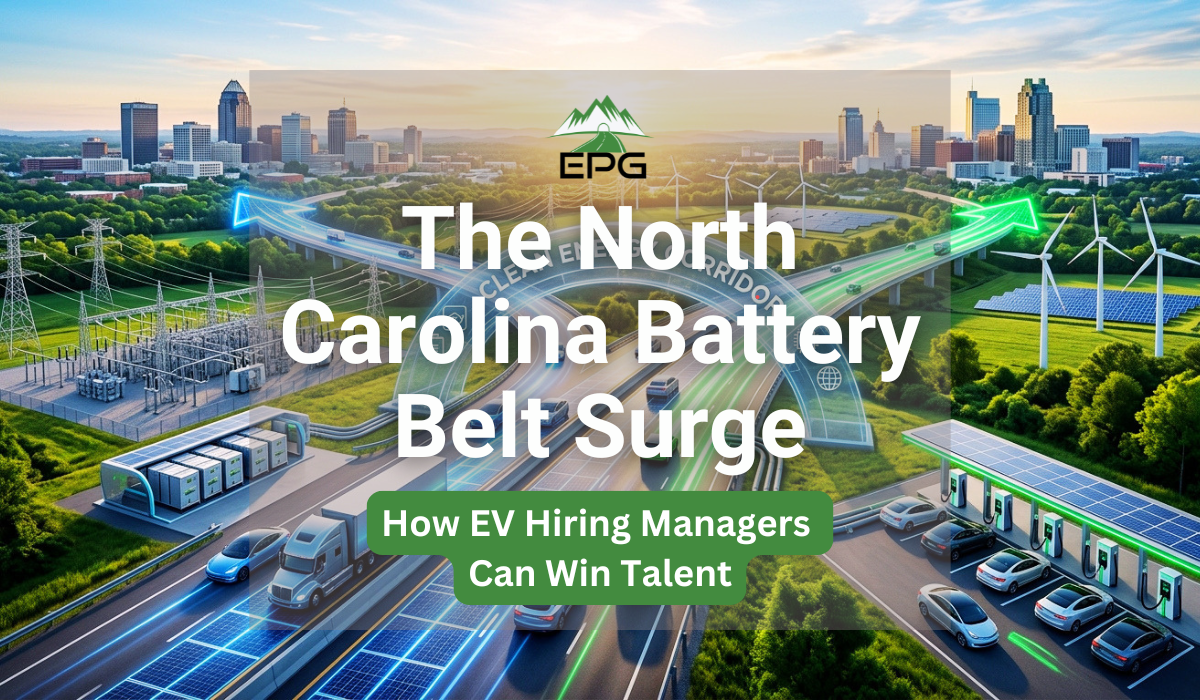
The North Carolina Battery Belt Surge: How EV Hiring Managers Can Win Talent
Summary: As North Carolina’s Piedmont Triad and Research Triangle establish the region as the premier U.S. “Battery Belt” hub, EV and clean-tech employers face an intense war for technical talent. Relying strictly on basic job-board scraping leaves talent acquisition leaders blind to where top candidates actually sit. Winning the region’s elite engineers, plant operators, and semiconductor specialists requires tapping into a multi-tiered academic grid (NC State, NC A&T, Duke, and regional community colleges), cross-industry sourcing pools (pharmaceutical cleanrooms, aerospace precision engineering, power electronics), leveraging key regional partnerships (such as Wolfspeed-Toyota), and capitalizing on state-backed clean-energy workforce training grants.
As the North American EV, battery, and advanced energy supply chains reorganize around regional gigafactories, Greensboro / Raleigh, NC has rapidly transformed into a core hub for Cell Manufacturing, Materials, silicon carbide semiconductors, and high-voltage power systems.
Driven by massive operational hiring ramps at Toyota Battery Mfg in Liberty and specialized high-energy cell expansion from Forge Battery in Morrisville, talent acquisition leaders face unprecedented local competition for specialized engineers, plant operators, and controls technicians. The region has officially outpaced traditional Midwestern logistics corridors in active battery-specific projects, making North Carolina ground zero for clean tech talent acquisition.
For Heads of People, Engineering VPs, and HR Directors, scaling operations in the Tar Heel state requires moving beyond standard tech-recruiting playbooks. Navigating the critical talent bottlenecks shaping the Greensboro-Raleigh market is essential to executing a high-converting candidate search.
1. Navigating the Local Talent Pipeline
While out-of-state relocation is a necessary safety valve, the fastest path to qualified talent involves tapping directly into the regional ecosystem spanning the Piedmont Triad and Research Triangle Park (RTP).
Academic Pipelines
- NC State (FREEDM, ChemE)
- NC A&T (STEPs4GROWTH)
- Duke (Pratt Energy Storage)
- JSNN (Nanoengineering)
- Community College Grid
(ACC, RCC, GTCC, Wake Tech)
Industry & Supply Chain Pools
- Silicon Carbide / Semi (Wolfspeed)
- Power Electronics CoE (Eaton)
- Bio-Pharma (Cleanroom/Slurry)
- Aerospace (IATF 16949/AS9100)
- Pouch Packaging (DNP)
- Realigned Auto Talent (VinFast)
Academic Partnerships & State Workforce Grants
-
North Carolina A&T State University (Greensboro): The country’s top producer of Black engineering graduates. Beyond its traditional Mechanical and Chemical Engineering programs, NC A&T leads STEPs4GROWTH – a $23.7M federal and state-backed clean energy workforce grant program using stackable certificates to build direct tech pipelines across NC.
-
North Carolina State University (Raleigh): A premier target for MS/PhD Chemical & Biomolecular Engineering graduates and high-voltage power electronics specialists coming out of the FREEDM Systems Center.
-
Duke University – Pratt School of Engineering (Durham): A major talent hub for advanced energy storage systems R&D, battery management system (BMS) software optimization, and electrochemical materials design.
-
Joint School of Nanoscience & Nanoengineering (JSNN): A joint initiative between UNCG and NC A&T specializing in advanced material characterization, thin-film coatings, and anode/cathode R&D.
-
Regional Community College Training Grid:
-
Randolph Community College (Asheboro) & Alamance Community College (Graham): Positioned adjacent to the Liberty megasite, offering dedicated cleanroom operations, automated systems, and customized industrial maintenance programs funded in part by NCWorks customized training grants.
-
Guilford Tech (GTCC) & Wake Tech: Active Li-ion manufacturing and mechatronics certificate programs producing high-calibre electrode coating techs, PLC programmers, and line maintenance technicians.
-
Cross-Industry & Supply Chain Sourcing Pools
If you are strictly hunting candidates with direct lithium-ion battery backgrounds, your candidate universe will feel dangerously small. Smart hiring managers source adjacent verticals and supply chain partners across the state:
Industry Highlight: The Wolfspeed–Toyota Integration
Wolfspeed’s multi-billion-dollar expansion in Durham and Chatham County (Siler City) supplies Silicon Carbide (SiC) MOSFET semiconductors directly for Toyota’s BEV platforms. Sourcing targets include wafer fab engineers, crystal growth scientists, and high-voltage power semiconductor specialists whose work directly mirrors the power electronics needs at TBMNC in Liberty.
-
Realigned Automotive Talent (VinFast Timeline Shift): VinFast’s strategic delay of its Chatham County assembly plant to 2028 shifted a substantial volume of experienced automotive, civil project, and plant commissioning managers back into the active regional candidate pool. Employers can aggressively target this floating talent for immediate operational roles at TBMNC, Wolfspeed, or Forge Battery.
-
Power Electronics R&D Centers (Eaton): Eaton’s Power Electronics Center of Excellence in Raleigh is a prime hunting ground for high-voltage power distribution, inverter design, and grid-integration engineers. As Wolfspeed CEO Robert Feurle highlighted, “we invented this market… silicon carbide technology is helping shape the semiconductor narrative as AI acceleration, electrification, and grid modernization converge.” For talent acquisition teams, framing technical roles around this multi-industry overlap allows hiring managers to draw from adjacent smart grid and industrial power pools.
-
Advanced Battery Packaging (DNP): Dai Nippon Printing (DNP) in Lexington holds top-tier roll-to-roll film and polymer packaging engineers powering pouch-cell containment.
-
RTP Pharmaceutical & Chemical Plants (Biogen, GSK): Chemical process engineers skilled in high-viscosity liquid mixing, slurry preparation, and strict cleanroom operations translate directly to electrode manufacturing.
-
Triad Aerospace Cluster (HondaJet, HAECO): Senior mechanical and quality engineers accustomed to strict precision tolerances and automotive-grade standards (IATF 16949 / AS9100).
2. Sourcing Strategy by Critical Discipline
3. Closing Candidates in a Competitive Market
Winning candidates away from rival regional employers – or convincing senior engineering leaders to relocate from traditional hubs like Detroit or the Bay Area – requires tailored employer messaging.
Selling Out-of-State Relocations
-
Purchasing Power: Highlighting the total cost of living, property tax benefits, and housing affordability of the Piedmont Triad and Triangle areas compared to California or the Northeast.
-
Long-Term Career Density: Out-of-state candidates often fear relocating for a single role. Position the Greensboro–Raleigh corridor as a permanent clean-tech career hub anchored by OEMs, Tier-1 suppliers, semiconductor fabs (Wolfspeed), and R&D centers (Eaton, Duke, NC State).
Retaining & Winning Local Engineers
-
Direct Ownership: Senior talent in mega-OEM environments often feels buried under bureaucratic layers. Pitch early-stage scaling opportunities, faster implementation cycles, and direct architecture ownership.
-
Leveraging State Training Subsidies: Inform candidates about ongoing, state-subsidized credentialing (such as NC A&T’s STEPs4GROWTH stackable certificates) to show your commitment to their long-term professional development.
-
Competitive Compensation Benchmarks: Match active operational market rates. Senior cell process engineers and power semiconductor specialists in the NC market command baseline packages competitive with national auto hubs, paired with aggressive sign-on incentives for candidates holding active pilot-to-mass-production experience.
Conclusion
Scaling a clean-tech, battery, or semiconductor workforce across the Greensboro–Raleigh corridor isn’t about waiting for candidate applications to trickle in through standard job boards. With rapid expansion taking place across gigafactories, supply chain partners, and R&D centers, the competitive advantage belongs to organizations that proactively hunt cross-industry talent and build direct pipelines with North Carolina’s elite universities and community college grid. By aligning your recruitment strategy with regional market realities, state grant funding, and realigned talent pools, you can consistently secure the specialized engineering and operational leaders needed to power your launch.
Frequently Asked Questions (FAQs)
Q1: Why is sourcing EV, semiconductor, and battery talent in the Greensboro–Raleigh metro so competitive right now?
North Carolina has become a premier centerpiece of the East Coast “Battery Belt” due to multi-billion-dollar investments like Toyota Battery Manufacturing NC in Liberty, Wolfspeed’s silicon carbide fab in Siler City, and Forge Battery in Morrisville. The rapid influx of capital has created intense local demand for niche chemical, power electronics, wafer fab, process, and controls engineers across a concentrated geographical corridor.
Q2: How does regional news – like the VinFast timeline shift or the Wolfspeed-Toyota partnership – impact hiring?
VinFast pushing its plant timeline to 2028 has released top-tier automotive project managers and manufacturing talent back into the local market. Meanwhile, strategic partnerships like Wolfspeed supplying Toyota with SiC semiconductors prove that the Triangle’s semiconductor talent pool is directly integrated into the Triad’s battery assembly ecosystem.
Q3: What state-level workforce funding programs can employers leverage in North Carolina?
Employers can plug into programs like NC A&T’s $23.7M STEPs4GROWTH initiative, which provides clean-energy credentialing across 16 NC counties. Additionally, state-backed NCWorks Customized Training grants allow incoming clean-tech plants to subsidize onboarding programs at local institutions like Randolph CC, ACC, GTCC, and Wake Tech.
Q4: Which academic institutions yield the strongest candidates for local technical roles?
Four-year programs at NC State (Chemical Engineering, FREEDM Systems Center), Duke University (Pratt School of Engineering for energy storage/BMS), and NC A&T State University (Mechanical and Chemical Engineering) supply top-tier engineers. For plant operations and technician roles, local community colleges offer specialized training tailored directly to local megasite requirements.
Q5: How can employers successfully convince out-of-state technical candidates to relocate to North Carolina?
Emphasize the significantly lower cost of living and property taxes compared to California or the Northeast, combined with a strong regional quality of life. Crucially, position the Greensboro–Raleigh region as a dense, long-term clean-tech ecosystem so candidates know they are moving into a thriving career hub with ongoing professional mobility.
Ready to Accelerate Your Clean-Tech Hiring Strategy?
Building a high-performing engineering or plant operations team in North Carolina requires deep regional insights, proactive candidate sourcing, and specialized market execution. Whether you are launching a greenfield facility or scaling an established team, we can help you outpace the competition for top-tier EV and advanced manufacturing talent.
Get in touch with our talent acquisition team today:
-
Schedule a Talent Strategy Call: Pick a convenient time on our calendar to discuss your current hiring bottlenecks, target headcount, and regional talent mapping.
-
Fill Out Our Contact Form: Send us your hiring requirements, and our clean-tech recruitment specialists will send you a tailored workforce analysis and candidate sourcing plan.
About the Author: EPG