Hiring for the California BESS Market: Regulations, Trends & Technical Talent

Summary
This article analyzes the California Battery Energy Storage System (BESS) market, examining how resource adequacy mandates, CAISO commercial integration, and evolving California Energy Code and safety regulations (such as SB 38) dictate technical talent acquisition. Designed for industry stakeholders and hiring managers, the piece highlights critical engineering competencies – including dispatch logic, API access, and asset management – and maps out key talent pipelines across top-tier developers, system integrators, and regional training institutions.
California’s energy landscape is undergoing a massive structural shift. With the California Independent System Operator (CAISO) managing a rapidly expanding fleet of utility-scale storage, the state has transitioned into a capacity-first market where grid reliability hinges entirely on advanced battery energy storage systems (BESS).
However, as the market matures, the engineering challenges have evolved. For hiring managers and talent acquisition leaders in the energy sector, this means one thing: generic electrical engineering backgrounds are no longer enough. Maximizing asset performance under strict CAISO compliance and commercial integration rules requires a highly specialized skill set.
The California Market: Beyond the Duck Curve to Resource Adequacy
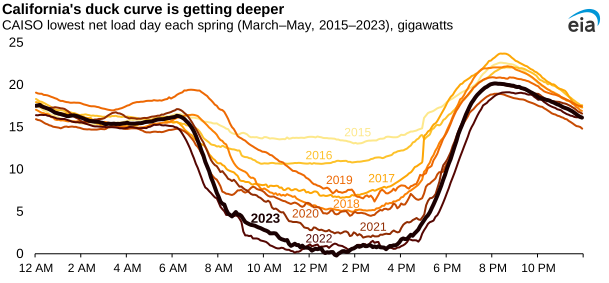
California’s daily solar surge creates the famous “duck curve,” characterized by massive midday generation peaks and steep evening ramps. To combat this, the market relies heavily on BESS assets to provide crucial Resource Adequacy (RA) and balance the grid during peak evening hours.
As market dynamics shift, industry leaders emphasize that commercial design must account for intense operational realities rather than theoretical forecasts. Capturing value in a volatile environment requires a deep understanding of Energy Management Systems (EMS) and Energy Arbitrage strategies to ensure assets remain financially viable while fulfilling strict capacity obligations.
The Talent Deficit: Why Generic Engineering Fails in CAISO
Designing a standalone battery container is vastly different from integrating it into a complex, multi-use commercial portfolio operating under CAISO tariffs. When hiring managers look to scale their technical teams, they often hit a wall because traditional power systems engineering does not cover modern market participation.
To successfully navigate real-time market signals, organizations must secure talent fluent in:
-
Dispatch Logic & API Access: Engineers who can build and manage automated bidding algorithms that react dynamically to CAISO wholesale market clearing prices.
-
Asset Management: Professionals capable of tracking degradation metrics against financial models to protect long-term project IRRs.
-
RTO/ISO Interconnection Queues: Specialists who understand the regulatory hurdles of moving a project from conceptual design to commercial operation.
How This Specialized Expertise is Attained
Finding professionals with this precise blend of competencies is notoriously difficult because these skills are rarely taught in a traditional university curriculum. While advanced degrees in electrical engineering, computer science, or energy economics provide a strong theoretical baseline, the practical mastery of BESS integration is typically acquired through a mix of targeted certification programs, specialized internships, or—most commonly—hands-on, on-the-job experience.
Because dedicated BESS-exclusive roles are still relatively young, the most successful talent pipelines often draw from professionals transitioning out of adjacent, high-complexity industries. Hiring managers frequently find exceptional transferable talent in:
-
Traditional Power Generation & Utilities: Engineers and operators from thermal, hydro, or wind power plants who understand SCADA systems, grid interconnections, and high-voltage substation operations.
-
The Major Investor-Owned Utilities (IOUs): Regulated by the California Public Utilities Commission (CPUC), these massive entities manage massive transmission, distribution, and legacy generation infrastructure: Pacific Gas and Electric Company (PG&E), Southern California Edison (SCE), San Diego Gas & Electric (SDG&E), and smaller IOUs like PacifiCorp (operating in far northern/eastern reaches), Liberty Utilities (Lake Tahoe area), and Bear Valley Electric Service (Big Bear Lake).
-
Major Municipal & Publicly Owned Utilities (POUs): Unlike IOUs owned by shareholders, these are non-profit, publicly owned entities operated by local governments or districts that own and manage their own power generation assets and distribution grids: Los Angeles Department of Water and Power (LADWP), Sacramento Municipal Utility District (SMUD), and other notable municipalities like Anaheim Public Utilities, Riverside Public Utilities, and Glendale Water & Power.
-
Independent Power Producers (IPPs) & Merchant Generators: While traditional utilities manage distribution, California’s wholesale generation is heavily populated by independent power producers that own large-scale natural gas, hydro, solar, and legacy thermal plants: Calpine Corporation, Vistra Corp., and LS Power.
-
-
ISO/RTO Market Operations: Analysts and commercial dispatchers coming directly from grid operators like CAISO, ERCOT, or PJM who intimately understand wholesale market rules, ancillary services, and congestion management.
-
Industrial Automation & Software Engineering: Tech professionals from advanced manufacturing, IoT, or algorithmic trading firms who bring rigorous API integration, real-time data modeling, and automated execution expertise.
-
Industrial IoT (Internet of Things) & Connected Operations: These companies build the massive, scalable architectures required to manage distributed edge devices, sensor streams, and real-time telemetry – skills that map directly to Battery Management Systems (BMS) and remote asset monitoring: Samsara, Kontron America, and Sierra Wireless / Semtech.
-
Advanced Manufacturing & Smart Factory Tech: Firms in this space specialize in automated production lines, robotics, digital twins, and closed-loop data processing: Tesla, Sonic Manufacturing, and Flex.
-
Algorithmic Trading & Quantitative Finance Firms: While many tier-one prop trading shops (like Jane Street or Citadel) are headquartered on the East Coast, several maintain major engineering, low-latency infrastructure, and quantitative research offices in the San Francisco Bay Area and Los Angeles: Hudson River Trading (HRT),Jump Trading, Virtu Financial, and Susquehanna International Group (SIG).
-
-
Solar & Wind IPPs (Independent Power Producers): Project developers and asset managers who have managed utility-scale renewable portfolios and are looking to pivot into the more complex, multi-use storage sector from companies like NextEra Energy Resources, Terra-Gen, Clearway Energy Group, EDP Renewables North America (EDPR NA), Intersect Power, and Invenergy.
Navigating Interconnection and Safety Compliance
Interconnection bottlenecks remain a primary friction point across Western markets. Navigating the CAISO queue requires rigorous technical adherence to IEEE 1547 standards and complex grid-forming control strategies.
Simultaneously, California’s regulatory landscape has experienced a dramatic tightening in response to high-profile utility-scale incidents—most notably the Moss Landing BESS fire. Grounded in legislative milestones like Senate Bill 283 (The Clean Energy Safety Act) and SB 38 mandates, developers are now legally required to formally meet and confer with local fire authorities at least 30 days prior to project application, execute mandatory pre-operation inspection checkpoints, and enforce strict adherence to NFPA 855 and UL 9540 standards.
Because state agencies and local fire marshals now demand comprehensive, site-specific emergency response plans (ERPs) and rigorous 24-hour incident reporting protocols, hiring managers are actively searching for compliance, safety, and permitting leads who can successfully bridge utility engineering requirements with local municipal oversight without stalling project timelines.
Operational Risk: Moving Past “Nameplate Capacity”
An asset’s nameplate rating tells only half the story. Long-term profitability and safety depend heavily on how well a system handles operational stress, thermal thresholds, and degradation over its entire lifecycle.
Recent high-profile events across the energy sector underscore the high stakes of operational oversight. Incidents such as the utility-scale battery fire at Salt River Project’s Bolster Substation near the Glendale-Peoria border in Arizona, alongside major containerized thermal events globally, have demonstrated that minor cell-level anomalies can quickly escalate if not caught early. Industry databases show that the vast majority of storage failures trace back to operational integration and system management oversights rather than baseline cell defects alone.
To protect multi-million-dollar asset valuations and prevent catastrophic outages, leading operators are actively prioritizing candidates skilled in:
-
State of Health (SoH) Modeling: Accurately predicting cell degradation and capacity fade under aggressive, real-world cycling conditions.
-
Thermal Runaway Mitigation & Fire Suppression Systems: Designing advanced containment and fail-safe architectures that protect multi-megawatt installations from cascading failures.
-
BMS Architecture & Predictive Maintenance: Leveraging real-time telemetry and continuous monitoring data to flag failing modules weeks before an incident occurs, avoiding forced outages and costly performance guarantee penalties.
The Truth About Battery Fires – Gore Street Capital
This technical breakdown explores real-world battery fire statistics, what actually happens minute-by-minute during thermal runaway, and how asset managers use early telemetry data to spot failing modules before they trigger operational failures.
The California BESS Ecosystem: Market Leaders & Talent Pipelines
To design, permit, and operate utility-scale assets under California’s stringent regulatory microscope, top-tier independent power producers (IPPs), system integrators, and engineering firms are in a relentless race for specialized human capital.
Key Industry Players & System Integrators
Organizations scaling operations in the CAISO footprint – ranging from global system integrators to specialized asset optimization platforms – frequently compete for the same elite pool of talent. When top-tier developers launch new projects, they look for engineers who have cut their teeth on complex merchant and resource adequacy structures rather than basic residential setups.
Major global system integrators and prominent energy storage technology providers with active footprints, regional headquarters, or major project pipelines in California include:
-
Tesla, Inc.: Operating heavily out of California (with major footprints in the Bay Area and Southern California), Tesla is a dominant force in the North American BESS market, deploying its Megapack systems across numerous CAISO-tied utility projects.
-
Fluence Energy: A leading global system integrator (joint venture between Siemens and AES) with substantial deployments across California utility portfolios, specializing in advanced storage software and hardware integration.
-
Sungrow Power Supply: A dominant global inverter and BESS integrator deeply active in the North American utility-scale market, powering numerous California solar-plus-storage installations.
-
Wärtsilä Energy (Younicos): Known for its digital energy platform (GEMS) and modular storage integration, Wärtsilä has delivered major utility-scale storage capacity to the California grid.
-
FlexGen: Prominent US-based system integrator that manages large-scale BESS deployment, software control architectures, and integration services across CAISO developer projects.
-
Global Cell-to-System Manufacturers (e.g., BYD and CATL-partnered channels): While many Tier-1 Chinese manufacturers navigate evolving federal supply chain dynamics, their hardware and integrated containerized solutions form the backbone of numerous large-scale California storage projects through domestic EPC partnerships.
Platforms specializing in asset optimization, intelligent energy management systems (EMS), and automated wholesale market dispatch are at the core of California’s storage ecosystem. Companies like Stem (with its AI-driven PowerTrack and automated optimization suite), Fluence (leveraging the Fluence IQ bidding application), and specialized optimization providers like Peak Power and Battalion Energy are actively operating within the CAISO footprint.
These platforms rely heavily on software architects, data scientists, and market operators who can bridge real-time grid telemetry with automated trading logic.
Educational & Trade Training Pipelines
Because traditional university electrical engineering programs rarely cover real-time market dispatch logic or battery management systems (BMS) architecture out of the box, the industry increasingly looks to targeted regional pipelines. Several California community colleges, technical centers, and regional workforce initiatives offer targeted clean energy programs, specialized certificates, and cross-skilling pathways designed to transition traditional trades into BESS operations, maintenance (O&M), and safety-critical roles:
-
Kern Community College District (KCCD) & The 21st Century Energy Center: Serving the Central Valley, KCCD provides specialized training frameworks – including specialized energy storage modules, EV infrastructure, and electrical fundamentals – geared toward upskilling construction and trade workers into clean energy operations.
-
Bakersfield College: Offers non-credit certificates such as the Modern Energy Certificate of Completion, which introduces adult learners and tradespeople to grid integration, renewable technologies, and emerging energy storage systems.
-
Los Angeles Cleantech Incubator (LACI) & Regional Partner Colleges: Through collaborative workforce initiatives funded in part by clean energy alliances, LACI’s Advanced Prototyping Center runs specialized microgrid, solar, and storage maintenance training programs. Partnering community colleges in these regional pipelines include Antelope Valley College, Compton College, Moorpark College, Rio Hondo College, Oxnard College, East Los Angeles College, and Ventura College. These programs frequently integrate hands-on storage training boards and safety credentials like OSHA-10 to prepare workers for hands-on site roles.
-
College of the Desert: Offers focused certification pathways like the California Energy Codes Certificate of Completion, training professionals and trade technicians to interpret and comply with complex state efficiency, building, and safety codes (such as Title 24 mandates impacting modern energy installations).
Frequently Asked Questions (FAQs)
Q: How do recent California regulatory shifts (like Title 24 and SB 38) affect BESS hiring?
A: New regulations mandate stricter safety compliance, site-specific emergency response plans, and BESS-ready building configurations. This has created a massive spike in demand for regulatory compliance officers, safety-critical design engineers, and O&M specialists who understand California’s unique legal framework.
Q: Where do top BESS employers look for specialized engineering and software talent?
A: Beyond traditional tier-one engineering universities, companies actively source candidates from competitive power markets, software-driven energy intelligence platforms, and specialized clean-tech trade conversion programs across the Western United States.
Q: Why is California’s BESS market shifting focus toward software and commercial integration talent?
A: As physical battery deployment accelerates, raw hardware capacity is no longer a differentiator. Because merchant revenues have compressed, asset owners rely entirely on advanced software, automated dispatch logic, and precise energy management systems to optimize revenues and secure resource adequacy contracts.
Q: What technical skills are most critical for overcoming CAISO interconnection challenges?
A: Hiring managers look for expertise in IEEE 1547 standards, grid-forming controls, RTO/ISO queue navigation, and advanced modeling capabilities that satisfy strict utility compliance requirements.
Q: Why partner with a specialized recruitment firm for BESS talent acquisition?
A: The intersection of power electronics, software modeling, and regulatory compliance creates a very narrow talent pool. Specialized recruiters understand the nuances of these technical domains, enabling them to source pre-vetted candidates who traditional HR channels often miss.
Secure Top-Tier BESS Talent Today
Building a high-performing technical team in the fast-paced energy storage sector requires more than standard resume matching—it demands deep industry insight and an established network.
Whether you are scaling your engineering division, looking for software architects, or seeking compliance experts, EPG connects you with the specialized professionals your projects require.
Ready to strengthen your team? Schedule a call with our recruitment specialists today or fill out our contact form to start your talent search.
About the Author: EPG