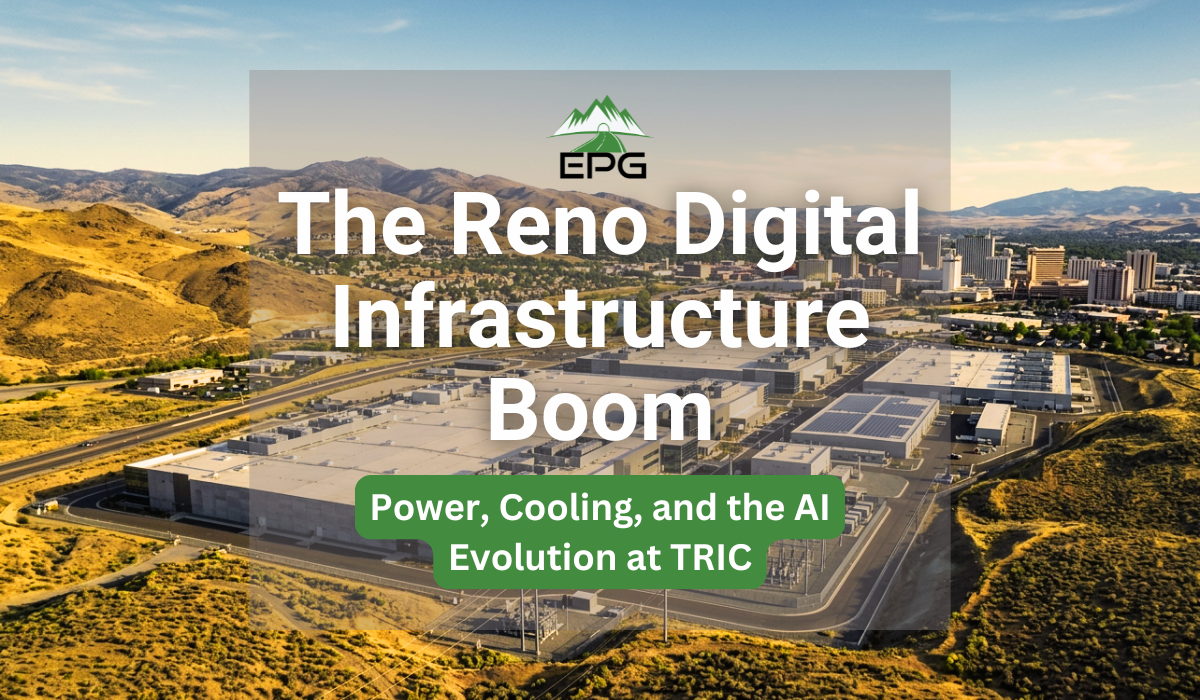
The Reno Digital Infrastructure Boom: Power, Cooling, and the AI Evolution at TRIC
Summary
The Blueprint: As Northern Nevada scales into a premier Tier 1 digital infrastructure market, local operators are moving away from traditional infrastructure playbooks. This technical analysis reviews the specific operational, cooling, and grid-integration strategies used by the 14 leading enterprise providers shaping the Reno-Sparks and Tahoe-Reno Industrial Center (TRIC) ecosystems.
Key Takeaways for Talent Acquisition: The structural divergence in regional engineering methodologies – spanning raw exascale infrastructure, high-density liquid cooling, and desert-optimized sustainability – is driving an acute mission-critical talent shortage. This breakdown highlights the specific technical skill sets regional hiring managers must secure to protect facility uptime and project timelines.
The Reno digital infrastructure ecosystem has officially transcended its historical reputation as a low-cost logistical alternative to Silicon Valley. Driven by an unprecedented surge in global Artificial Intelligence (AI) and machine learning compute demands, the Tahoe-Reno Industrial Center (TRIC) and the surrounding Washoe and Storey County corridors have consolidated into one of the most vital digital infrastructure hubs in the United States.
However, as the regional market scales, a standard, one-size-fits-all approach to infrastructure design no longer works. Based on our team’s active tracking of the local employment market, the companies defining Reno’s tech ecosystem are succeeding because they are deploying highly specialized engineering strategies. To conquer the region’s unique geographical, grid, and resource constraints, local operators have divided into three distinct operational philosophies: maximizing raw exascale power footprints, deploying hyper-dense liquid cooling architectures, or building desert-optimized sustainability models.
Strategy 1: Solving for Raw Scale and Exascale Power Footprints
For massive cloud providers and enterprise colocation giants, the primary operational imperative is securing the massive, continuous power allocations required to guarantee 100% uptime for global workloads. Building at this scale demands profound integration with regional utility networks, massive capital deployment for dedicated substation infrastructure, and long-term land banking.
This scale-first methodology is anchored by market titans like Switch, whose sprawling Citadel Campus off USA Parkway remains a global benchmark for multi-megawatt capacity. Similarly, hyperscale leaders Google, Apple, and Microsoft continue to invest billions into localized, self-contained server campuses across the region that form the physical backbone of the global cloud ecosystem.
This momentum is accelerating at a record-breaking pace. Fleet Data Centers recently advanced the local market by breaking ground on its massive, multi-billion-dollar project along the USA Parkway corridor. Backed by state and local leaders, this mega-scale development highlights the intense push for pre-positioned power. To feed these massive campuses before they even break ground, master-developers like Tract are aggressively securing and preparing massive parcels of land with pre-positioned utility infrastructure to accelerate time-to-market for future hyperscalers.
Connecting these massive islands of compute to the global grid requires unparalleled network density. Fiber-optic infrastructure pioneers like Lumen and CC Communications act as the underlying networking foundation for Northern Nevada’s data centers, deploying ultra-low-latency terrestrial fiber paths that link Reno directly to major coastal technology corridors.
The Recruitment Reality
Building and maintaining exascale footprints requires a constant influx of specialized, heavy-infrastructure talent. Reno hiring managers in this sector face an incredibly tight candidate market for:
-
High-Voltage Electrical Engineers
-
Data Center Substation Construction Managers
-
Civil, Structural, and Architectural (CSA) Managers
-
EHS Construction Specialists
Strategy 2: Engineering for the AI Surge with High-Density Liquid Cooling
While some operators focus on horizontal acreage, a new cohort of providers is radically re-engineering the interior of the data hall to accommodate the extreme thermal realities of modern AI deployments. Standard cloud environments run predictably on traditional air-cooling and raised-floor architectures. However, next-generation graphics processing unit (GPU) clusters generate intense, concentrated heat loads that quickly overwhelm legacy mechanical systems, pushing power densities from a historic 10–15 kW per rack to over 40–100 kW per rack.
Operators in Northern Nevada are meeting this disruption head-on. Vantage Data Centers has introduced highly adaptable infrastructure at their multi-facility Reno campus, engineered specifically to support the variable, high-density requirements of modern AI tenants. Concurrently, high-performance computing (HPC) specialists Colovore have entered the market with their “RNO1” facility, boasting Nvidia DGX-ready architectures capable of delivering liquid cooling directly to the cabinet.
Other prominent national builders, including EdgeCore and PowerHouse, are actively developing flexible, master-planned hyperscale footprints across the region designed to seamlessly transition between advanced air management and direct-to-chip liquid cooling loops as tenant requirements evolve.
The Recruitment Reality
The shift toward liquid cooling moves data center operations closer to advanced mechanical and chemical processing. Our internal placement tracking shows talent acquisition teams are heavily prioritizing professionals who thoroughly understand fluid dynamics and high-density environments:
-
Mechanical Engineers specializing in closed-loop fluid dynamics
-
Mission-Critical HVAC Specialists & Chiller Technicians
-
Cooling Distribution Unit (CDU) Operators
-
MEP (Mechanical, Electrical, Piping) Construction Managers
Strategy 3: Pioneering Sustainable Reno Digital Infrastructure and Edge Ecosystems
Operating a massive digital footprint at an altitude of over 4,000 feet in a high-desert environment introduces a complex variable: resource conservation. As local community, regulatory, and municipal conversations increasingly focus on environmental stewardship – evidenced by recent urban zoning and power-permitting debates within Reno city limits – the smartest operators are turning sustainable design into a core competitive advantage.
A premier example of this desert-optimized strategy is Novva Data Centers. Their facility in Storey County utilizes advanced, closed-loop air-cooled chiller networks coupled with waterless heat exchangers. By eliminating traditional evaporative cooling systems that consume millions of gallons of water daily, they maintain a Water Usage Effectiveness (WUE) ratio near zero. To top it off, they aggressively deploy next-generation automation, including autonomous aerial drone surveillance and agile robotic patrols to manage perimeter security.
Simultaneously, developers like Oppidan Connect are demonstrating how to balance footprint constraints by delivering highly efficient, smaller-scale edge data centers closer to urban corridors, providing vital localized latency benefits without placing excessive strain on rural utility grids.
The Recruitment Reality
Sustainable, highly automated data centers rely less on manual monitoring and more on intelligent, predictive systems. Talent acquisition teams in this space are prioritizing professionals who bridge the gap between physical infrastructure and software:
-
Building Management Systems (BMS) Administrators
-
Automation and Robotics Technicians
-
Sustainability Compliance Managers
-
Mission-Critical Security Systems Engineers
The Verdict: Northern Nevada’s Tech Autonomy
The expansion within the Tahoe-Reno Industrial Center and surrounding corridors proves that Northern Nevada is no longer just absorbing California’s tech overflow. By pioneering solutions across exascale grid integration, high-density fluid dynamics, and waterless desert sustainability, Reno is actively building the physical foundation of the global AI economy. For local businesses and the mission-critical workforce, this evolution promises a highly sophisticated, diverse, and recession-resistant employment market for decades to come.
Frequently Asked Questions
1. Why is the Tahoe-Reno Industrial Center (TRIC) so attractive to data center operators?
TRIC offers a rare combination of geographic benefits, including incredibly low natural disaster risk, proximity to major West Coast technology hubs, and highly favorable tax incentives from the State of Nevada. Additionally, the region features robust, scalable fiber-optic corridors and vast tracts of land that allow hyperscalers and colocation providers to build multi-megawatt campuses that would be physically and financially restrictive in coastal markets.
2. What is driving the shift from air cooling to liquid cooling in Reno data centers?
Traditional air cooling utilizes large computer room air handlers (CRAHs) to push cold air through server racks, which works perfectly for standard cloud computing. However, modern AI workloads utilize hyper-dense GPU clusters that generate massive amounts of localized heat. Because liquid absorbs up to 4,000 times more heat than air, companies like Colovore and Vantage are deploying direct-to-chip liquid cooling loops to manage these intense thermal loads efficiently.
3. How are Reno data centers managing regional power grid constraints?
The rapid expansion of data centers has placed historic demand on the regional utility grid, leading to unique infrastructure solutions. While long-term transmission updates like NV Energy’s Greenlink project are underway, mega-scale developers like Fleet Data Centers are working closely with state energy regulators to implement innovative infrastructure solutions to ensure campus certainty and protect local utility capacity during early deployment phases.
4. What kind of full-time job opportunities do these data center projects bring to Northern Nevada?
Unlike traditional logistics or fulfillment warehouses, modern data center campuses bring highly technical, six-figure career opportunities to the Reno-Sparks area. These mission-critical operations require a highly skilled workforce, including electrical and mechanical engineers, instrumentation and controls specialists, building management systems (BMS) administrators, and mission-critical facilities operators.
Build Your Critical Infrastructure Team with EPG
As Northern Nevada’s data center market rapidly diversifies across exascale power grids, intricate liquid-cooling distribution networks, and advanced fiber infrastructure, finding the specialized talent to keep these facilities online has become the industry’s greatest challenge. Generalist recruiting firms simply do not understand the nuanced differences between standard enterprise IT and the rigorous engineering demands of a 100% uptime, mission-critical environment.
At EPG, data center and technical recruiting is our core DNA. Whether you are a hyperscaler rushing to bring an AI-optimized facility online at TRIC, or an infrastructure provider looking for specialized high-voltage, mechanical, or MEP construction talent within the Reno-Sparks market, we handle the heavy lifting. We maintain a deep, highly vetted pipeline of local and national mission-critical professionals who understand the exact operational realities of your specific infrastructure strategy.
Let’s Solve Your Hiring Challenges Together
Don’t let talent bottlenecks delay your construction schedules or threaten your facility’s uptime metrics. We make it incredibly easy to scale your technical, operations, and engineering teams.
- Want a direct strategic consultation? Skip the back-and-forth emails and instantly lock in a time on our calendar by clicking here to Schedule a Call with the EPG Recruiting Team.
-
Ready to discuss your open roles? Take 60 seconds to tell us about your technical talent needs by filling out our EPG Contact & Intake Form.
About the Author: EPG