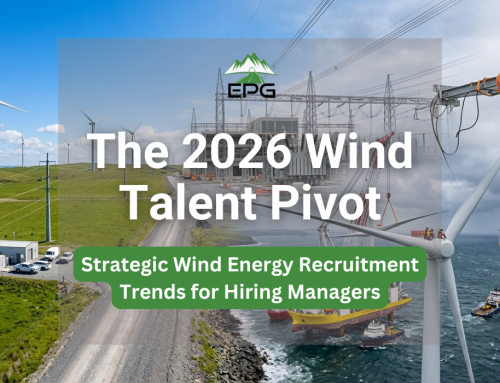
Clean Energy Recruitment Trends 2026: Navigating the Global Talent Shortage

⚡ Snapshot: The 2026 Green Labor Market
Hiring Growth: Energy sector jobs are currently growing at double the rate of the global economy (IEA).
The Bottleneck: Over 50% of energy firms report critical hiring delays threatening project timelines.
The AI Impact: 60% of renewable professionals now use AI to bridge internal skill gaps; yet, manual roles in O&M remain at a record deficit.
Demographic Crisis: In advanced economies, there are 2.4 retirees for every 1 new entrant under age 25.
Top Growth Niche: Battery Storage and Grid Modernization roles have seen a 33% surge in demand since 2025.
Introduction
The global energy landscape has reached a historic tipping point. According to the IEA’s latest World Energy Employment data, the “Age of Electricity” is officially here, with the electricity sector now surpassing fuel supply as the world’s largest energy employer. As renewables are projected to dominate global power generation by the end of this year, the primary challenge for the industry has shifted from technology to talent.
At EPG, we are tracking these macro shifts to help our clients secure the workforce needed to meet 2030 targets in an increasingly competitive labor market.
Key Clean Energy Recruitment Trends for 2026
1. The Rise of “Green Digital” & AI Integration
Clean energy is no longer just a hardware industry. According to the 2026 GETI Report, AI adoption within the renewables workforce has nearly doubled in the last 24 months. Organizations are now hunting for “hybrid” talent: professionals who understand power systems but can also leverage AI for predictive maintenance, grid balancing, and carbon accounting.
2. The Great Demographic Pivot
A critical demographic crisis is hitting the sector. IEA data shows that in the U.S. and Europe, nuclear and grid-related professions face the steepest challenges, with retirements outnumbering new entrants by a ratio of 1.7 to 1. To combat this, 32% of hiring managers are now expanding graduate recruitment and STEM initiatives to build the pipeline from the ground up (2026 GETI Report).
3. Skills-Based Hiring Over Degrees
As the “Green Talent Gap” widens, leading firms are abandoning strict degree requirements. Recent 2026 benchmarks show that hiring for “Green Impact Skills” (like GHG inventory management and circularity) is growing twice as fast as the supply of workers with those traditional credentials. Practical competencies and micro-certifications are becoming the new gold standard for employability.
4. Battery Storage & Grid Resilience
While solar and wind are the faces of the transition, BloombergNEF highlights that 2026 is the year of Storage. With battery storage costs hitting record lows, developers added nearly 90 GW of storage-integrated solar in the last year alone. This has created an urgent, specialized demand for power system engineers and storage technicians that the market is currently struggling to fill.
Challenges in Clean Energy Recruitment
-
The Mobility Gap: Despite a rise in regional transfers, the number of professionals willing to relocate has dropped to a record low of 71% (down from 86% in 2022). Localized “talent deserts” are the new reality.
-
The Inclusivity Mandate: Women currently represent only 32% of the renewable workforce. Forward-thinking firms are realizing that solving the labor shortage requires tapping into the underrepresented parts of the global talent pool.
-
Speed-to-Hire: In a candidate-driven market, top-tier talent is often off the market within 10 days. Slow internal HR processes are currently the #1 reason renewable firms lose out on specialized engineers.
Conclusion
The data is clear: the energy transition is no longer a technology challenge—it is a human capital challenge. By staying ahead of clean energy recruitment trends and leveraging authoritative data to guide hiring decisions, your organization can move from reactive hiring to proactive talent acquisition.
Frequently Asked Questions (FAQs)
1. What are the most in-demand clean energy recruitment trends in 2026? The most dominant trends are the integration of AI in operations, a shift toward “Skills-Based” hiring, and a massive surge in roles related to battery storage and grid resilience.
2. How significant is the “Green Skills Gap”? It is critical. Industry reports suggest that roughly 50% of green economy jobs risk remaining unfilled this year due to a lack of qualified candidates with specialized technical expertise.
3. Why is “Employer Branding” so important for renewable firms? Professionals in 2026 are vetting employers on their internal sustainability. They prioritize transparency, DEI, and clear career development paths. If a company doesn’t “walk the talk,” they will lose talent to more mission-driven competitors.
4. How is AI changing the energy workforce? While AI is being used by 60% of the workforce to handle data and reporting, it is not replacing manual roles. Instead, it is being used as a “Co-pilot” to help existing staff manage more complex projects and bridge technical knowledge gaps.
How Can EPG Help?
EPG is a specialized recruitment partner equipped to help you navigate this complex market. We offer:
-
Executive Search: Finding leadership for the “Age of Electricity.”
-
Contract Staffing: Rapidly scaling your workforce for storage and solar projects.
-
Direct Placement: Building your core team of engineers and digital specialists.
Ready to future-proof your workforce with 2026’s leading talent? Whether you want to discuss the latest hiring statistics or need a customized talent strategy, our experts are ready to consult.
Schedule a Strategy Call with EPG or Fill out our Inquiry Form to Learn More
About the Author: EPG