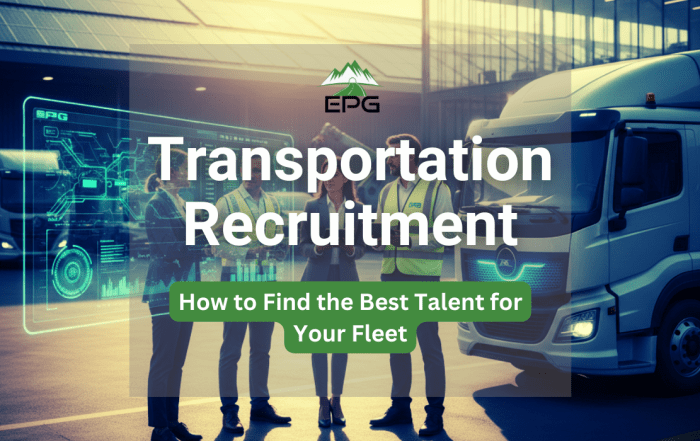
Transportation Staffing: A Strategic Guide to Navigating the New Era of Logistics

Executive Summary: The Future of Transportation Staffing
The transportation sector is undergoing a massive transformation driven by autonomous technology, electrification, and a persistent labor gap. Efficient transportation staffing now requires a dual focus: securing traditional operational talent (like CDL drivers and fleet managers) while aggressively pursuing tech-forward roles in logistics AI and EV infrastructure. Recent industry data suggests a shortage of over 80,000 drivers in the U.S. alone, making specialized recruitment partnerships essential for maintaining supply chain resilience.
As the global supply chain becomes more complex, the demand for highly skilled professionals in the transportation sector has never been higher. At EPG, we have built our reputation on finding elite talent for niche industries. We are now leveraging our deep expertise in technical recruitment to provide comprehensive transportation staffing solutions.
In this guide, we examine the shifting landscape of the industry and how your company can secure the talent necessary to lead in a competitive market.
The Evolving Roles in Transportation and Logistics
Modern transportation is no longer just about moving goods from point A to point B; it is about data, efficiency, and sustainability. To succeed, companies need a diverse mix of talent:
-
Executive Leadership (C-Suite & Upper Management): In an era of disruption, you need leaders who understand global trade shifts and digital transformation.
-
Logistics & Supply Chain Managers: These professionals are the architects of your operations, ensuring lean inventories and optimized routes.
-
Fleet & Operations Supervisors: The “boots on the ground” experts who manage driver retention, safety compliance, and vehicle uptime.
-
Specialized Technicians: With the rise of “smart” fleets, technicians now need a hybrid skillset—understanding both diesel mechanics and advanced telemetry/software systems.
-
Autonomous & EV Integration Specialists: As the industry pivots toward sustainability, experts who can manage the transition to electric fleets and autonomous pilot programs are becoming the most sought-after hires in the country.
The Challenges: Why Transportation Staffing is Getting Harder
The “old way” of hiring—simply posting to general job boards—is no longer effective. The industry faces several high-stakes hurdles:
-
The Talent Gap: According to the American Trucking Associations (ATA), the industry must hire approximately 1.2 million new drivers over the next decade to keep pace with demand and retirements.
-
Technological Velocity: The rapid integration of AI in route optimization and the shift toward EV heavy-duty trucks mean that the skills required three years ago are already becoming obsolete.
-
Regulatory Compliance: From FMCSA safety ratings to evolving environmental ESG standards, your staff must be more knowledgeable than ever regarding legal and safety frameworks.
How to Optimize Your Hiring Strategy
To maintain a high-performance workforce, transportation companies must move from reactive hiring to proactive talent acquisition.
-
Define “High-Value” Skills: Don’t just hire for experience; hire for adaptability. Can your new logistics manager navigate a SaaS-based TMS (Transportation Management System)?
-
Prioritize Retention: In transportation, staffing isn’t just about the “get”—it’s about the “keep.” Competitive benefits and clear career pathways are essential.
-
Partner with Niche Experts: Generalist agencies often fail to understand the nuances of DOT requirements or the technical requirements of modern logistics software. Working with a specialized firm like EPG ensures you see candidates who are already vetted for the specific rigors of the sector.
By the Numbers: Authoritative Insights
-
Growth: The Bureau of Labor Statistics (BLS) projects that employment in transportation and material moving occupations will grow faster than the average for all occupations through 2032.
-
Innovation: A recent McKinsey & Company report highlights that autonomous trucking could reduce operating costs by up to 45%, but only if companies can hire the specialized technical staff to manage these complex systems.
Frequently Asked Questions (FAQs)
1. What is the current biggest challenge in transportation staffing?
The primary challenge is the “skills mismatch.” While there is a high volume of applicants, there is a shortage of candidates who possess both traditional logistics experience and the technical literacy required to operate modern digital supply chain tools.
2. How does EPG find specialized talent that isn’t on LinkedIn?
We utilize a “passive candidate” strategy. Many of the best fleet managers and logistics directors aren’t actively looking for work. We use our deep industry network and proprietary database to reach out to proven performers directly.
3. Does transportation staffing include “green” energy roles?
Absolutely. As the sector moves toward sustainability, we specialize in finding professionals experienced in EV fleet conversion, charging infrastructure, and hydrogen fuel cell logistics.
4. How long does it typically take to fill a high-level logistics role?
While the market is tight, our specialized focus allows us to typically present a qualified shortlist within 10-14 days, significantly faster than generalist recruiters.
Ready to Future-Proof Your Fleet?
The transportation landscape is changing at breakneck speed. Whether you are looking to discuss the latest hiring trends, understand salary benchmarks for 2026, or need to fill a critical leadership role, EPG is here to help.
Let’s move your business forward.
Schedule a Strategy Call with Our Team (Or fill out the form below!)
About the Author: EPG