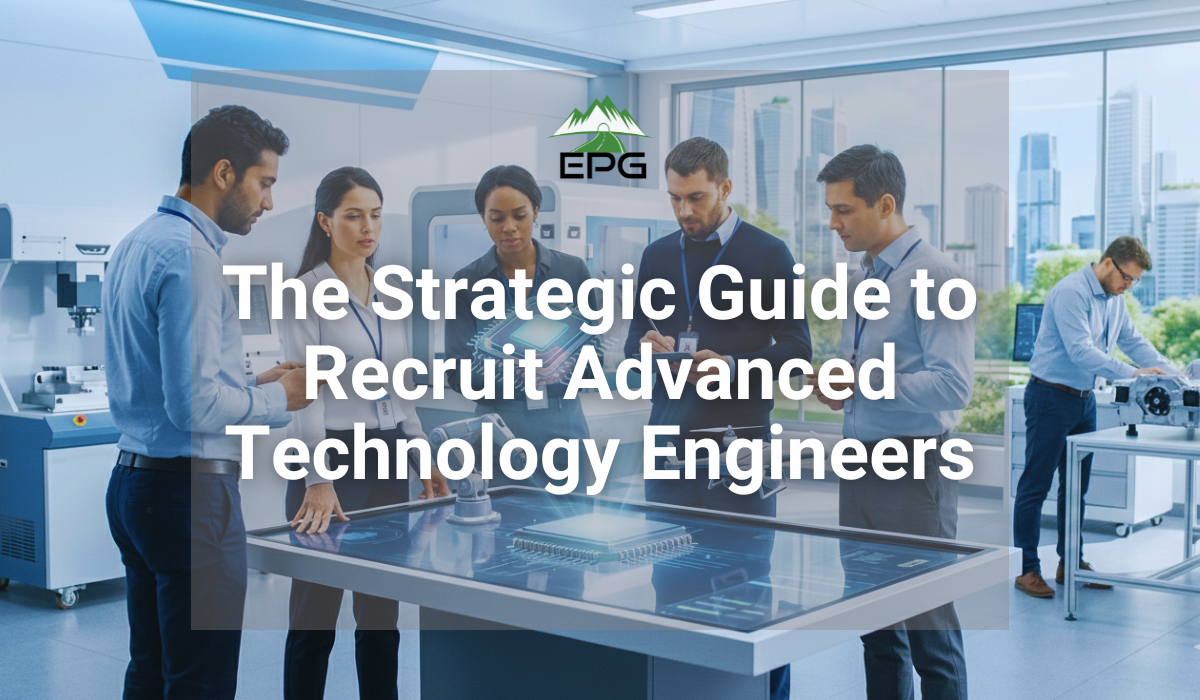
The Strategic Guide to Recruit Advanced Technology Engineers
Executive Summary: How to Recruit Advanced Technology Engineers
To recruit advanced technology engineers in 2026, firms must shift from broad job boards to niche community sourcing (e.g., GitHub, arXiv) and implement cross-disciplinary technical vetting. Success requires a data-driven approach to bridge the projected 67,000-worker gap in specialized sectors like semiconductors and AI.
Primary Sourcing: Target “Frontier” communities like Kaggle for AI or IEEE for hardware.
Vetting Protocol: Replace generic coding tests with system-architecture challenges.
Value Proposition: Prioritize R&D autonomy and “frontier” project access over traditional perks.
Market Insight: The wage premium for workers with specialized AI skills has skyrocketed to 56% in some areas, more than doubling from the 25% premium seen just one year ago.
In the current industrial landscape, “technology” is no longer a department; it is the foundation of global competition. Whether your firm is pioneering Generative AI integrations, developing autonomous systems, or scaling semiconductor fabrication, the ability to recruit advanced technology engineers is the single greatest predictor of your company’s valuation and speed to market.
At EPG, we have observed a fundamental shift in the recruitment paradigm. In 2026, the most sought-after engineers are looking for more than just a title; they are seeking to join organizations that demonstrate clear technical leadership, a proven track record of innovation, and a culture of integrity. To attract this caliber of talent, your recruitment strategy must lead with these values to build immediate credibility with the world’s best innovators.
1. Crafting a High-Performance Job Architecture
The “Post and Pray” method is dead. To recruit advanced technology engineers, your job description must act as a technical document, not just an HR requirement.
Beyond the Job Title
Advanced technology roles are rarely mono-disciplinary. A “Systems Engineer” in 2026 is often expected to understand both hardware constraints and machine learning frameworks. Define the intersection of disciplines—such as Mechatronics, Edge Computing, or Quantum Information Science—to ensure you attract candidates with the necessary cognitive flexibility.
The “Impact Statement”
Top-tier engineers are mission-driven. According to recent McKinsey research on tech talent, “meaningful work” is a top-three driver for job satisfaction. Instead of listing “Requirements,” list the Technical Challenges. For example: “You will solve thermal throttling issues in high-density AI server clusters,” rather than “Experience with thermal management required.”
2. Navigating the Global Talent Shortage
The demand for specialized engineering talent is outstripping supply at an astronomical rate. A report by the Semiconductor Industry Association (SIA) highlights that nearly 58% of new jobs in the sector may go unfilled due to a lack of qualified graduates.
To successfully recruit advanced technology engineers, you must expand your sourcing surface area:
-
Target “Frontier” Communities: Stop looking on general boards. Elite talent lives in niche communities like GitHub for open-source, arXiv for research, Kaggle for AI, and IEEE for hardware.
-
The “Passive” Pipeline: 70% of the global workforce is made up of passive talent who aren’t looking for work but are open to it. Your recruitment partner should have a “warm” network of engineers who are currently employed but waiting for the right “frontier” project.
3. High-Fidelity Technical Vetting
The emergence of AI-assisted coding and automated resumes has made traditional screening less reliable. To ensure you are hiring the top 1%, your interview process must evolve.
-
Peer-to-Peer Interviews: Elite engineers want to be interviewed by people who speak their language. Ensure your senior architects are involved early in the process to validate technical depth.
-
System Design Over Syntax: Don’t test for rote memorization of code. Test for system design—how the candidate handles scalability, latency, and integration within an advanced tech ecosystem.
4. Why Specialized Recruitment Matters
Recruiting for a “Software Engineer” is not the same as recruiting for a “Propulsion Specialist.” The nuances in salary benchmarks are volatile; according to the PwC 2025 Global AI Jobs Barometer, workers with specialized AI skills now command a 56% wage premium – a figure that has more than doubled from the 25% premium seen just a year prior.
Partnering with a firm that understands the Total Addressable Talent (TAT) in these niche sectors allows your company to move faster than the competition.
Frequently Asked Questions (FAQs)
Q: What is the most effective way to recruit advanced technology engineers in a competitive market? A: The most effective strategy is “Active Headhunting.” Unlike traditional roles, advanced tech talent rarely applies to job boards. You must leverage a recruiter who has established trust within specialized technical circles and can present your opportunity as a career-defining move.
Q: How does the “AI talent war” affect engineering recruitment?
A: AI expertise is being integrated into every engineering discipline. Even if you aren’t an AI company, you need engineers who understand how to implement AI-driven efficiencies. This has caused a massive spike in salary floors, requiring companies to offer highly competitive, performance-based compensation packages.
Q: Should we prioritize local talent or remote engineers for advanced tech roles?
A: While hardware-heavy roles require on-site presence, many advanced tech sectors (like simulation, software-defined vehicles, or chip design) are moving toward hybrid or remote models. Restricting your search to a single zip code significantly decreases your chances of finding “unicorn” talent.
Q: How long does it typically take to recruit advanced technology engineers?
A: On average, specialized tech roles take 45–90 days to fill. However, by utilizing EPG’s pre-vetted talent pipelines, many of our clients are able to shorten this cycle to under 30 days.
Partner with EPG: Build Your Future Team
The race for innovation is won by those who have the best people. At EPG, we don’t just fill seats; we find the architects of the future. Whether you are looking for a single Principal Engineer or building an entire R&D department from scratch, we provide the technical insight and industry connections to help you scale.
Ready to secure the talent you need to lead the industry?
-
Fill Out Our Talent Inquiry Form
About the Author: EPG