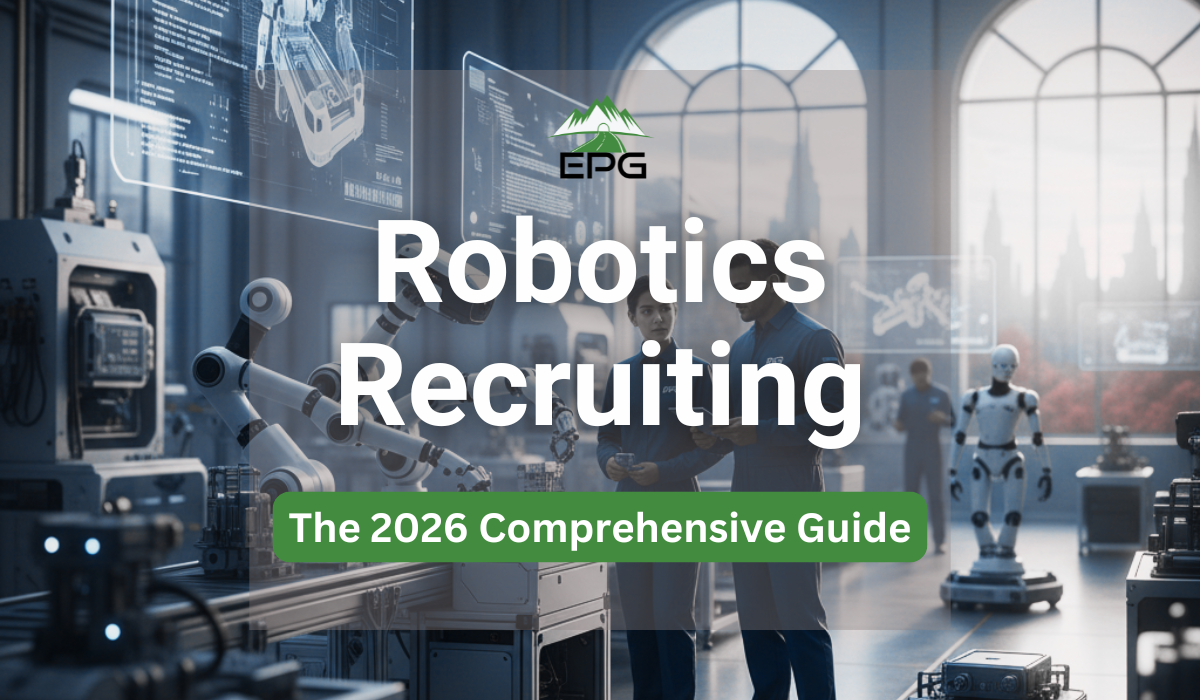
Robotics Recruiting: The 2026 Comprehensive Guide
🤖 Snapshot: The State of Robotics Recruiting in 2026
Market Surge: The global industrial robot market has reached a record $16.7 billion in 2026, driven by a 9.5% CAGR in automation adoption.
The “Automation Gap”: Despite the tech, a critical shortage of competent workers remains the #1 barrier to Industry 4.0 implementation.
Top 3 Skill Sets: Recruiters are currently prioritizing ROS 2, Edge AI deployment, and Sim-to-Real (Digital Twin) expertise.
Hiring Shift: 2026 marks a transition from “Rule-Based Automation” to “Physical AI,” requiring engineers who can manage self-evolving, autonomous systems.
The industrial landscape of 2026 is no longer defined by simple, pre-programmed machinery. We have entered the era of Physical AI, where autonomous systems perceive, learn, and adapt to their environments in real-time. According to the Global Robotics Report 2026, the sector now employs over 9.3 million workers worldwide, yet firms report that specialized roles remain vacant for an average of 114 days.
This “Automation Gap” has made specialized robotics recruiting services, such as EPG, an essential partner for firms looking to scale.
The 2026 Automation Surge
The global industrial robot market has officially crossed the record $16.7 billion mark. This growth isn’t just in hardware; the 9.5% CAGR in adoption represents a fundamental shift in how businesses operate. For EPG’s clients, this means the competition for talent is no longer local—it is a global race to staff the most advanced automated facilities in history.
The 2026 Demand for Robotics Professionals
The modern robotics sector has moved beyond isolated industrial arms. Recent data from the Association for Advancing Automation (A3) shows that while automotive OEMs still lead, non-automotive sectors (Life Sciences, Food/Beverage, and Electronics) now account for 56% of all robot orders.
To stay competitive, companies need a diverse array of experts:
-
Agentic AI Specialists: Developing robots that don’t just follow paths but make autonomous decisions.
-
Humanoid & Cobot Integrators: With humanoid pilots turning into production reality in 2026, experts who can integrate these into “brownfield” facilities are in high demand.
-
OT/ICS Cyber Security Engineers: As IT and OT converge, protecting connected robots from network vulnerabilities is now a top hiring priority.
Key Considerations in Robotics Recruiting
To build a high-performance team in 2026, your robotics recruiting strategy must prioritize candidates who master the “Robotics Trinity”:
-
Simulation-to-Real (Sim2Real) Expertise: Top engineers now use Digital Twins to build, test, and optimize workcells in high-fidelity virtual environments before a single physical bolt is turned.
-
Middleware Mastery (ROS 2): Proficiency in ROS 2 is the 2026 industry standard for modular software development, allowing for faster scaling and better interoperability across different robot brands.
-
Edge Computing & Low Latency: As robots process terabytes of data, look for specialists who can deploy models directly onto hardware like NVIDIA Jetson Orin to ensure millisecond-level reaction times.
-
Functional Safety Standards: Candidates must be fluent in ISO 10218 and TS 15066 to ensure human-robot collaboration remains safe and compliant.
Best Practices for Robotics Recruiting
-
Define Your Technical Stack: Are you building on C++, Python, or Rust? Do you use Gazebo or Isaac Sim for testing? Clearly defining your stack helps EPG identify “Plug-and-Play” talent.
-
Target Passive Talent: In 2026, the best Motion Control developers aren’t on job boards. We leverage niche technical networks and GitHub repositories to find elite engineers.
-
Focus on Mechatronics Fluency: Ensure your candidates can bridge the gap between digital logic and physical actuators.
Robotics Recruiting FAQs
Q: What is the average salary for a Robotics Engineer in 2026?
A: According to current market data, the median base salary for a Robotics Engineer has risen to approximately $114,000, with AI-specialized robotics roles often exceeding $135,000 plus performance bonuses.
Q: Why is “Digital Twin” experience suddenly so important?
A: In 2026, the “Simulate-then-Procure” model is the industry standard. Hiring engineers who can validate ROI in a simulation before capital expenditure (CapEx) is committed reduces deployment risk by up to 40%.
Q: Are collaborative robots (cobots) still a growing segment?
A: Yes. A3 reports that cobots now account for nearly 24% of all robotic units ordered in North America, as they are the primary solution for labor-constrained environments.
Q: How has AI changed the job description for a Robotics Engineer?
A: The role has shifted toward Software-Defined Robotics. Engineers are now expected to understand data science and neural network integration alongside traditional mechanical and electrical engineering.
Build Your Automated Future with EPG
The race for automation talent is tighter than ever. Whether you are a startup scaling a prototype or a global manufacturer modernizing a legacy line, EPG connects you with the specialized talent that generalist recruiters simply cannot reach.
Schedule a Call with EPG or Fill Out Our Contact Form to discuss current 2026 hiring trends, salary benchmarks, or to begin your search for the best in robotics recruiting.
About the Author: EPG