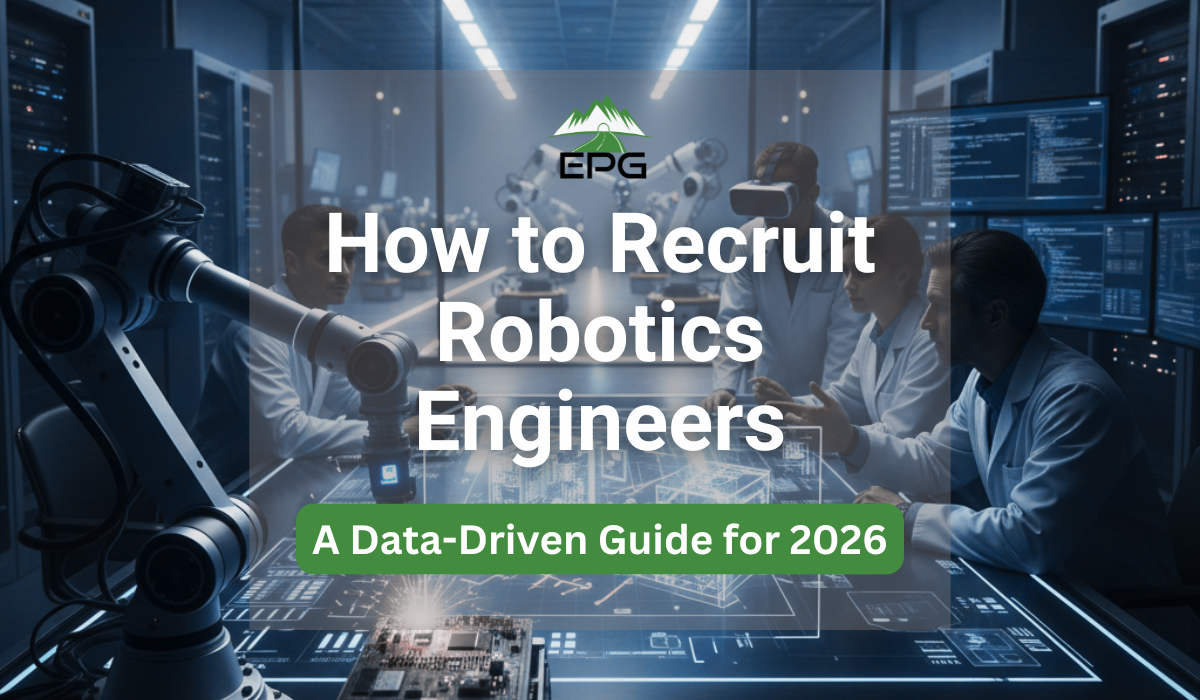
How to Recruit Robotics Engineers: A Data-Driven Guide for 2026
Snapshot: How to Recruit Robotics Engineers (2026 Edition)
The Market: Demand for “Physical AI” specialists has surged by 35%, driven by a record 4.6 million industrial robots now in global operation.
The Key Shift: Recruitment has moved from general mechatronics to Sim2Real (Simulation-to-Real) proficiency and ROS 2 mastery.
Compliance Baseline: Hiring teams must prioritize candidates fluent in the ISO 10218:2025 safety updates, which now treat “cobots” and industrial robots under a unified collaborative framework.
Strategic Advantage: Utilizing Digital Twins and Edge AI deployment skills are the primary differentiators for top-tier robotics talent this year.
Introduction
The global robotics market has reached a pivotal milestone in 2026, with the market value of industrial installations hitting an all-time high. According to the latest World Robotics Report by the International Federation of Robotics (IFR), the total number of industrial robots in operational use globally has climbed to over 4.6 million units. For hiring managers, this surge means the “Automation Gap” is no longer a theoretical risk—it is a daily operational hurdle. To effectively recruit robotics engineers in this climate, firms must shift from generalist sourcing to a specialized approach.
The 2026 Technical Stack: What to Look For
In 2026, the industry has transitioned away from basic, rule-based automation toward Physical AI – systems that perceive and adapt in real-time. When vetting candidates, focus on these non-negotiable proficiencies:
-
Middleware Mastery (ROS 2): ROS 2 is now the definitive industry baseline. Look for engineers who understand DDS (Data Distribution Service) fundamentals and Quality of Service (QoS) tuning.
-
Simulation-to-Real (Sim2Real) Expertise: The “Simulate-then-Procure” model is the 2026 standard. Leading engineers use Digital Twins (via platforms like NVIDIA Isaac Sim or Gazebo) to validate ROI in high-fidelity virtual environments.
-
Edge AI Deployment: As low latency becomes critical, look for specialists who can deploy neural networks directly onto edge hardware (e.g., NVIDIA Jetson Orin) to ensure millisecond-level reaction times.
The Robotics Engineering Talent Matrix
Because “Robotics” is an umbrella term, we recommend segmenting your search based on the specific “stack” your project requires:
| Stack Category | Primary Focus | 2026 Industry Standard Tech |
| Mobile & Field | AMRs, SLAM, & Navigation | ROS 2, LiDAR, C++, Python |
| Industrial/Cobots | Precision & Human-Robot Collab | PLC (Siemens/Beckhoff), ISO 10218:2025 |
| Perception & AI | Computer Vision & Object Detection | PyTorch, OpenCV, CUDA, Edge GPUs |
Modern Safety and Compliance Standards
In 2026, the safety landscape has been revolutionized by the ISO 10218:2025 update. This new standard eliminates the distinct category for “cobots,” instead focusing on the Collaborative Application. This means your engineers must be fluent in:
-
ISO 10218-1 & -2:2025: Unified safety requirements for both manufacturers and integrators.
-
Power and Force Limiting (PFL): Mandatory pressure testing to ensure robot forces remain within legal safety limits.
Frequently Asked Questions (FAQs)
1. What is the average salary for a robotics engineer in 2026?
As of early 2026, the median base salary for a Robotics Engineer in the U.S. is approximately $114,000, while specialists in Agentic AI frequently see packages exceeding $145,000.
2. Why is “Digital Twin” experience a priority for recruiters now?
In 2026, companies use Digital Twins to de-risk investments. Hiring an engineer who can validate a workcell virtually can reduce physical deployment risks and downtime by up to 40%.
3. How has the ISO 10218:2025 update changed hiring needs?
It has increased the demand for Functional Safety Engineers. Firms now need engineers capable of conducting complex risk assessments that combine hardware sensors with software interlocks.
4. Where are the best places to find “passive” robotics talent?
Elite engineers are rarely on active job boards. Look for contributors to ROS Discourse, participants in IROS conferences, and developers with significant commits to robotics repositories on GitHub.
How EPG Can Help You Recruit Robotics Engineers
At EPG, we track the technical shifts of the automation industry so you don’t have to. We understand the difference between a PLC programmer and a Physical AI specialist. Our deep-vetting process ensures that every candidate we present is fluent in the 2026 standards of safety, simulation, and real-time control.
Build Your Automated Future
Whether you are navigating the move to ROS 2 or scaling a fleet of AMRs, our team is ready to discuss the hiring trends and salary benchmarks specific to your niche.
Schedule a Discovery Call or Fill Out Our Inquiry Form to learn how EPG can streamline your search for world-class robotics talent.
About the Author: EPG