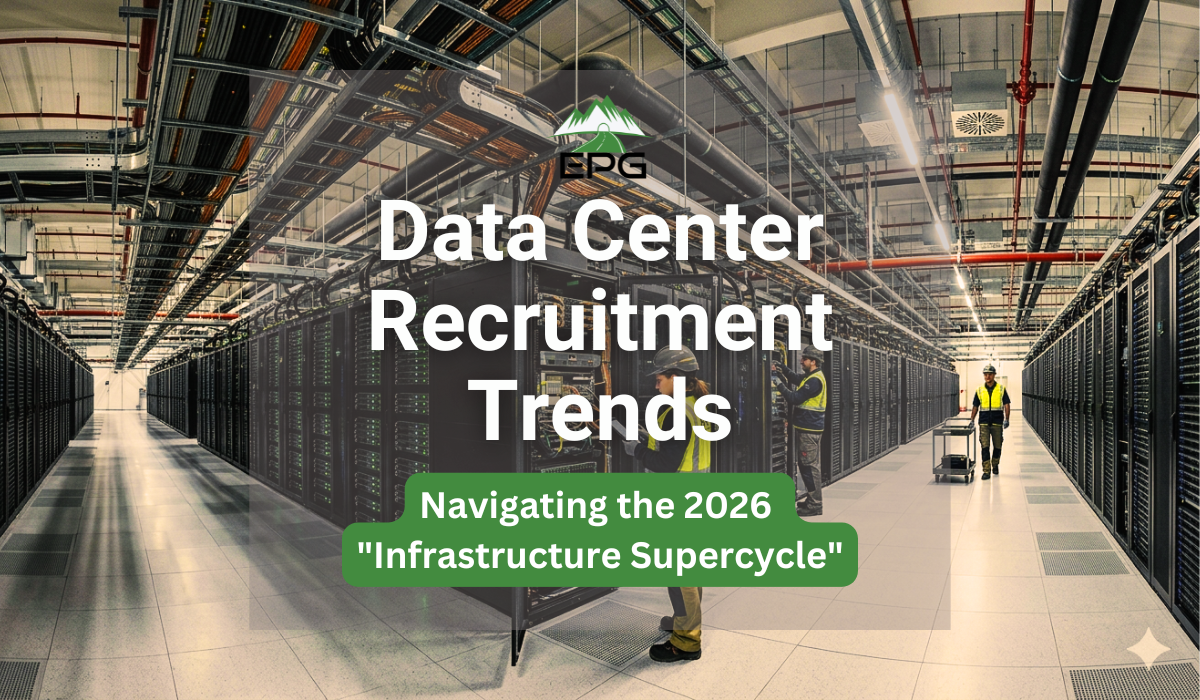
Data Center Recruitment Trends: Navigating the 2026 “Infrastructure Supercycle”
Market Pulse: The global data center capacity is projected to double by 2030, requiring nearly $3 trillion in investment. However, the 2026 bottleneck isn’t capital; it’s a chronic shortage expected to balloon to 140,000 skilled tradespeople. We are seeing a fundamental shift where Power Compute Effectiveness (PCE) – maximizing “tokens per watt” – has replaced simple uptime as the primary metric for operational success.
Introduction
The data center industry has reached a “thermal wall.” As AI workloads scale from 15% to a projected 40% of all data center traffic by 2030, the infrastructure required to support them has fundamentally changed. Organizations are no longer just building “data warehouses”; they are building high-density AI factories. At EPG, we track these shifts to ensure our clients are staffed for the future, not the past.
Key Trends in Data Center Recruitment
Trend 1: The Rise of “Chemical Literacy” in Facilities Engineering
With liquid cooling expected to jump from 15% to 76% adoption by late 2026, the job description for a Facilities Technician has evolved. Leading firms are now recruiting for “Chemical Literacy”—the ability to manage complex coolant chemistry, pressure manifolds, and CDU (Coolant Distribution Unit) integration. This is a pivot away from traditional HVAC toward process engineering.
Trend 2: The “Inference Inversion” and Edge Staffing
In 2026, the industry has reached the “Inversion Point” where running AI models (inference) consumes more power than training them. This is driving a surge in Edge Data Centers – smaller, highly distributed, and often unmanned modular sites. Recruitment is now focusing on “Mobile Critical Ops” teams who can maintain a fleet of distributed sites rather than a single massive campus.
Trend 3: Grid-Interactive Power Specialists
Data centers are transitioning from passive consumers to grid stakeholders. We are seeing a niche recruitment trend for experts in Small Modular Reactors (SMRs), on-site battery storage, and “Grid-Balancing” software. Companies are hiring specialists who can manage “Behind-the-Meter” generation to bypass utility constraints that are delaying projects by years.
Trend 4: Cloud Repatriation Architects
Nearly 80% of enterprises in 2026 report moving specific AI workloads back from the public cloud to on-premises or colocation facilities to control skyrocketing costs. This has created a massive demand for “Repatriation Architects” who specialize in transitioning high-density GPU clusters from the cloud back to physical hardware.
Challenges in Data Center Staffing
The 25% “Trade-to-Tech” Premium
The U.S. construction industry is currently short roughly 439,000 skilled workers. Data center trades – electricians, pipefitters, and welders – now command a 25-30% salary premium over other industrial sectors. Finding talent requires a “Trade-to-Tech” pipeline, often recruiting from the Navy or heavy industrial manufacturing.
Addressing the “Industrial Copilot” Skills Gap
Technicians in 2026 must work alongside AI control planes that manage heterogeneous silicon (NVIDIA, AMD, and custom hyperscale chips). The gap isn’t just in physical labor; it’s in AI Literacy – the ability to interpret AI-driven predictive maintenance dashboards.
Frequently Asked Questions (FAQs)
What is the most difficult role to fill in data center recruitment in 2026?
The “Critical Facilities Engineer” with liquid cooling expertise. Because this technology was niche until recently, there is a severe shortage of professionals who have managed 100kW+ rack densities in a live production environment.
How is “Power Compute Effectiveness” (PCE) affecting hiring?
PCE measures tokens processed per watt. Hiring managers are now seeking “Optimization Specialists” who can tune both the hardware and the cooling systems to hit these ROI metrics, rather than just ensuring the lights stay on.
Are data centers moving toward “unmanned” operations?
While AI-driven automation is increasing, human expertise is still critical for physical maintenance. However, the trend is moving toward “Centralized Remote Ops” where a core team of senior engineers monitors multiple “lights-out” facilities via Digital Twins.
Why is there a sudden demand for nuclear and gas experts in data centers?
Utility grid constraints have forced operators to generate their own power. Experts in natural gas turbines (with carbon capture) and SMRs are being recruited to ensure facilities can go live even when the local utility can’t provide the necessary megawatts.
How Can EPG Help?
EPG is a specialized recruiting firm that understands the technical nuances of the 2026 infrastructure supercycle. We don’t just find “staff”; we find the engineers who understand the “thermal wall” and the architects of the AI revolution.
-
Executive Search: Visionary leadership for high-density AI deployments.
-
Technical Staffing: Specialized CFEs and Liquid Cooling Technicians.
-
Strategic Consulting: Benchmarking your compensation against the 30% “trade premium.”
Ready to discuss your 2026 hiring strategy? Connect with EPG today to secure the talent that will power your next gigawatt.
Schedule a Call with our Data Center Team | Inquiry Form
About the Author: EPG