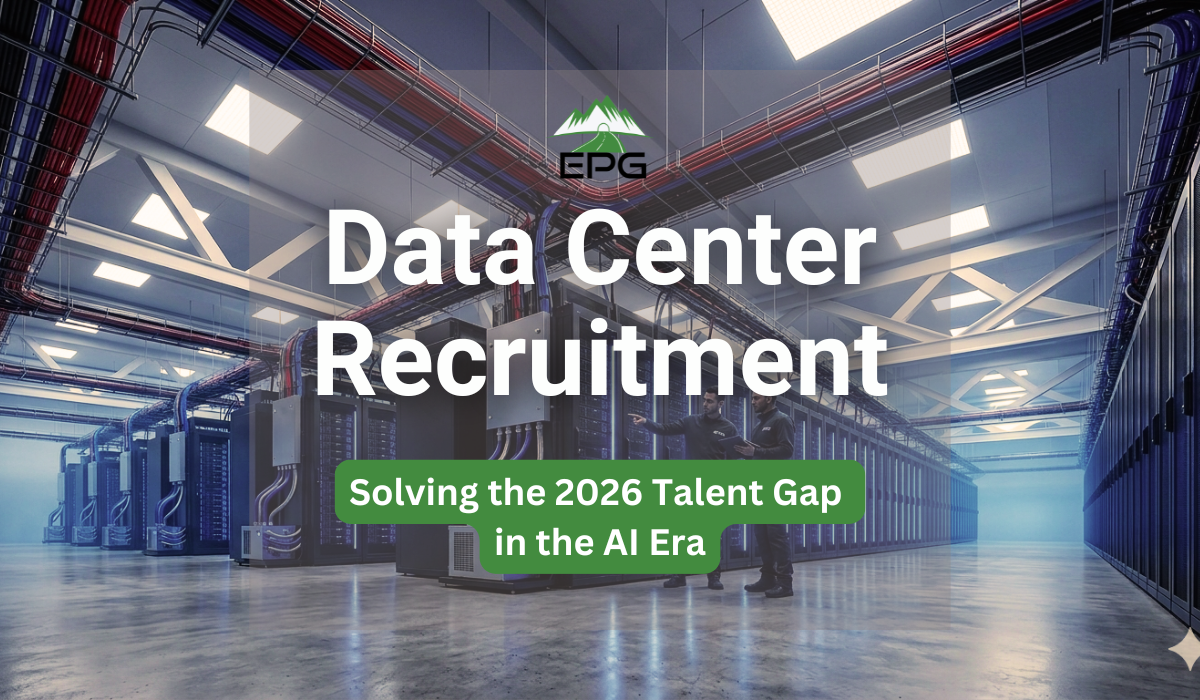
Data Center Recruitment: Solving the 2026 Talent Gap in the AI Era
Snapshot: The 2026 Data Center Talent Outlook
The data center industry has entered an “infrastructure supercycle,” with global capacity expected to double by 2030. In 2026, power availability has replaced location as the #1 site-selection criteria, and liquid cooling has moved from a niche experiment to a standard requirement for 40% of all workloads. For hiring managers, this means the “generalist” technician is a thing of the past; the market now demands specialists in high-density thermal management and grid-interactive power systems.
The global data center market is no longer just growing; it is undergoing a fundamental structural shift. Driven by the “Inference Inversion”—where the volume of AI inference tokens has officially surpassed training tokens—facilities are being redesigned at a breakneck pace. According to recent 2026 projections from JLL and the Uptime Institute, nearly 100 GW of new capacity will come online by 2030, requiring a massive $3 trillion in investment.
However, the greatest bottleneck isn’t capital or silicon—it’s people. Finding elite talent for data center recruitment requires navigating a market where passive candidates dominate, and technical requirements change every six months.
The Shift in Expertise: 2026 Talent Requirements
In 2026, the metrics of success have evolved. While Power Usage Effectiveness (PUE) remains a baseline, industry leaders are now hiring for Power Compute Effectiveness (PCE) – the ability to maximize “tokens per watt.”
To meet these high-density demands, hiring managers must look for candidates who master specific, next-gen technologies:
-
Thermal Intelligence: Expertise in direct-to-chip cooling and immersion cooling is now non-negotiable as rack densities push toward 100 kW.
-
Grid-Interactive Power: As data centers transition from passive consumers to “grid stakeholders,” roles now require knowledge of Small Modular Reactors (SMRs), on-site battery storage, and hydrogen-ready backup generators.
-
AI-Driven Operations: We are seeing the rise of the “Industrial Copilot.” Technicians must now be able to work alongside AI control planes that manage heterogeneous silicon environments (mixing NVIDIA, AMD, and custom hyperscale chips).
Hiring Manager Strategy: Comparing Infrastructure Roles
To help your HR team prioritize, we’ve mapped out how core roles have evolved in this “AI factory” era:
Role 2022 Focus (Legacy) 2026 Focus (AI Era) Required Tech Stack Facilities Engineer Air-cooled HVAC, UPS maintenance Liquid cooling, Thermal Digital Twins Direct-to-chip, CDUs, BMS Network Engineer North-South traffic (User-to-Server) East-West traffic (Server-to-Server) 800G/1.6T Switches, InfiniBand Operations Manager Uptime and physical security PCE Optimization, Token-per-watt ROI DCIM 2.0, Predictive Analytics Energy Specialist Renewable Energy Credits (RECs) On-site generation, Grid-balancing SMRs, Green Hydrogen, Microgrids
Strategic Sourcing for the Data Center Workforce
With the World Economic Forum reporting that over 4 million Boomers are exiting the workforce annually as of 2026, you cannot rely on traditional job postings. Successful hiring managers are using a “Constraint-First” recruitment model:
-
Targeting the “Navy Nuke” Pipeline: Veterans from nuclear and high-voltage backgrounds remain the gold standard for critical facilities engineering.
-
Repatriation Specialists: As 80% of enterprises report moving specific workloads from the public cloud back to on-premises facilities for cost control, demand is surging for “Cloud Repatriation” architects.
-
Cross-Training Skilled Trades: Gen Z is entering the sector through “Trade-to-Tech” programs. Partnering with recruiters like EPG allows you to tap into these specialized pipelines before they hit the open market.
Conclusion
The data center industry is no longer an invisible utility; it is the frontline of global innovation. Recruiting for this sector in 2026 requires a partner who understands that you aren’t just looking for “IT support”—you are looking for the engineers and operators who will power the AI revolution.
Data Center Recruitment FAQs
1. How has AI changed the specific “job description” for technicians?
Technicians now need “Chemical Literacy.” With liquid cooling becoming mainstream, staff must manage coolant chemistry, pressure control, and manifold integrity—skills more common in process engineering than traditional IT.
2. What is the “Inference Inversion” and why does it matter for hiring?
In 2026, more power is spent running AI models (inference) than training them. This shift is driving the construction of “Edge AI” sites. Hiring managers now need staff who can manage smaller, highly distributed, and often unmanned modular data centers.
3. Is “remote work” a reality in data center recruitment?
For “Critical Facilities” roles, 100% on-site presence remains the standard. However, to attract talent, firms are offering “Phased Retirement” for senior engineers to act as remote mentors for junior on-site staff, preserving institutional knowledge.
4. What is the most difficult role to fill in 2026?
The Energy Strategy Lead. Because power is the #1 constraint, companies are hiring experts who can negotiate directly with utilities and manage on-site microgrids—a rare blend of real estate, policy, and electrical engineering.
Let’s Discuss Your 2026 Hiring Roadmap
Whether you need to scale a high-density AI cluster or want to discuss the latest PCE metrics and hiring trends we’re seeing across the industry, our team at EPG is ready to collaborate.
Schedule a Strategy Call with EPG or Fill Out Our Talent Request Form to learn how we can secure the elite talent your infrastructure demands.
About the Author: EPG